


 Ban & Monetization Policy
 MyLiveRoom Rewards Program Rules & Eligibility
Psychiatric Billing and Coding Services: A Complete Guide for Mental Health Practices
Introduction
The demand for mental health care has grown significantly in recent years, and with it, the complexity of billing and coding in psychiatry has also increased. Providers are not only focused on delivering quality care but also on ensuring timely reimbursements, accurate claim submissions, and compliance with constantly changing regulations. This is where psychiatric billing and coding services play a crucial role.
Unlike general medical billing, psychiatric billing involves unique documentation requirements, time-based coding rules, therapy session tracking, and strict payer guidelines. Even small errors can lead to claim denials or delayed payments, affecting the financial health of a practice.
In this blog, we’ll explore how psychiatric billing works, common challenges faced by providers, key coding considerations, and why outsourcing these services can significantly improve revenue cycle efficiency.
Understanding Psychiatric Billing and Coding Services
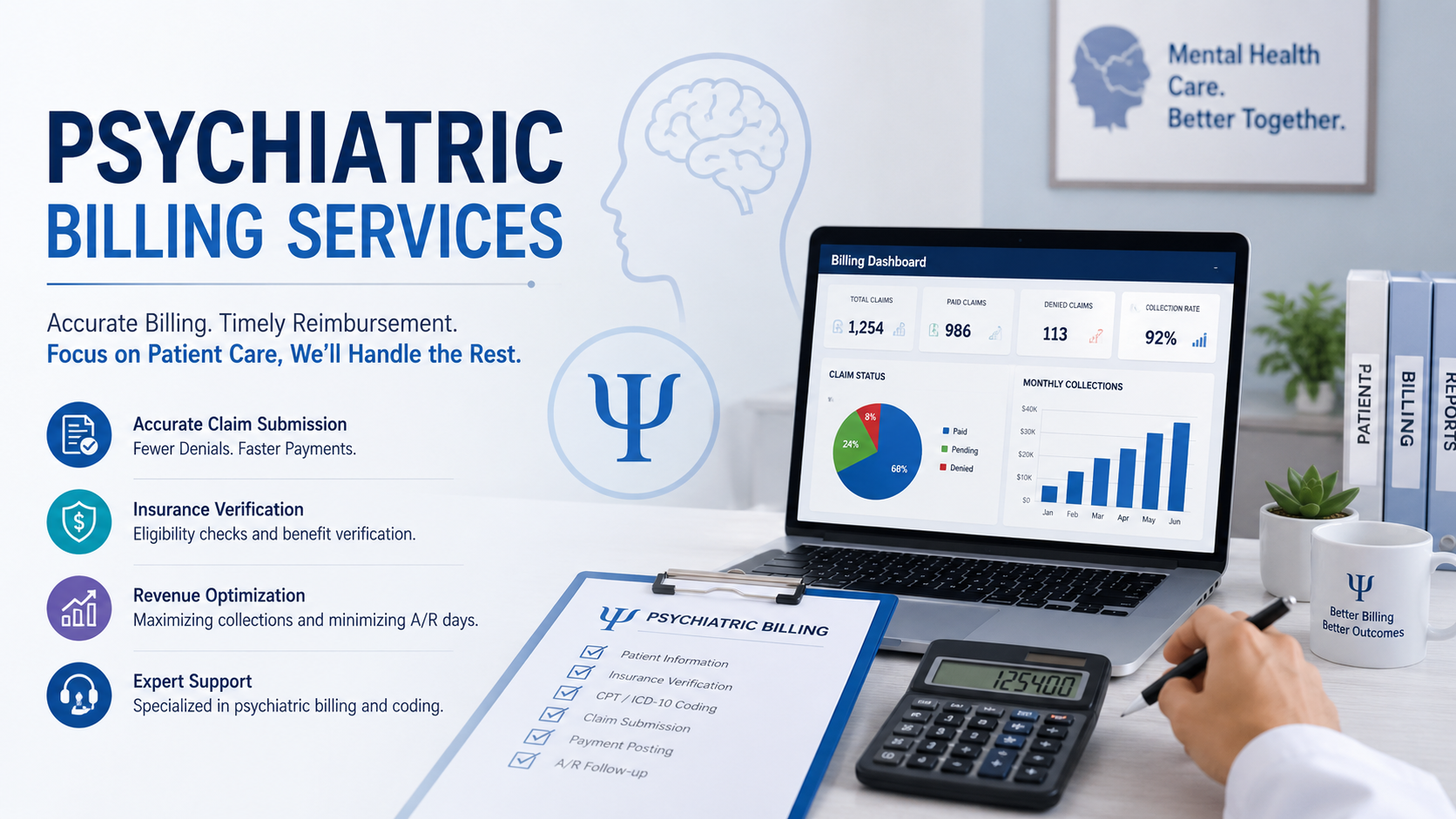
Psychiatric billing and coding is a specialized process that focuses on translating mental health services into standardized codes for insurance reimbursement. These services cover a wide range of treatments, including psychotherapy, psychiatric evaluations, medication management, crisis intervention, and behavioral assessments.
The main goal of psychiatric billing and coding services is to ensure that every clinical service provided is properly documented and accurately billed using CPT (Current Procedural Terminology) and ICD-10 codes.
Unlike other medical specialties, psychiatry heavily relies on time-based coding. For example, a 45-minute therapy session and a 60-minute session may fall under different billing categories, making precision extremely important.
Key components include:
- Patient eligibility verification
- Accurate documentation of therapy sessions
- Correct CPT and ICD-10 code selection
- Insurance claim submission
- Denial management and follow-ups
- Compliance with HIPAA and payer regulations
A strong billing system ensures that mental health providers can focus more on patient care rather than administrative burdens.
Common Challenges in Psychiatric Medical Billing
Despite the importance of mental health services, psychiatric billing remains one of the most complex areas in healthcare revenue management. Providers often face several challenges that impact cash flow and operational efficiency.
1. Frequent Claim Denials
One of the biggest issues in psychiatric billing is claim rejection due to missing or incorrect information. Common reasons include:
- Incorrect CPT code selection
- Insufficient documentation of therapy time
- Missing modifiers
- Eligibility issues
Even minor mistakes can lead to delays in reimbursement.
2. Complex Time-Based Coding
Psychiatric services are heavily dependent on session duration. For instance, psychotherapy codes vary based on 30, 45, 60, or 90-minute sessions. Misreporting time can result in underpayment or claim denial.
3. Insurance Authorization Requirements
Many behavioral health services require prior authorization from insurance companies. Failure to obtain approval before treatment can lead to non-payment, even if the service was medically necessary.
4. Constantly Changing Regulations
Healthcare billing rules are frequently updated. Staying compliant with CMS guidelines, payer-specific rules, and ICD-10 updates can be overwhelming for in-house staff.
5. Documentation Challenges
Psychiatric notes must be detailed and support medical necessity. Incomplete documentation is one of the leading causes of denied claims in mental health billing.
These challenges highlight why many practices turn to specialized psychiatric billing and coding services to manage their revenue cycle efficiently.
Key CPT & ICD-10 Considerations in Behavioral Health Billing
Accurate coding is the backbone of successful psychiatric billing. Understanding commonly used CPT and ICD-10 codes is essential for proper reimbursement.
Common CPT Codes in Psychiatry
Some widely used CPT codes include:
- 90791 – Psychiatric diagnostic evaluation (no medical services)
- 90792 – Psychiatric diagnostic evaluation with medical services
- 90832 – Psychotherapy, 30 minutes
- 90834 – Psychotherapy, 45 minutes
- 90837 – Psychotherapy, 60 minutes
- 90846 / 90847 – Family psychotherapy (without or with patient)
- 90853 – Group psychotherapy
Each code requires precise documentation, especially regarding time spent and treatment type.
ICD-10 Codes in Mental Health
ICD-10 codes define the diagnosis and medical necessity of psychiatric treatment. Common categories include:
- F32.x – Major depressive disorder
- F41.x – Anxiety disorders
- F31.x – Bipolar disorder
- F20.x – Schizophrenia
- F90.x – Attention-deficit hyperactivity disorder (ADHD)
Selecting the correct diagnosis code is critical because insurance reimbursement depends heavily on medical necessity validation.
Importance of Modifiers
Modifiers such as -25 or -59 are often required in psychiatric billing when multiple services are provided in a single visit. Incorrect use of modifiers is a common reason for claim denials.
Proper coding ensures smoother claim processing and faster reimbursements, which is why many providers rely on expert psychiatric billing and coding services for accuracy.
Benefits of Outsourcing Psychiatric Billing and Coding Services
Outsourcing billing functions has become a strategic choice for many mental health providers. It offers multiple advantages that directly impact both financial performance and operational efficiency.
1. Improved Revenue Cycle Management
Professional billing teams specialize in reducing claim errors, improving submission accuracy, and accelerating reimbursement cycles. This results in a more stable cash flow for psychiatric practices.
2. Reduced Administrative Burden
By outsourcing billing tasks, clinicians and staff can focus more on patient care rather than paperwork, coding updates, or insurance follow-ups.
3. Fewer Claim Denials
Experienced billing professionals understand payer requirements and coding guidelines, significantly reducing the chances of claim rejection.
4. Compliance and Accuracy
Outsourced billing providers stay updated with the latest regulatory changes, ensuring compliance with HIPAA, CMS guidelines, and payer-specific rules.
5. Cost Efficiency
Maintaining an in-house billing team can be expensive due to salaries, training, and software costs. Outsourcing provides access to expert services at a lower operational cost.
6. Advanced Technology Support
Many billing companies use advanced practice management systems, automated claim scrubbing tools, and analytics dashboards to optimize performance.
Overall, outsourcing psychiatric billing and coding services allows providers to focus on delivering quality mental health care while ensuring financial stability.
FAQ: Psychiatric Billing and Coding Services
1. What are psychiatric billing and coding services?
They are specialized medical billing processes that convert mental health services into standardized codes for insurance reimbursement, ensuring accurate claims and compliance.
2. Why is psychiatric billing more complex than general medical billing?
Psychiatric billing relies heavily on time-based coding, detailed documentation, and frequent insurance authorization requirements, making it more complex than general medical billing.
3. What are the most commonly used CPT codes in psychiatry?
Common CPT codes include 90791, 90792, 90832, 90834, 90837, and group therapy codes like 90853.
4. How do psychiatric billing services reduce claim denials?
They ensure accurate coding, proper documentation, timely submission, and compliance with payer guidelines, which significantly reduces errors and denials.
5. Can small clinics benefit from outsourcing billing services?
Yes, small and mid-sized clinics benefit greatly as outsourcing reduces operational costs and improves revenue cycle efficiency.
6. What role does documentation play in psychiatric billing?
Documentation is critical as it supports medical necessity, validates treatment provided, and ensures compliance with insurance requirements.
Conclusion
Psychiatric practices operate in a highly specialized and regulation-driven environment where accurate billing is just as important as quality patient care. From complex time-based coding to strict insurance requirements, managing revenue cycles can be challenging without expert support.
This is why many providers are turning to professional Medical Billing Services to streamline operations, reduce claim denials, and improve financial outcomes. With the right support system in place, psychiatric clinics can focus on what truly matters—delivering effective mental health care while maintaining a healthy and sustainable practice.
 Russian
 English
 Arabic
 French
 Spanish
 Portuguese
 Deutsch
 Turkish
 Dutch
Dutch
 Italiano
 Romaian
 Portuguese (Brazil)
 Greek
Greek
