


 Ban & Monetization Policy
 MyLiveRoom Rewards Program Rules & Eligibility
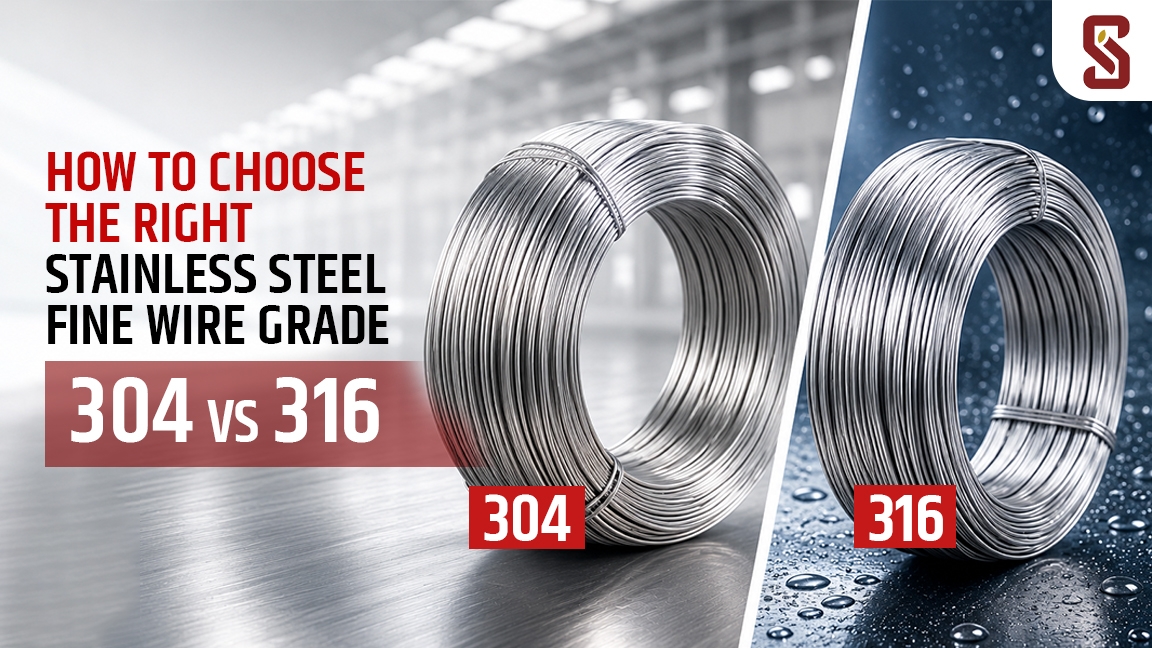
How to Choose the Right Stainless Steel Fine Wire Grade: 304 vs 316 | Sumukh Steel Casting
Introduction of Stainless Steel Fine Wire
Selecting the correct stainless steel grade for fine wire applications is not a cosmetic decision — it directly determines corrosion performance, mechanical life, weldability, and regulatory compliance of your final product. Engineers specifying Stainless Steel fine wire for medical devices, filtration meshes, aerospace components, or industrial sensors often default to AISI 304 or 316 without fully evaluating whether those grades match their actual service conditions.
This guide provides a structured technical framework for grade selection, covering the most commonly used stainless steel fine wire grades — AISI 304, 304L, 316, and 316L— and the specific application parameters that should drive your decision.
Why Grade Selection Matters More in Stainless Steel Fine Wire Than in Bar or Sheet
Fine wire, typically produced in diameters between 0.10 mm and 0.80 mm, undergoes extreme cold deformation during the drawing process. This work hardening significantly alters the mechanical properties of the wire relative to the base alloy:
-
Tensile strength increases substantially — often reaching 780–850 N/mm² depending on diameter and drawing reduction ratio
-
Ductility decreases as the material approaches its cold work limits
-
Phase transformation can occur in metastable austenitic grades (like 304), inducing a small amount of martensite — which affects magnetic permeability and corrosion behaviour
This means the grade you choose must be evaluated not just for its annealed properties listed in material standards, but for how it behaves after cold drawing to your target diameter.
Overview of Key Stainless Steel Fine Wire Grades
AISI 304 / 304L
Composition: ~18% Chromium, ~8–10% Nickel, max 0.08% Carbon (304) / max 0.03% Carbon (304L)
AISI 304 is the most widely produced austenitic stainless steel globally and forms the baseline for most general-purpose fine wire applications. It offers good corrosion resistance in mild environments, excellent formability, and reliable weldability.
304L (low carbon) is the preferred choice when the wire will be welded or subjected to heat cycles, as the reduced carbon content minimises the risk of sensitisation — the precipitation of chromium carbides at grain boundaries that reduces corrosion resistance in the heat-affected zone.
Best suited for:
-
General industrial filtration meshes
-
Architectural and decorative wire applications
-
Springs and formed components in non-chloride environments
-
Electrical conductor applications where magnetic neutrality is not critical
-
Food processing equipment in mild duty environments
Limitations:
-
Not suitable for chloride-rich environments (marine, coastal, chemical processing)
-
304 (not 304L) should be avoided when post-weld corrosion resistance is critical
-
Slight magnetic response may occur after heavy cold drawing
AISI 316 / 316L
Composition: ~16–18% Chromium, ~10–14% Nickel, 2–3% Molybdenum, max 0.08% Carbon (316) / max 0.03% Carbon (316L)
The addition of 2–3% Molybdenum is what differentiates 316 from 304 and makes it the grade of choice for applications involving chlorides, marine environments, and aggressive chemical exposure. Molybdenum enhances pitting and crevice corrosion resistance, particularly in saline and acidic media.
316L is typically the default specification for fine wire in critical applications, owing to its superior weldability and lower risk of sensitisation.
Best suited for:
-
Medical devices and surgical instruments (316L is preferred for implantable or body-contact applications)
-
Marine and offshore applications
-
Chemical processing equipment
-
Pharmaceutical and food industry equipment requiring frequent washdown with chlorinated cleaners
-
Precision meshes in filtration of corrosive liquids
-
Electronics exposed to humidity or salt-spray environments
Limitations:
-
Higher cost than 304/304L due to molybdenum content
-
Not suitable for high-temperature applications above approximately 870°C (1600°F) in continuous service
Grade Selection Decision Framework
Use the following decision criteria to narrow down your grade selection systematically:
Step 1 — Define the service environment
|
Environment |
Recommended minimum grade |
|
Dry indoor, mild atmosphere |
304 / 304L |
|
Humid, mild chemical exposure |
304L |
|
Chloride-containing (marine, coastal, saline) |
316 / 316L |
|
Chemical processing (acids, solvents) |
316L |
Step 2 — Evaluate welding and joining requirements
If the wire will be welded or brazed, always prefer L-grade (304L or 316L) to avoid sensitisation. Standard 304 and 316 can be used for welded applications only if post-weld annealing is feasible.
Step 3 — Assess magnetic permeability requirements
In medical imaging (MRI compatibility), electronics, and certain sensor applications, even trace magnetic response is unacceptable. 316L typically shows lower residual magnetism after cold drawing than 304/304L due to its more stable austenitic structure. For the most demanding non-magnetic requirements, specify annealed condition and verify permeability with the supplier.
Step 4 — Consider mechanical condition
Fine wire is typically available in two mechanical conditions:
-
Annealed — softened after final draw, higher ductility, lower tensile strength, easier to form and weld
-
Hard drawn (as drawn) — higher tensile strength (780–850 N/mm² depending on diameter), lower ductility, suitable for load-bearing and spring applications
The grade choice interacts with the mechanical condition — for example, hard-drawn 316L at 0.15 mm diameter will behave differently from annealed 304 at the same diameter.
Step 5 — Check regulatory and industry standards
Certain industries impose grade requirements regardless of engineering suitability:
-
Medical devices (implantable): ISO 5832-1 references 316L specifically
-
Food contact: Many national regulations accept 304 and 316 series for direct food contact
-
Aerospace: AMS specifications may mandate specific grades (e.g., AMS 5688 for 316L wire)
-
Pharmaceutical: USP and EU GMP guidelines often specify 316L for product-contact surfaces
Always verify the applicable standard before finalising grade selection.
Summary Comparison Table
{
"@context": "https://schema.org",
"@type": "BlogPosting",
"headline": "How to Choose the Right Stainless Steel Fine Wire Grade: 304 vs 316 | Sumukh Steel Casting ",
"description": "<p class="zw-paragraph heading2" data-header="2" data-margin-bottom="18.75pt" data-hd-info="2"...",
"image": "https://cloud.myliveroom.com/storage/bucket-objects/1/uploads/photos/2026/06/mylivepics_8d676ce0c325d1e7d57421053e99d2dd.jpg",
"author": {
"@type": "Person",
"name": "Sumukh Casting",
"url": "https://myliveroom.com/sumukhcasting"
},
"publisher": {
"@type": "Organization",
"name": "Myliveroom — Live Events & Online Communities",
"url": "https://myliveroom.com"
},
"datePublished": "2026-06-11 10:21:48",
"dateModified": "2026-06-11 10:21:48",
"mainEntityOfPage": {
"@type": "WebPage",
"@id": "https://myliveroom.com/blogs/103380/How-to-Choose-the-Right-Stainless-Steel-Fine-Wire-Grade"
},
"url": "https://myliveroom.com/blogs/103380/How-to-Choose-the-Right-Stainless-Steel-Fine-Wire-Grade",
"articleSection": "άλλο",
"keywords": "Stainless_Steel_Fine_Wire, 304_Stainless_Steel_Wire, 316_Stainless_Steel_Wire, 304_vs_316_Stainless_Steel, SS_Fine_Wire_Manufacturer, Stainless_Steel_Wire_Grades, 316L_Wire, 304L_Wire, Fine_Wire_Applications, Sumukh_Steel_Casting",
"wordCount": "65535",
"commentCount": "",
"interactionStatistic": [{
"@type": "InteractionCounter",
"interactionType": "https://schema.org/CommentAction",
"userInteractionCount": ""
},
{
"@type": "InteractionCounter",
"interactionType": "https://schema.org/ViewAction",
"userInteractionCount": ""
}
]
}
 Greek
Greek
 English
 Arabic
 French
 Spanish
 Portuguese
 Deutsch
 Turkish
 Dutch
Dutch
 Italiano
 Russian
 Romaian
 Portuguese (Brazil)
