


 Ban & Monetization Policy
 MyLiveRoom Rewards Program Rules & Eligibility
What Soil-Sand Blending Ratios Are Used in Professional Horse Training Facilities?
Let us be honest for a second... when we look at a riding arena, we usually only notice the top layer. It looks smooth, clean, maybe even perfect. But what really makes an equestrian sand arena feel right is not just what we see... it is what is mixed underneath.
And no, it is not random at all.
People who run professional horse training facilities think about this stuff a lot more than we might expect. They tweak, test, adjust... sometimes over and over... just to get that surface feeling “just right.” Because even a small change in the mix can totally change how a horse moves.
So, Why Does the Soil-Sand Mix Even Matter?
Think about walking on sand yourself.
Sometimes it feels firm and easy... other times your feet sink and it feels like a workout. Annoying, right?
It is pretty much the same idea for horses.
We want a surface that feels balanced. Not too soft, not too hard. Something that supports movement but still gives a little cushion. And at the same time... it should not turn into a muddy mess after rain or a dusty cloud in dry weather.
Kind of sounds like a lot to ask from dirt and sand... but that is the goal.
A good mix helps with:
- Keeping the surface stable
- Giving some softness for joints
- Letting water drain instead of sitting on top
- Reducing dust (because no one likes that)
- Staying consistent day after day
Miss that balance, and things go downhill fast.
The Ratios People Actually Use
Now here is where it gets interesting... there is no one “perfect” formula. If anyone tells you that, they are probably oversimplifying it.
But yeah, most professional places tend to stay within a few common ranges.
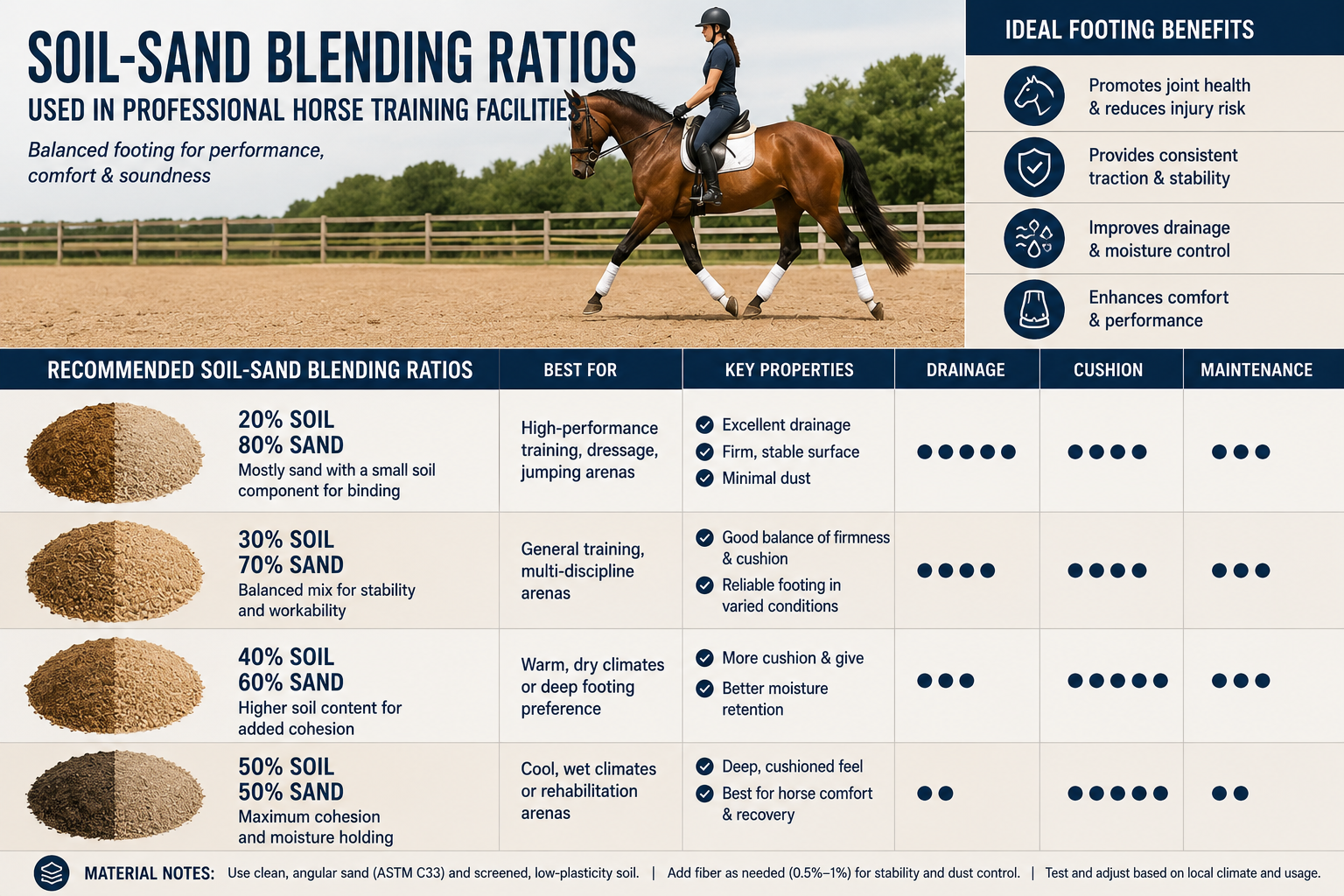
80% Sand and 20% Soil
This is kind of the sweet spot for many arenas.
There is enough sand to keep things from getting too hard... and just enough soil to hold everything together. It feels stable without being stiff.
A lot of busy training facilities lean toward this because it holds up well with regular use.
70% Sand and 30% Soil
Some places go a little heavier on soil.
Why? Mostly to help hold moisture. In drier areas, this can make a big difference. It keeps the surface from drying out too fast and cuts down on dust.
It also makes the footing feel a bit firmer... which some riders actually prefer.
90% Sand and 10% Soil
Now this one is more on the softer side.
Lots of sand means better drainage and more cushion... but it can also shift around more. So yeah, it usually needs more maintenance to keep it level and even.
Some performance arenas like this feel, but it is not always the easiest to manage.
Here is the Thing Most People Miss...
The ratio is only part of the story.
Seriously.
You can have two arenas with the exact same mix... and they can feel completely different. Why? Because not all sand behaves the same way.
Some sand packs nicely. Some stays loose. Some drains better. Some turns dusty quickly.
That is why professionals do not just pick a ratio and call it a day. They spend time choosing the right sand first... then figure out how to blend it.
Kind of like cooking... the ingredients matter just as much as the recipe.
Different Riding Styles, Different Needs
Not every rider wants the same feel under their horse.
Dressage riders usually like things a bit more stable and predictable. Jumping arenas often need a bit more cushion because of the impact. Western riding? That can lean toward firmer footing for quick movements.
So yeah... the mix changes depending on what the arena is used for.
There is no one-size-fits-all here.
Weather Changes Everything
Let us not forget about climate... because honestly, it plays a huge role.
In dry areas, people often add more soil to help hold moisture. Otherwise, the surface dries out way too fast.
In wetter regions, more sand helps keep things from getting soggy. Nobody wants to deal with a muddy arena.
This is why copying someone else’s setup does not always work. What works perfectly in one place might be a disaster somewhere else.
And Then Comes Maintenance...
Even the best mix will not save you if you ignore maintenance.
That is just the truth.
Dragging the surface, leveling it, adding water when needed... all of that keeps things working the way they should. Skip that, and even a great equestrian sand arena can start feeling uneven or compacted.
And yeah... we have all seen that happen.
Final Thoughts
At the end of the day, building a good arena is not about chasing some perfect formula.
It is more about finding what works for your horses, your riding style, and your environment. Most professional setups stay somewhere between 70/30 and 90/10, with 80/20 being a pretty common middle ground.
But honestly... it is the combination of the right materials, the right balance, and regular care that makes everything come together.
Get that right, and the surface just feels... right. You can tell.
FAQs
1. What is the most common soil-sand ratio used in horse arenas?
Most professional arenas go with around 80% sand and 20% soil. It tends to give a nice balance between stability and cushioning.
2. Why is sand preferred over soil in riding arenas?
Sand helps with drainage and keeps the surface from getting too hard. It also makes the footing more consistent.
3. Can too much soil cause problems in an arena?
Yes, it can. Too much soil can make the surface harder and lead to muddy conditions after rain.
4. Does climate affect soil-sand blending ratios?
Definitely. Dry areas often need more soil to hold moisture, while wetter places usually benefit from more sand.
5. How often should arena footing be maintained?
It really depends on usage, but regular grooming, leveling, and watering are pretty standard in most professional setups.
 Dutch
Dutch
 English
 Arabic
 French
 Spanish
 Portuguese
 Deutsch
 Turkish
 Italiano
 Russian
 Romaian
 Portuguese (Brazil)
 Greek
Greek
