


 Ban & Monetization Policy
 MyLiveRoom Rewards Program Rules & Eligibility
Your Complete Roadmap to Engineering Admission in India 2026: From Entrance Exams to Seat Confirmation

Every year, lakhs of students across India sit with one clear goal—get into a good engineering college and build a career that actually pays off. The ambition is real. So is the competition. But what most students lack is not intelligence or hard work—it is a clear, honest picture of how the entire Engineering Admission in India process actually works, from eligibility to seat confirmation.
This guide covers everything you need—the entrance exams that matter, the best engineering colleges in India across both government and private sectors, the branches worth considering, and the step-by-step process that takes you from a JEE application to walking into your first lecture. No fluff, no filler — just the information you need to make a smart decision.
Why Engineering Remains One of the Most Sought-After Career Choices in India
Before getting into the process, it helps to understand why engineering continues to attract so many students despite the competition being intense.
India produces over 1.5 million engineers every year, yet demand for specialized engineers in fields like artificial intelligence, robotics, renewable energy, and infrastructure continues to outpace supply. The IT sector alone employs over 4.5 million engineers and contributes significantly to India's GDP. Fresh B.Tech graduates from the Best Engineering Institute in India can expect starting salaries ranging from ₹5 lakhs to ₹15 lakhs annually depending on their specialization and institution, with many organizations offering additional benefits beyond base pay.
India also has over 3,500 engineering colleges—making it one of the largest hubs for technical education globally. The key is finding the right college and the right branch for your specific profile.
Two Routes Into Engineering — Know Which One Applies to You
Engineering Admission in India follows two main paths:
The first is the entrance exam route—where your performance in national or state-level exams like JEE Main, JEE Advanced, or state CETs determines your rank, and your rank determines which college you can access. This is how most seats at top engineering colleges in India are filled.
The second is the merit-based and quota route — some private colleges offer admission based on Class 12 PCM percentage without requiring an entrance exam. Most also have a management quota where seats are filled directly by the institution under its own criteria and an NRI quota with separate fee structures. The requirements vary significantly from college to college.
Understanding which route you are taking early changes how you plan your preparation and application timeline.
Eligibility — The Non-Negotiables Before You Apply
Before shortlisting the top private engineering institutes in India or registering for any exam, confirm you meet these requirements:
Class 12 was completed with physics, chemistry, and mathematics as core subjects. A minimum of 50% aggregate in PCM for general category students and 45% for reserved categories—though this varies by institution, so always verify with the specific college. For entrance exams like JEE Main, eligibility conditions are separately specified and updated each year on the official NTA website at jeemain.nta.nic.in.
Entrance Exams That Open Doors to the Best Engineering Colleges in India
Choosing the right exams to appear for depends on which colleges you are targeting. Here is a clear breakdown:
JEE Main is the national gateway exam conducted by NTA. It is the entry point for NITs, IIITs, and centrally funded technical institutes across India. It also serves as the qualifying exam for JEE Advanced.
JEE Advanced is specifically for IIT admission. Only students who clear JEE Main above a certain percentile cutoff are eligible to appear. For any student aiming at the best engineering institute in India at the IIT level, cracking JEE Advanced requires consistent preparation; a strong grasp of physics, chemistry, and mathematics at a depth beyond standard board-level understanding; and a well-planned two-stage preparation strategy.
State-level exams are equally important if you are targeting colleges within your home state. Maharashtra has MHT-CET, Karnataka has KEA-CET, West Bengal has WBJEE, and Telangana has TG EAPCET. Each opens access to a large pool of quality government and private colleges within that state at lower competition levels than national exams.
Private University Exams — VIT Vellore conducts VITEEE, SRM Chennai conducts SRMJEEE, Manipal conducts MET, and BITS Pilani conducts BITSAT. These are completely separate from JEE and worth attempting if these institutions are on your list. BITS Pilani in particular is consistently among the Top Private Engineering Institutes in India and BITSAT is the sole route in.
Delhi Engineering Colleges—DTU, NSUT, GGSIPU, and IP University—base admissions on Class 12 PCM percentage combined with JEE Main scores for normal quota seats. Management quota and NRI quota seats have separate processes.
High-Demand Engineering Branches — Picking What Fits Your Strengths
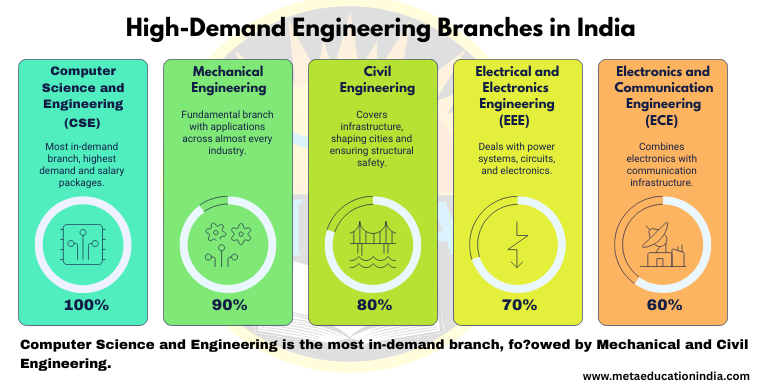
The branch you choose matters as much as the college. Here is an honest look at the options available at the top engineering colleges in India:
Computer Science and Engineering (CSE) is the most in-demand branch right now. AI, data science, software development, and machine learning are all rooted here. If you enjoy problem-solving and coding, this is where the highest demand and salary packages currently sit.
Mechanical engineering is for students who are drawn to machines, manufacturing, and physical systems—from industrial equipment to automotive design to aerospace components. It is a fundamental branch with applications across almost every industry.
Civil engineering covers infrastructure—bridges, roads, buildings, dams, and urban planning. Civil engineers literally shape the cities around us and ensure structural safety and functionality.
Electrical and Electronics Engineering (EEE) deals with power systems, circuits, and electronics—from the grid that powers homes to the microchips inside smartphones.
Electronics and Communication Engineering (ECE) combines electronics with communication infrastructure — satellites, mobile networks, and internet systems. A strong choice for students interested in connectivity and signal systems.
Information Technology (IT) is closely related to CSE but focuses more on software systems, databases, and networking applications in real-world environments.
Chemical engineering is for students who enjoy chemistry and want to understand how raw materials are converted into products like medicines, fuels, and plastics at an industrial scale.
Aerospace engineering covers aircraft, spacecraft, and advanced aeronautical technologies—suitable for students with a strong interest in aviation and defense industries.
Biotechnology combines biology with engineering principles—covering genetic engineering, pharmaceutical research, and bioproduct development.
Automobile engineering focuses on vehicle design and manufacturing, including the rapidly growing electric vehicle segment.
Recognition and Approvals — What to Check Before Finalizing a College
Not all colleges are equal, and not all approvals carry the same weight. When evaluating Best Engineering Colleges in India, check for these:
IITs are autonomous institutions of national importance — the top tier. NITs are another set of government-funded prestigious institutions with strong national reputations. Beyond these, AICTE (All India Council for Technical Education) approval is the minimum standard for any engineering college operating legally in India — always verify this first. UGC recognition applies to universities. State-level affiliations like Anna University in Tamil Nadu or VTU in Karnataka are important for colleges within those states.
Any college you are seriously considering should have AICTE approval at minimum. The absence of this is a serious warning sign.
Top 10 Private Engineering Colleges in India
The top private engineering institutes in India have significantly raised their standards in recent years—better faculty, modern labs, strong placement cells, and genuine industry connections:
|
S.N. no. |
College Name |
Location |
|
1 |
Birla Institute of Technology and Science (BITS) |
Pilani |
|
2 |
Vellore Institute of Technology (VIT) |
Vellore |
|
3 |
Manipal Institute of Technology (MIT) |
Manipal |
|
4 |
SRM Institute of Science and Technology |
Chennai |
|
5 |
BSG College of Technology |
Coimbatore |
|
6 |
PES University |
Bangalore |
|
7 |
PICT College of Engineering |
Pune |
|
8 |
MIT College of Engineering |
Pune |
|
9 |
R.V College of Engineering |
Bangalore |
|
10 |
BMS College of Engineering |
Bangalore |
Top 10 Government Engineering Colleges in India
These are the institutions students prepare years for — and with good reason. The academic culture, peer quality, research opportunities, and placement outcomes at India's top government engineering colleges remain unmatched:
|
S.N. no. |
College Name |
Location |
|
1 |
Indian Institutes of Technology (IITs) |
Delhi, Bombay, Madras, Kanpur, Kharagpur |
|
2 |
National Institutes of Technology (NITs) |
Trichy and others |
|
3 |
Indian Institute of Science (IISc) |
Bangalore |
|
4 |
Delhi Technological University (DTU) |
Delhi |
|
5 |
Jadavpur University |
Kolkata |
|
6 |
College of Engineering |
Pune |
|
7 |
Aligarh Muslim University (AMU) |
Aligarh |
|
8 |
Institute of Chemical Technology (ICT) |
Mumbai |
|
9 |
Delhi Technological University |
Delhi |
|
10 |
National Institute of Technology (NIT) |
Tiruchirappalli |
The Complete Step-by-Step Admission Process for 2026
Step 1 — Confirm Eligibility Verify your Class 12 PCM percentage, confirm your age, and check whether your subject combination meets the requirements of the colleges you are targeting. Different colleges have slightly different cutoffs.
Step 2 — Shortlist Your Exams Based on your target colleges, decide which exams to appear for—JEE Main for central institutes and NITs, state CET for state-level colleges, BITSAT for BITS, VITEEE for VIT, or SRMJEEE for SRM. You can appear for multiple exams simultaneously.
Step 3 — Prepare Seriously Focus on Class 11 and 12 PCM concepts as the foundation. Solve previous years' question papers. Take timed mock tests regularly to build speed and accuracy. Begin preparation at least a year before your target admission year.
Step 4 — Register and Apply When exam notifications are released, register through official portals. Fill out application forms carefully, upload required documents—photograph, signature, and Class 10 and 12 mark sheets—and pay registration fees before deadlines. Missing a deadline means waiting another year.
Step 5 — Appear and Check Results Appear on scheduled dates with your admit card and valid ID proof. After results are declared, check your score and rank to understand your realistic college options.
Step 6 — Participate in Counselling: Most top engineering colleges in India fill seats through counselling. Register with the relevant counselling authority—JoSAA for IITs and NITs, state counselling for state colleges, or direct college counselling for private institutions. Fill in preferences carefully, complete document verification, and wait for seat allotment.
Step 7 — Confirm and Report Once satisfied with your allotted seat, pay the admission fee within the stated deadline to confirm. Visit the college to submit original documents and complete final enrollment formalities.
Factors That Separate a Good Engineering College From a Great One
Rankings matter, but they do not tell the full story. When comparing the best engineering colleges in India for your specific needs, evaluate these:
Academic reputation and the quality of faculty — not just names, but whether faculty actively engage in research and industry projects. Infrastructure including labs, computing facilities, libraries, and hostel quality. Placement record—specifically, which companies visit campus, what the median package is (not just the highest), and how many students from your target branch get placed. Research and innovation culture — whether the college encourages projects, patents, and startup activity. Campus environment and student life—where you spend four years matters for your overall development, not just academics.
A college that scores well across all these dimensions — not just on one ranking list — is the right fit for a four-year investment.
Quick Tips That Actually Help
Stay updated on exam dates and counseling schedules—missing a notification can cost you a full year. Keep all documents organized well in advance—Class 10, Class 12, caste certificate (if applicable), domicile certificate, and passport-size photographs. Start entrance exam preparation during Class 11, not after Class 12 results. Research colleges before counseling begins—do not make preferences in a rush during the seat allotment window. Talk to current students at colleges you are seriously considering—their experience tells you more than any brochure.
Frequently Asked Questions
When do B.Tech applications typically open? Application timelines vary. Some colleges begin accepting applications as early as October or November of the previous year. Others open closer to exam dates. Always check official college websites and NTA portals for updated schedules.
Can I apply to multiple colleges simultaneously? Yes. Appearing for multiple entrance exams and applying to multiple colleges simultaneously is both allowed and recommended. Confirm deadlines and requirements for each separately.
What makes extracurricular activities relevant for engineering admissions? For most entrance-exam-based admissions, extracurricular activities are not part of the initial selection. However, for colleges that conduct personal interviews or for scholarship applications, they can meaningfully strengthen your profile by demonstrating leadership, teamwork, and interests beyond academics.
When should preparation for JEE ideally begin? Class 11 is the right starting point. The JEE syllabus is built almost entirely on Class 11 and 12 PCM concepts. Students who build their foundation in Class 11 — rather than starting a crash course in Class 12 — consistently perform better.
What is the management quota, and how is it different from the normal quota? Normal quota seats are filled through entrance exam ranks via counseling. Management quota seats are filled directly by the college and typically carry higher fees. AICTE approval and NEET/JEE qualification requirements still apply even under management quota at most institutions.
Final Word
Engineering admission in India in 2026 is competitive—but it is also structured. Every step from eligibility to seat confirmation follows a defined process, and students who understand that process early have a significant advantage over those who figure it out in a panic after results are declared.
Choose your branch based on genuine interest, not just current salary trends. Target the best engineering institute in India that fits your rank, your budget, and your career goals—not just the one with the highest ranking number. Prepare with consistency from Class 11. And if you need guidance on college shortlisting, counseling strategy, or top private colleges in India for engineering admission under the management or NRI quota, professional counseling saves both time and costly mistakes.
For complete admission support and personalized college guidance, contact Meta Education India at +91-8588877675 or visit www.metaeducationindia.com.
References
 English
 Arabic
 French
 Spanish
 Portuguese
 Deutsch
 Turkish
 Dutch
Dutch
 Italiano
 Russian
 Romaian
 Portuguese (Brazil)
 Greek
Greek
