Mental health care is no longer on the sidelines of healthcare—it’s front and center. As more patients seek therapy, counseling, and psychiatric support, providers are facing a different kind of challenge: getting paid accurately and on time. That’s where billing for mental health becomes critical.
Unlike general medical billing, mental health billing comes with its own set of complexities—session-based coding, evolving payer rules, and strict documentation standards. Whether you're an independent therapist or part of a growing practice, understanding how billing works can directly impact your revenue and patient satisfaction.
This guide breaks down the essentials, highlights common pitfalls, and explores how modern solutions—including outsourcing—can simplify the process.
Why Billing for Mental Health Is More Complex Than You Think
Mental health billing isn't just about submitting claims. It involves interpreting nuanced therapy sessions, matching them with the correct codes, and ensuring compliance with insurance guidelines.
Here’s what makes it unique:
- Session Variability: Unlike standard procedures, therapy sessions vary in duration and type.
- Frequent Coding Updates: CPT and ICD codes change regularly.
- Authorization Requirements: Many payers require pre-approvals for sessions.
- Confidentiality Concerns: Sensitive patient data must be handled with extra care.
Because of this complexity, many providers turn to mental health insurance billing services to avoid costly errors.
Understanding the Role of a Mental Health Billing Specialist
A mental health billing specialist does far more than basic claim submission. They act as a bridge between providers, patients, and insurance companies.
Their responsibilities include:
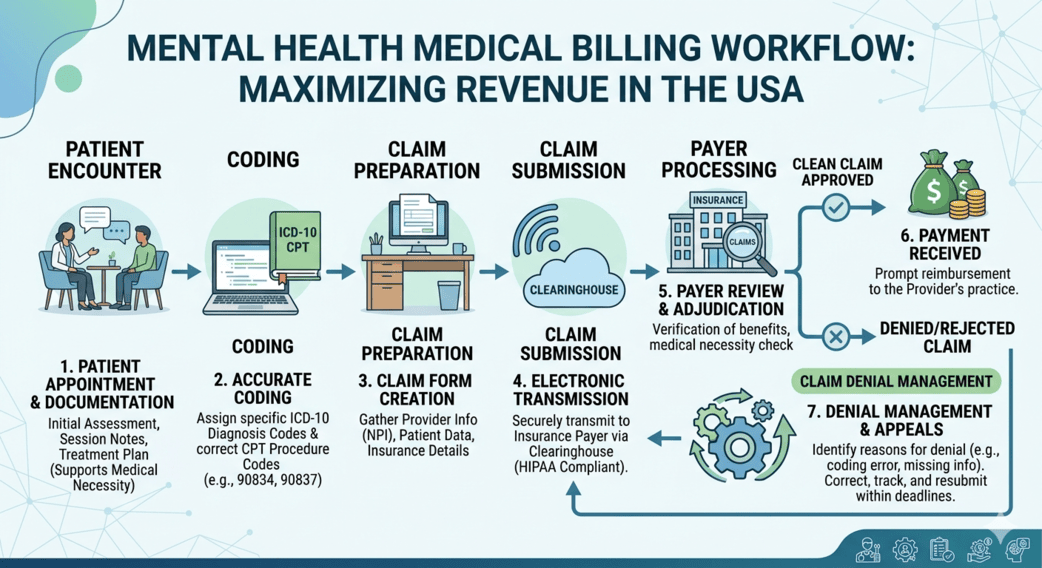
- Verifying insurance eligibility
- Assigning accurate CPT and ICD codes
- Managing claim submissions and follow-ups
- Handling denials and appeals
- Ensuring compliance with payer policies
Having a skilled specialist can significantly reduce claim rejections and improve cash flow.
In-House vs Outsourced Mental Health Billing: What Works Best?
Many practices struggle with the decision to manage billing internally or outsource it.
In-House Billing
Pros:
- Direct control over processes
- Immediate communication within the team
Cons:
- High staffing costs
- Ongoing training requirements
- Increased risk of errors
Outsourced Billing
Choosing to outsource mental health billing services can offer:
- Access to experienced professionals
- Reduced administrative burden
- Faster claim processing
- Improved revenue cycle efficiency
This is why many providers prefer outsourced mental health billing, especially as their practice scales.
Key Features of the Best Mental Health Billing Agency
Not all billing partners are created equal. The best mental health billing agency will offer more than just claim submission.
Look for these features:
- Specialized Expertise in mental health billing and coding
- Transparent Reporting with real-time insights
- Denial Management Systems to recover lost revenue
- HIPAA Compliance for data security
- Scalable Services for growing practices
A reliable mental health billing services agency becomes an extension of your practice rather than just a vendor.
The Importance of Accurate Coding in Mental Health Billing
Coding errors are one of the biggest reasons claims get denied.
A strong mental health billing and coding company ensures:
- Correct use of CPT codes (like 90834, 90837)
- Accurate diagnosis coding with ICD-10
- Proper documentation alignment
This is where medical coding services play a crucial role. When coding is done right, reimbursements become faster and more predictable.
How Mental Health Medical Billing Services Improve Revenue
Professional mental health medical billing services streamline the entire billing workflow. Instead of juggling multiple tasks, providers can focus on patient care.
Benefits include:
- Reduced claim denials
- Faster reimbursement cycles
- Improved patient billing transparency
- Better financial reporting
A complete mental health medical billing solution integrates billing, coding, and reporting into one efficient system.
Billing Services for Mental Health Therapists: What to Expect
Independent therapists often face the biggest billing challenges due to limited administrative support.
Dedicated billing services for mental health therapists typically include:
- Insurance verification before sessions
- Automated claim submission
- Patient invoicing support
- Payment tracking and reconciliation
These services are also ideal for billing services for mental health providers operating in small clinics or group practices.
Why Mental Health Billing Companies Are in High Demand
With rising mental health awareness, the demand for professional billing support has increased.
Top mental health billing companies offer:
- End-to-end claim lifecycle management
- Integration with EHR systems
- Regular compliance updates
- Advanced analytics for performance tracking
Choosing a top outsource mental health billing company can transform how your practice manages revenue.
Common Challenges in Mental Health Billing (and How to Solve Them)
Even experienced providers face billing issues. Here are some common problems:
1. Claim Denials
Often caused by incorrect coding or missing documentation.
Solution: Work with a skilled mental health billing specialist or outsource to experts.
2. Delayed Payments
Insurance companies may take weeks—or months—to process claims.
Solution: Use efficient revenue cycle management services to track and follow up claims.
3. Insurance Verification Errors
Incorrect eligibility checks can lead to unpaid claims.
Solution: Automate verification or rely on professional billing services.
4. Compliance Risks
HIPAA violations can result in penalties.
Solution: Partner with a compliant mental health billing agency.
The Role of Technology in Mental Health Billing
Modern billing systems are transforming how practices operate.
Today’s mental health medical billing services outsourcing solutions use:
- AI-driven claim scrubbing
- Automated eligibility verification
- Real-time dashboards
- Secure cloud-based platforms
These tools reduce manual work and improve accuracy across the board.
Integrating Core Healthcare Services for Better Results
To truly optimize billing, practices should look beyond just claims processing.
Combining the following services creates a stronger financial ecosystem:
Medical Billing Services
Handle claim submissions, tracking, and reimbursements efficiently.
Medical Coding Services
Ensure accurate code assignment for every patient interaction.
Medical Billing and Coding Services
A combined approach that minimizes errors and maximizes revenue.
Revenue Cycle Management Services
Oversee the entire financial journey—from patient registration to final payment.
Credentialing Services
Ensure providers are properly enrolled with insurance companies, preventing claim rejections.
When these services work together, practices experience smoother operations and better financial outcomes.
Real-World Example: A Growing Therapy Practice
Consider a mid-sized therapy clinic struggling with delayed payments and frequent claim denials. After switching to a mental health billing services agency, they experienced:
- 30% reduction in claim denials
- 40% faster reimbursement turnaround
- Improved patient satisfaction due to clear billing
This demonstrates how the right billing strategy can directly impact growth.
Choosing the Right Mental Health Billing Partner
Before selecting a provider, ask:
- Do they specialize in mental health billing?
- Can they scale with your practice?
- Do they offer transparent reporting?
- How do they handle denied claims?
A reliable mental health billing agency should align with your long-term goals—not just your immediate needs.
Conclusion
Efficient billing for mental health is no longer optional—it’s essential for sustainable practice growth. With increasing demand for mental health services, providers must ensure their billing processes are accurate, compliant, and efficient.
Many practices are now turning to experienced partners like 247 medical billing services, who understand the nuances of mental health billing while supporting broader needs such as medical billing services, medical coding services, medical billing and coding services, revenue cycle management services, and credentialing services. When these elements come together, providers can focus on what truly matters—delivering quality care.
FAQs
1. What is billing for mental health?
Billing for mental health involves submitting insurance claims for therapy, counseling, and psychiatric services using specific CPT and ICD codes.
2. Why should I outsource mental health billing services?
Outsourcing reduces administrative workload, improves claim accuracy, and speeds up reimbursements.
3. What does a mental health billing specialist do?
They manage insurance verification, coding, claim submission, denial handling, and compliance.
4. How do mental health billing companies improve revenue?
They reduce errors, ensure proper coding, and manage the full revenue cycle efficiently.
5. What is included in mental health medical billing services?
Services include coding, claim submission, payment tracking, denial management, and reporting.
6. Are credentialing services necessary for mental health providers?
Yes, credentialing ensures providers are approved by insurance companies, allowing claims to be processed without issues.



 Ban & Monetization Policy
 MyLiveRoom Rewards Program Rules & Eligibility
 English

 Arabic
 French
 Spanish
 Portuguese
 Deutsch
 Turkish
 Dutch
Dutch
 Italiano
 Russian
 Romaian
 Portuguese (Brazil)
 Greek
Greek