Mental health practices across the USA are growing rapidly, but so are the complexities behind getting paid. From evolving insurance policies to strict documentation requirements, billing for mental health therapists has become more than just submitting claims—it’s a strategic process that directly impacts profitability and patient care.
Whether you're a solo therapist, a group practice owner, or managing a behavioral health clinic, understanding how billing for mental health services works can make the difference between steady revenue and constant claim rejections. This guide breaks down everything you need to know, with real-world insights and actionable strategies.
Why Mental Health Billing Is More Complex Than Ever
Unlike general healthcare billing, mental health medical billing involves unique challenges:
- Time-based CPT codes instead of procedure-based billing
- Frequent pre-authorization requirements
- Strict documentation for therapy sessions
- Constant updates in payer rules
For example, billing a 60-minute psychotherapy session requires precise documentation to justify the time spent. Missing even a small detail can lead to delays or denials.
That’s why many practices are now exploring mental health billing solutions to streamline their operations.
Understanding the Basics of Billing for Mental Health Therapists
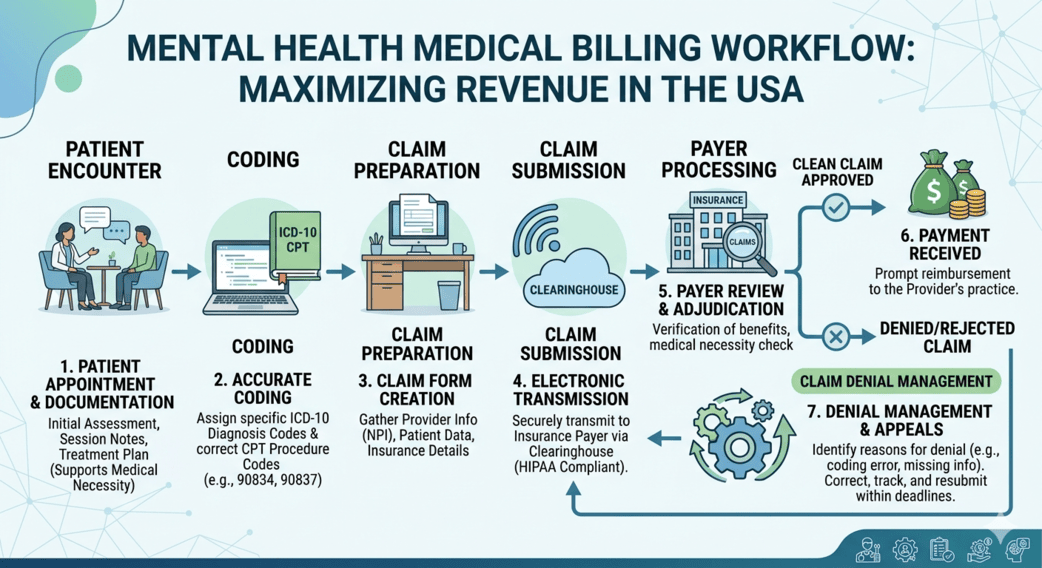
At its core, billing for mental health therapists includes three key steps:
1. Patient Eligibility Verification
Before the session even begins, verifying insurance eligibility is crucial. This ensures:
- Coverage for mental health services
- Copay and deductible details
- Authorization requirements
Skipping this step often leads to unpaid claims.
2. Accurate Coding
This is where medical coding services play a vital role. Therapists must use the correct:
- CPT codes (e.g., 90834, 90837)
- ICD-10 diagnosis codes
Even minor coding errors can result in claim denials.
3. Claims Submission and Follow-Up
Once claims are submitted, tracking them is essential. Effective revenue cycle management services ensure:
- Faster reimbursements
- Reduced denial rates
- Consistent cash flow
Common Challenges in Mental Health Billing
Many providers struggle with billing for mental health providers due to:
❌ Frequent Claim Denials
Insurance companies often reject claims due to:
- Incorrect coding
- Lack of documentation
- Missing authorizations
❌ Complex Medicare Rules
Billing Medicare for mental health services requires strict compliance, especially with:
- Telehealth guidelines
- Session duration requirements
❌ Administrative Burden
Managing billing internally can overwhelm staff, especially in growing practices.
The Role of Coding and Documentation
Proper coding and billing for mental health services goes hand in hand with detailed documentation.
A well-documented session should include:
- Duration of therapy
- Type of service provided
- Patient progress notes
- Treatment plan updates
This level of detail supports claims and protects against audits.
Why Many Practices Choose Outsourcing
With increasing complexity, outsourcing mental health billing has become a practical solution.
Benefits of Outsourced Billing
- Reduced administrative workload
- Improved claim accuracy
- Faster reimbursements
- Access to expert billing professionals
For example, a mid-sized therapy clinic in Texas reduced its denial rate by 35% after switching to outsourced billing for mental health.
Choosing the Right Mental Health Billing Partner
Not all billing providers are the same. When selecting mental health billing services, look for:
✔ Industry Experience
They should specialize in behavioral and mental health billing services, not just general medical billing.
✔ End-to-End Support
From eligibility checks to denial management, comprehensive mental health billing and credentialing services are essential.
✔ Transparency
Clear reporting and communication are non-negotiable.
✔ Cost Efficiency
While many look for a cheap outsource mental health billing company, the focus should be on value—not just price.
Key Features of Effective Mental Health Billing Solutions
A reliable system for billing mental health services should include:
- Automated claim tracking
- Real-time eligibility verification
- Integrated EHR systems
- Denial management workflows
These features help practices stay compliant while improving revenue.
The Importance of Credentialing in Mental Health Billing
Before billing can even begin, providers must be credentialed with insurance companies.
Credentialing services ensure:
- Providers are approved by payers
- Claims are accepted without delays
- Reimbursements are processed smoothly
Without proper credentialing, even correctly submitted claims can be rejected.
Medicare and Mental Health Billing: What You Need to Know
Billing Medicare for mental health services comes with its own rules:
- Coverage for individual and group therapy
- Specific telehealth regulations
- Documentation for medical necessity
Therapists must stay updated with these policies to avoid compliance issues.
Real-World Insight: A Growing Practice’s Billing Transformation
A behavioral health clinic in California struggled with delayed payments and high denial rates. Their in-house team couldn’t keep up with the complexities of medical billing for mental health.
After switching to a professional billing partner:
- Claim approval rates increased by 40%
- Average reimbursement time dropped from 45 days to 18 days
- Staff could focus more on patient care
This highlights the impact of efficient billing services for mental health clinics.
How Revenue Cycle Management Impacts Mental Health Practices
Effective revenue cycle management services go beyond billing. They cover:
- Patient scheduling
- Insurance verification
- Coding accuracy
- Payment posting
- Denial management
When done right, it creates a seamless financial workflow.
Integrating Medical Billing and Coding Services
Combining medical billing and coding services ensures:
- Fewer errors
- Faster claim approvals
- Better compliance
This integration is especially important in mental health, where coding nuances are critical.
Is Outsourcing the Right Choice for You?
If your practice is experiencing:
- Increasing claim denials
- Delayed reimbursements
- Staff burnout
- Revenue inconsistencies
Then outsourcing may be worth considering.
The best outsource mental health billing and coding services act as an extension of your team, not just a vendor.
Final Thoughts
Navigating billing for mental health therapists in the USA requires more than basic knowledge—it demands expertise, accuracy, and constant adaptation to changing regulations.
Many practices are now turning to trusted partners like 247 medical billing services to streamline their operations. With support in medical billing services, medical coding services, medical billing and coding services, revenue cycle management services, and credentialing services, providers can focus on what truly matters—delivering quality mental health care.
FAQs
1. What is the biggest challenge in billing for mental health therapists?
The most common challenge is claim denials due to incorrect coding or insufficient documentation. Mental health billing is highly detail-oriented.
2. How does outsourcing mental health billing help practices?
Outsourcing reduces administrative workload, improves claim accuracy, and speeds up reimbursements, allowing providers to focus on patient care.
3. What codes are commonly used in mental health billing?
Common CPT codes include 90834, 90837, and 90832, depending on session duration and type of therapy provided.
4. Is credentialing necessary for mental health billing?
Yes, without proper credentialing, insurance companies may reject claims even if they are correctly submitted.
5. How can I reduce claim denials in my practice?
Ensure accurate coding, verify patient eligibility, maintain proper documentation, and consider professional billing support.
6. Are mental health billing services worth the cost?
Yes, especially for growing practices. Efficient billing services can significantly increase revenue and reduce operational stress.



 Ban & Monetization Policy
 MyLiveRoom Rewards Program Rules & Eligibility
 Spanish

 English
 Arabic
 French
 Portuguese
 Deutsch
 Turkish
 Dutch
Dutch
 Italiano
 Russian
 Romaian
 Portuguese (Brazil)
 Greek
Greek