Relationships rarely break down because of one dramatic event. More often, distance grows slowly through repeated misunderstandings, unspoken expectations, emotional fatigue, and unresolved disagreements. Many couples wait until problems feel unbearable before seeking help, but early support can make a significant difference. Choosing to book couples therapy session or talk to relationship expert now can help partners understand what is happening beneath the surface before frustration turns into long-term resentment.
At the beginning of a relationship, small conflicts often seem harmless. A missed call, a forgotten promise, different opinions about money, or varying expectations about family life may not appear serious. Couples often tell themselves that love will naturally solve everything. But emotional patterns tend to repeat. When a concern is ignored once, it usually returns again—often with stronger emotions attached.
Over time, these small unresolved issues can quietly reshape the emotional atmosphere of a relationship. One partner may begin to feel unheard. The other may feel constantly criticized. Instead of sharing feelings openly, both people may start protecting themselves. Silence becomes easier than conversation. Irritation replaces patience. Distance grows, even when both people still care deeply for each other.
One of the biggest myths about counselling is that it is only for couples who are close to separation. In reality, healthy couples often seek support before reaching that stage. Relationship counselling is not only about fixing damage—it is also about preventing damage. It offers a space to understand communication habits, emotional triggers, and hidden fears that can slowly affect trust and closeness.
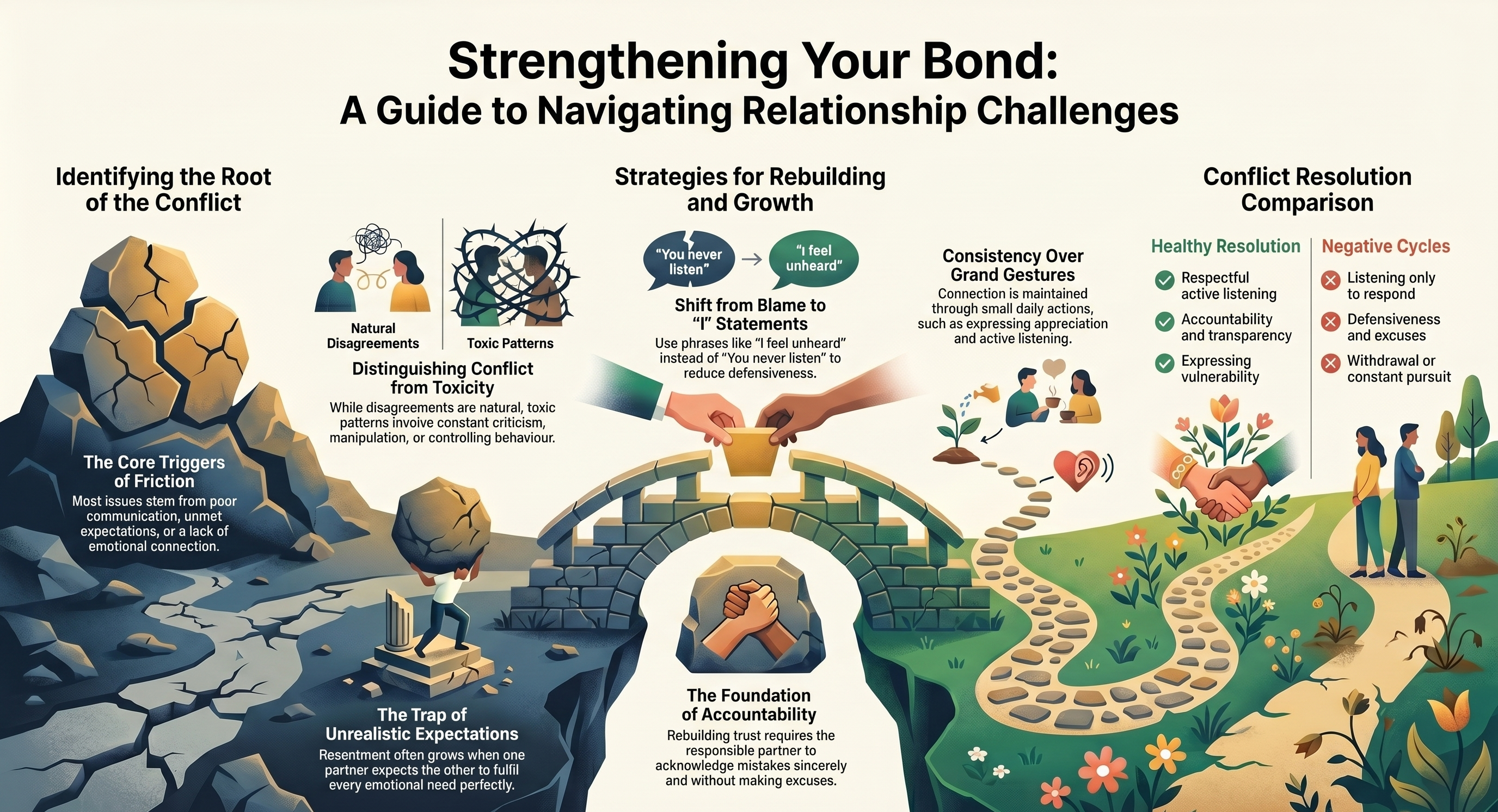
Many couples do not realize how often they repeat the same conflict in different forms. A disagreement about household responsibilities may actually be about feeling unsupported. A fight about texting back may really be about emotional reassurance. Arguments about spending money may be connected to deeper concerns about control, safety, or partnership. Without understanding the emotional meaning behind conflict, couples often keep arguing without ever resolving the real issue.
This is why early intervention matters. When problems are still small, both partners are usually more open, less defensive, and more willing to listen. It is much easier to rebuild understanding when resentment has not yet hardened into emotional walls. Seeking help early can prevent months—or even years—of repeated hurt.
Another reason small problems become big ones is because couples often misunderstand the purpose of conflict. Conflict itself is not necessarily harmful. Every close relationship includes disagreement. The real issue is how conflict is handled. Some couples shut down. Others become overly reactive. Some avoid difficult conversations until emotional pressure explodes. These patterns, if left unchecked, can gradually damage emotional safety.
Emotional safety is the foundation of lasting intimacy. It means both partners feel safe enough to speak honestly, express vulnerability, and share fears without feeling attacked, dismissed, or judged. Once emotional safety weakens, even ordinary conversations can start feeling risky. A simple question may sound like criticism. A request may feel like blame. When this happens, couples often begin reacting to past pain rather than present reality.
That is why professional guidance can be so helpful. A therapist does not simply listen to problems. They help identify patterns that couples may not notice on their own. Often, the problem is not just what partners are saying—it is what they are hearing, assuming, or emotionally carrying from past experiences.
For example, one partner may ask for more time together, but the other hears it as “I’m not good enough.” One partner may ask for practical help at home, while the other experiences it as criticism. These emotional interpretations can intensify conflict far beyond the original issue. A relationship expert helps slow the process down and make those hidden layers visible.
Many couples are surprised by how much relief they feel after simply being understood clearly. Often, people are not asking for perfection. They are asking to feel seen, heard, respected, and emotionally valued. When these needs are not addressed, even loving relationships can begin to feel lonely.
There is also a practical side to relationship counselling. It teaches skills. Couples learn how to listen without interrupting, express needs without blame, respond instead of react, and repair conflict before it escalates. These are not things most people are naturally taught, yet they shape everyday relationship health.
A strong relationship is not built on never having problems. It is built on knowing how to move through problems together.
In many modern relationships, daily stress adds another layer of pressure. Work deadlines, financial demands, parenting responsibilities, and digital distractions can make it harder for couples to stay emotionally connected. People may live together but feel increasingly disconnected. Conversations become transactional—about schedules, bills, and tasks—rather than emotional.
When emotional connection becomes weak, even minor disappointments can feel bigger than they are. A forgotten message can feel like neglect. A distracted reply can feel like rejection. The issue may not be the event itself but the emotional disconnection surrounding it.
This is often the stage where many couples begin considering professional support, and today help is far more accessible than ever before. Instead of waiting weeks for appointments or struggling with travel schedules, many couples now prefer online counselling booking because it fits naturally into busy lives. The convenience of being able to consult therapist online removes many of the barriers that once stopped couples from seeking help early.
Online therapy has changed how people approach relationship support. Couples no longer need to wait until emotional damage becomes severe. They can seek guidance at the first signs of disconnection. This matters because timing often determines how difficult repair becomes.
When couples reach out early, counselling can feel more like emotional maintenance than crisis recovery. It helps clarify misunderstandings before they become deeply personal. It creates room for honest conversation before resentment takes over. It helps couples reconnect before distance begins to feel normal.
There are several warning signs that suggest small issues may already be growing. Repeated arguments about the same topics are one sign. Feeling emotionally lonely even when together is another. If conversations quickly become defensive, sarcastic, or emotionally exhausting, it may be time to pause and understand what is happening underneath.
Another sign is avoidance. Many couples stop talking about certain topics because they assume the conversation will end badly. On the surface, this may look peaceful. But avoidance often creates emotional accumulation. What remains unsaid does not disappear—it tends to grow silently.
Some couples also experience what feels like emotional numbness. They are no longer fighting intensely, but they are no longer connecting deeply either. This can feel confusing because there may be no obvious crisis, yet the relationship feels flat, heavy, or distant. Often, this is not a lack of love—it is a sign that unresolved emotional needs have gone unattended for too long.
Seeking support does not mean the relationship is weak. In many cases, it means both people still care enough to protect it.
There is courage in admitting that something important feels difficult. There is maturity in recognizing that love alone may not automatically solve recurring emotional patterns. And there is strength in choosing growth instead of waiting for pain to become unbearable.
Therapy also helps couples understand personal emotional histories. Sometimes present relationship reactions are shaped by earlier experiences—family dynamics, past heartbreak, fear of abandonment, or fear of failure. A partner may not be reacting only to the current disagreement; they may be reacting to something older and deeper.
When couples understand this, blame often softens. Compassion becomes easier. Instead of seeing each other as the enemy, they begin seeing the emotional cycle itself as the real problem.
This shift can transform a relationship.
Instead of “Why are you always doing this to me?” the question becomes, “What are we getting stuck in, and how can we understand it better?”
That change alone often creates powerful emotional movement.
It is also worth remembering that relationship problems rarely stay limited to one area of life. Emotional stress between partners often affects sleep, work concentration, confidence, parenting, and overall mental wellbeing. When relationship tension becomes constant, it can quietly drain emotional energy from everything else.
Addressing relationship strain early is therefore not only about protecting the relationship—it is about protecting emotional wellbeing more broadly.
Couples who seek help early often discover something encouraging: the problem may not be as impossible as it feels. Sometimes they simply need better communication tools. Sometimes they need help naming emotions more clearly. Sometimes they need a structured space where both people can finally feel heard without interruption.
Even when relationships feel tense, healing is often possible when both partners are willing to understand rather than just defend.
Small issues become big problems when they are left unattended, repeated, and emotionally misinterpreted. But small issues can also become opportunities—opportunities to understand each other more deeply, strengthen emotional trust, and build healthier patterns.
That is why waiting for a crisis is rarely the best strategy.
If something feels off, if conversations feel harder than they used to, if emotional closeness feels thinner than before, it may be the right time to act. You do not have to wait until things feel broken. Reaching out for instant relationship counselling can provide clarity when emotions feel tangled, and choosing to book marriage counsellor support early can help protect the love, trust, and connection that brought you together in the first place.



 Ban & Monetization Policy
 MyLiveRoom Rewards Program Rules & Eligibility
 Deutsch

 English
 Arabic
 French
 Spanish
 Portuguese
 Turkish
 Dutch
Dutch
 Italiano
 Russian
 Romaian
 Portuguese (Brazil)
 Greek
Greek