


 Ban & Monetization Policy
 MyLiveRoom Rewards Program Rules & Eligibility
How Bluetooth Label Printers Transform Frontline Workflows
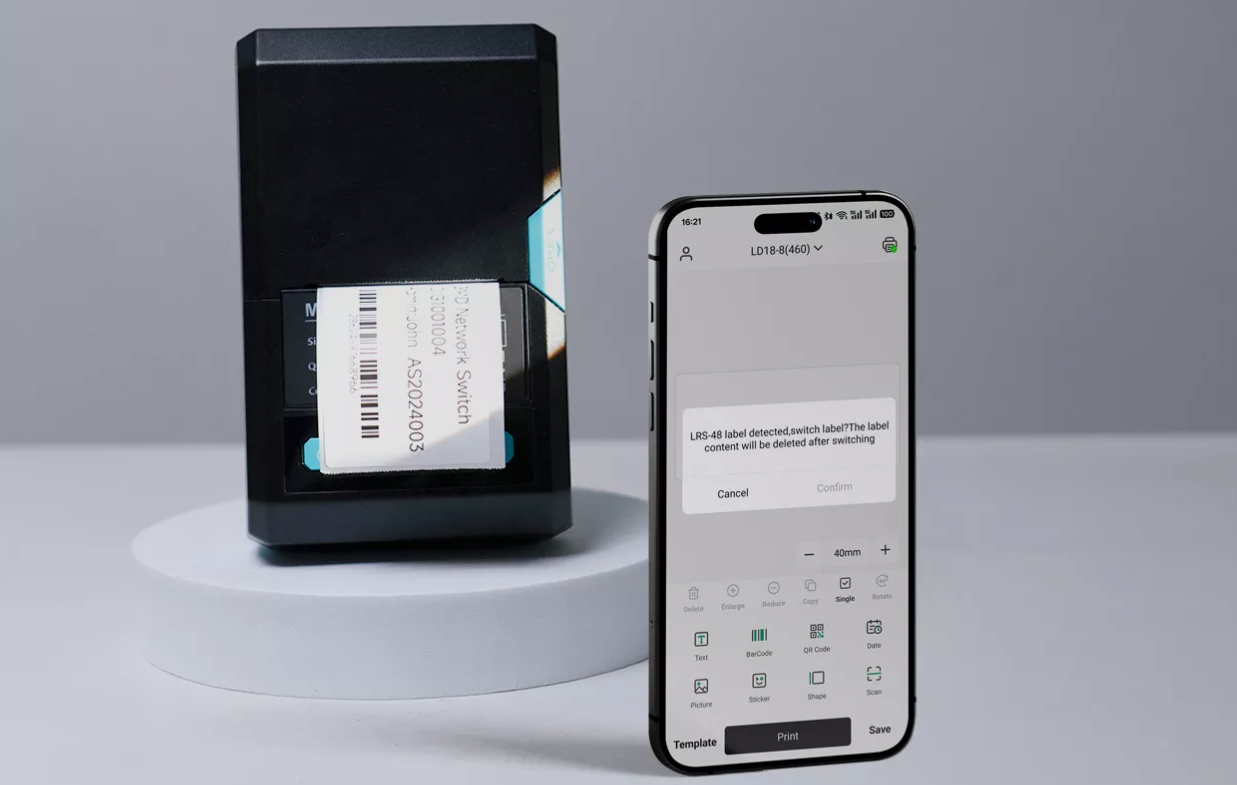
On any frontline operation—warehouse receiving, retail backrooms, field service, or manufacturing lines—labeling is seldom the main job, yet it constantly interrupts the main job.
Picture a warehouse clerk receiving a 50-carton shipment. Each carton needs a location label, a put-away label, and a batch code. The current process: walk 40 meters to a stationary printer connected to a desktop PC, print a batch of labels, walk back to the cartons, match each label manually, apply them, then discover one label misprinted—walk back again.
Or consider a field service technician repairing medical devices in a hospital basement. After completing calibration, they need to print a tamper-evident service label. No printer nearby. They handwrite the details, which later fail regulatory audit because the handwriting is illegible or incomplete.
These are not isolated frustrations. They are structural inefficiencies hidden in the gap between digital data and physical labeling.
Common frontline pain points include:
-
Excessive walking – 20–35% of a frontline worker’s motion can be non-value-added travel to and from printers.
-
Data transcription errors – Re-typing serial numbers from a scanner to a print dialog introduces errors at rates of 1–3%, which translates to hundreds of mislabeled assets per month.
-
Workflow fragmentation – Switching between a mobile device for data capture and a PC for printing breaks concentration and doubles task time.
-
Delayed label application – Batching printing means labels are created minutes or hours after the work is done, leading to lost items, incorrect put-away, and shipping mis-sorts.
The frontline does not need more powerful desktop printers. It needs printing that moves with the worker.
Legacy Printing Was Never Designed for Mobility
Traditional label printing solutions are anchored to a desk, a cable, or a fixed network. In frontline environments, those anchors become chains.
1. Tethered USB/Serial printers require a host computer within cable length. In a large warehouse aisle, a truck loading bay, or an outdoor yard, this is physically impossible. Workers either bring a laptop (expensive, fragile, heavy) or leave the work area—both inefficient.
2. Network-dependent wireless printers (Wi-Fi only) collapse when roaming between access points or working in coverage dead zones like metal racking aisles, shipping containers, or underground service areas. Re-authenticating to Wi-Fi can take 30–90 seconds per interruption.
3. Batch printing from mobile forms forces workers to collect data on a handheld device, synchronize to a cloud or on-premise server, then manually trigger a print job from a separate terminal. Any server queue, latency, or sync conflict creates idle waiting. In peak hours, that waiting multiplies across dozens of workers.
4. Consumer-grade or office mobile printers lack the durability for frontline conditions. Dust, humidity, drops from waist height, and temperature swings cause frequent jams, battery failures, and printhead damage. Field teams learn to mistrust the tool and revert to manual methods.
5. No real-time print verification means when a label fails to print or prints incorrectly, the frontline worker discovers it only after walking back to the task location. The cost of a single unreadable barcode in a hospital or automotive plant can exceed 100 times the cost of the label itself.
Traditional methods prioritize print quality and low cost per label over mobility and real-time reliability. Frontline operations need the exact opposite: instant, context-aware, error-proof printing at the point of work.
Five Non-Negotiable Features for Frontline Printing
An effective bluetooth label printer solution for frontline workflows must deliver:
-
Direct, cable-free printing from any iOS or Android device (smartphone, tablet, wearable, or rugged handheld) without passing through a PC, server queue, or Wi-Fi access point.
-
Sub‑second wake and print – No warm-up delay. The printer should go from sleep to first label out in under 3 seconds, because frontline tasks happen in bursts.
-
Offline capability – The ability to cache and print when temporarily out of network range, then sync job status later. Metal warehouses and remote yards cannot depend on perfect connectivity.
-
Industrial durability – Minimum IP54 dust/water resistance, 1.5m drop protection, and operation from -20°C to 50°C, with all-shift battery life (8+ hours active or 3,000+ labels).
-
Seamless software integration – Direct API or SDK connection to existing frontline apps (WMS, ERP, field service platforms, inspection checklists). No copy-paste. No manual template selection every time.
-
Intelligent data mapping – The printer or companion app should automatically pull relevant fields (serial number, timestamp, location, order ID) from scanned data and map them to pre-defined label templates.
When these capabilities come together, printing becomes an invisible step inside the frontline workflow—not a separate task.
How MakeID Engineers a Bluetooth Label Printer Solution That Actually Works in the Field
MakeID has built a mobile printing ecosystem specifically for frontline realities: unpredictable environments, variable connectivity, and zero patience for device friction.
Hardware that survives the shift
The MakeID series mobile printers are:
-
Pocket-sized but rugged – Under 400g with IP54 rating and 1.5m drop survival. Designed to be worn on a belt, carried in an apron, or tossed into a toolbox.
-
Instant-on – Sleep mode draws near-zero power, yet the printer wakes and produces the first label in ≤3 seconds.
-
Dual-mode Bluetooth (Classic + BLE) – Compatible with every modern frontline mobile device, from iOS iPhones to Zebra rugged terminals to Android tablets. BLE mode reduces battery drain on the host device.
-
Extended battery – Hot-swappable 2200mAh battery delivers 8–10 hours of mixed use. One spare battery covers a double shift.
-
Print verification – Onboard sensors detect label stock out, door open, or low battery, and report status back to the mobile app in real time.
A real frontline workflow – warehouse receiving
A receiver unloads 40 cartons at a dock. With MakeID:
-
Connect – The printer auto-pairs with the receiver’s existing warehouse tablet (Android, Bluetooth already on).
-
Scan – Receiver scans each carton’s GS1-128 barcode using the tablet’s built-in camera or a Bluetooth ring scanner.
-
Auto-populate – The MakeID-enabled WMS app fetches PO data, generates a put-away location (dynamically assigned by the system), and maps it to the “receiving label” template.
-
Print – One tap. The prints a location label with human-readable text, barcode, and timestamp.
-
Apply – Receiver slaps the label on the carton and moves it to the designated zone.
Result: The receiver never leaves the dock. No walking. No handwriting. No batch confusion. The 40-carton receiving task that previously took 55 minutes (including three round trips to a fixed printer) now takes 22 minutes.
A second frontline example – field service compliance
A biomedical technician finishes calibrating an infusion pump in a hospital storage room. The MakeID printer lives in the technician’s kit. Using the MakeID Label app on an iPhone:
-
Technician scans the pump’s existing asset tag.
-
App auto-fills calibration date, technician ID, next-due date.
-
Prints a small, adhesive service label in 2 seconds.
-
Label is applied before the technician zips the kit.
-
Digital log is updated automatically via cellular sync when back in range.
Regulatory audit passes because every label is complete and legible. No rework. No handwritten forms scanned into a system later.
 Italiano
 English
 Arabic
 French
 Spanish
 Portuguese
 Deutsch
 Turkish
 Dutch
Dutch
 Russian
 Romaian
 Portuguese (Brazil)
 Greek
Greek
