


 Ban & Monetization Policy
 MyLiveRoom Rewards Program Rules & Eligibility
The Neuroscience of Precision: How Fine Motor Skill Games Sharpen the Brain
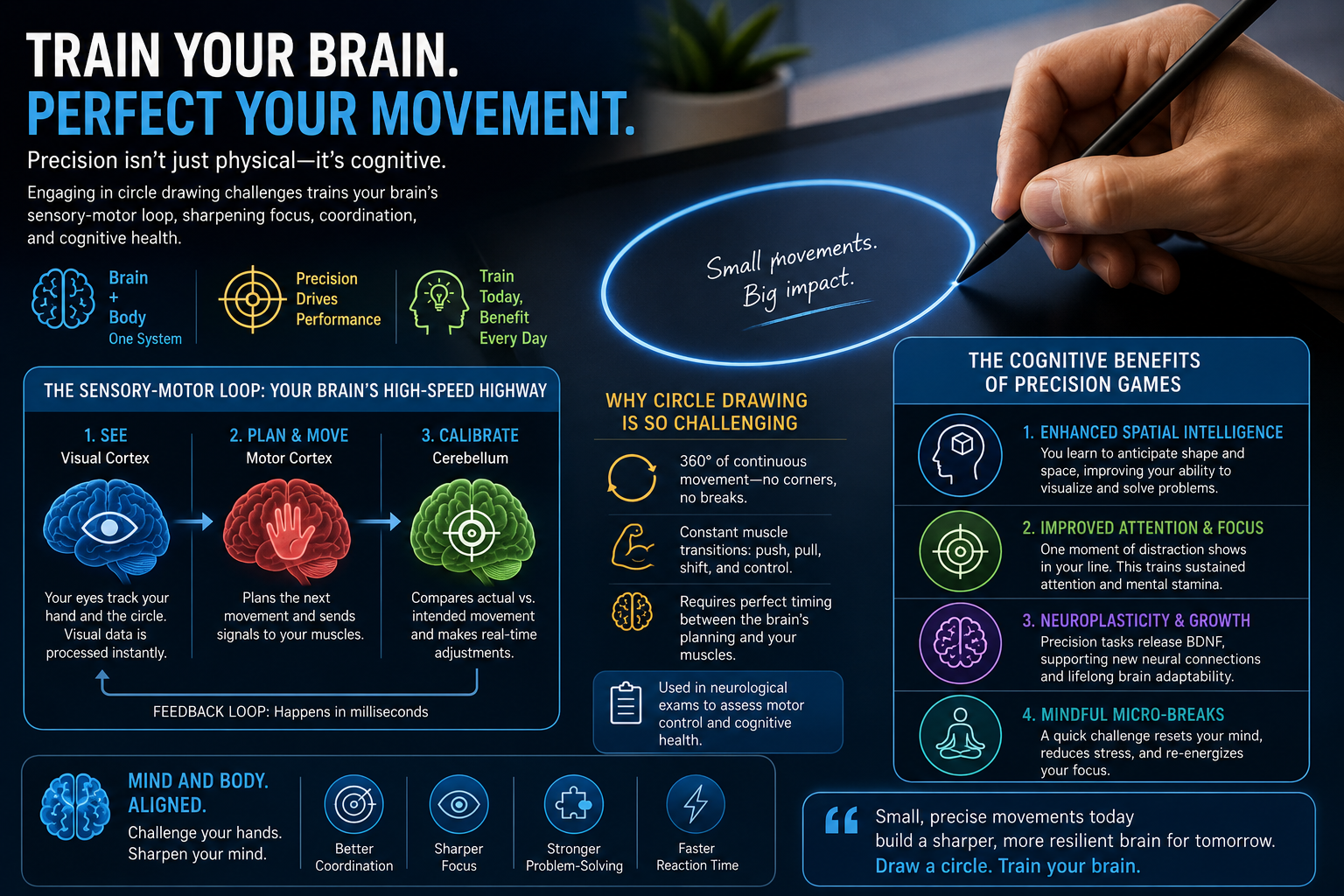
When we think about brain training, our minds usually drift toward Sudoku, crossword puzzles, or memory retention exercises. For years, the cognitive training market has been dominated by apps designed to boost mental arithmetic and vocabulary, but testing your skills on a free perfect circle drawing game shows that physical precision is just as vital. Modern neuroscience is revealing that our cognitive health is deeply intertwined with another crucial domain: motor precision.
The ability to perform subtle, high-accuracy movements—such as threading a needle, performing surgery, or drawing a precise geometric shape—requires complex neural networks to communicate at lightning speed. Engaging in activities that challenge our hand-eye coordination and fine motor skills does not just train our muscles; it actively sharpens our brain.
The Sensory-Motor Loop: A High-Speed Neural Highway
Every time you attempt a task that requires physical precision, your brain executes a continuous, high-speed feedback loop known as the sensory-motor loop. This process relies on close communication between several brain regions, primarily the visual cortex, the motor cortex, and the cerebellum.
When you draw or trace a line, your visual cortex processes the current position of your hand. This sensory data is immediately sent to the motor cortex, which plans the next muscle contraction, and the cerebellum, which acts as the brain’s calibration center. The cerebellum compares your actual hand position with your intended path and adjusts muscle tension in real-time.

This entire sequence occurs in milliseconds. When you practice games that demand extreme precision, you are essentially training this neural highway to run more efficiently. Over time, these pathways become stronger, leading to faster reaction times and smoother physical control.
Why Circle Drawing is a Masterclass in Motor Control
Among all geometric shapes, the circle is perhaps the most difficult for the human hand to draw perfectly. Straight lines are relatively easy because they require consistent muscle movement in a single direction. A circle, however, requires a constant, gradual transition of muscle groups.
As you draw a circle, your hand must move through 360 degrees, which means your wrist, fingers, and arm muscles are continuously shifting responsibilities. At one moment you are pulling; the next, you are pushing. The brain must manage this transition without a single pause or abrupt change in speed. If your motor cortex lags for even a fraction of a second, the curve flattens, or the line jerks.
Because of this complexity, drawing circles is often used in neurological exams to assess motor control and cognitive health. It serves as a window into how well your brain is managing real-time feedback and spatial coordinates.
The Cognitive Benefits of Precision Games
Engaging in fine motor games offers several cognitive benefits that extend far beyond the game itself:
1. Enhanced Spatial Intelligence
Spatial intelligence is the ability to visualize and manipulate patterns and shapes in your mind. Precision drawing games require you to anticipate the curvature of a shape before your hand gets there. This foresight trains your brain to map out two-dimensional space more accurately.
2. Improved Attention and Focus
Unlike mindless tapping games, precision-based challenges do not allow you to drift off. The moment your attention wanders, your hand slips. This makes fine motor games an excellent tool for training sustained attention, helping you build the mental stamina required to focus on demanding cognitive tasks in your daily life.
3. Neuroplasticity and Skill Acquisition
Neuroplasticity is the brain's ability to reorganize itself by forming new neural connections throughout life. Practicing difficult motor tasks stimulates the release of brain-derived neurotrophic factor (BDNF), a protein that supports the survival of existing neurons and encourages the growth of new ones. By pushing your physical limits in a safe, digital space, you encourage your brain to stay adaptable and active.
Micro-Breaks for Mindful Movement
In today's digital workplace, many of us spend hours typing on keyboards or scrolling through feeds. These repetitive, low-effort movements do not challenge our brain's motor processing systems. Over time, this lack of variety can lead to mental fatigue and a decline in coordination.
Integrating brief, mindful challenges into your day can serve as an excellent mental reset. Taking a quick break to play a simple geometry challenge forces you to slow down, control your breathing, and focus entirely on a single, precise movement. It acts as a form of active meditation, clearing away distractions while testing your brain's coordination center.
Conclusion
Our brains and bodies are not separate entities; they are part of a unified feedback loop. While traditional mental exercises are valuable, challenging your physical coordination is an equally powerful way to maintain cognitive sharpness. By engaging in simple, precision-oriented drawing challenges, you give your brain's motor networks a workout that boosts focus, spatial awareness, and overall neural health.
 Romaian
 English
 Arabic
 French
 Spanish
 Portuguese
 Deutsch
 Turkish
 Dutch
Dutch
 Italiano
 Russian
 Portuguese (Brazil)
 Greek
Greek
