



 Ban & Monetization Policy
 MyLiveRoom Rewards Program Rules & Eligibility
EPR Registration for E-Waste: Process, Documents & Fees Explained
India is generating more than 1.6 million tonnes of e-waste annually, and this number is growing rapidly with increasing electronics consumption. To manage this, the government has made EPR Registration for E-Waste mandatory for producers, importers, and brand owners.
If your business deals with electrical or electronic products, understanding EPR compliance is not optional anymore - it is a legal requirement.
In this blog, we break down the complete process, documents, and fees for EPR registration in India.
What is EPR Registration for E-Waste?
Extended Producer Responsibility (EPR) means that producers are responsible for the collection, recycling, and disposal of e-waste generated from their products.
Under the E-Waste (Management) Rules, 2022:
Producers must register on the CPCB portal
They must meet recycling targets annually
They must work only with authorized recyclers
The system ensures a circular economy where waste is reused instead of being dumped.
👉 Read detailed blog here: https://www.greenpermits.in/10/epr-registration-for-e-waste-process-documents-fees/
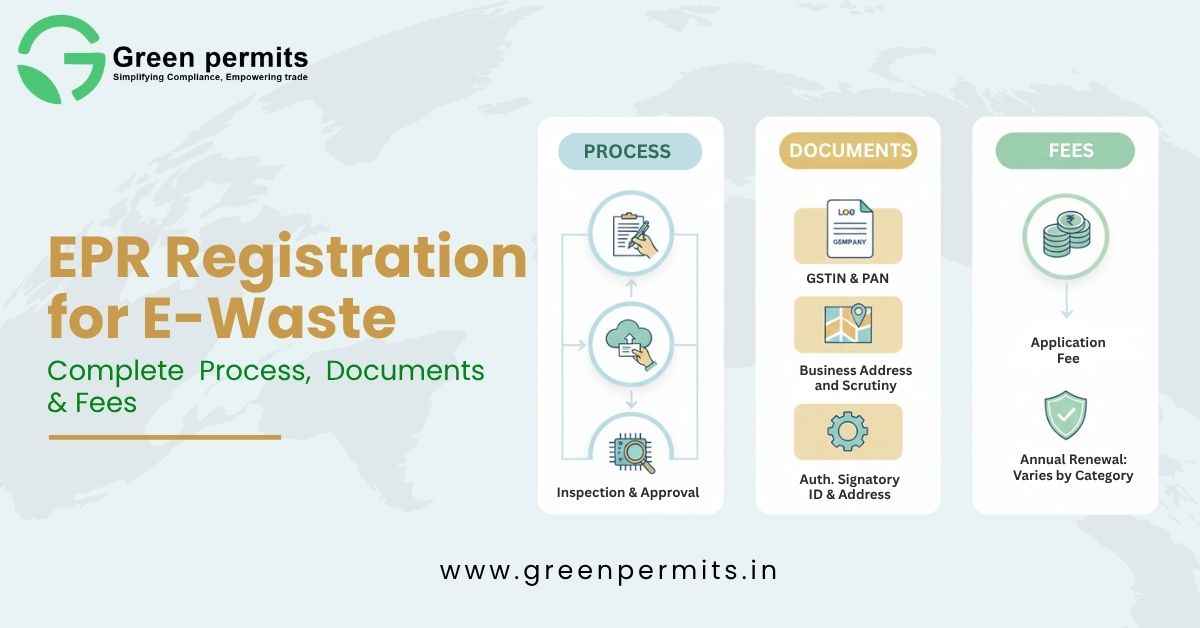
Step-by-Step EPR Registration Process in India
The registration process is completely online through the CPCB portal. However, it requires proper documentation and technical understanding.
Step 1: Business Identification
You must first identify your category:
Manufacturer
Producer (Brand Owner)
Importer
Each category has different compliance requirements.
Step 2: Portal Registration
Register on CPCB EPR Portal
Create login credentials
Fill company details (GST, PAN, IEC, CIN)
As per CPCB SOP, no entity can operate without registration on the portal, making it a mandatory compliance step
Step 3: Documentation Submission
Upload all required documents (covered below)
Step 4: EPR Plan Submission
You must submit:
Estimated e-waste generation
Collection mechanism
Recycling partnerships
Step 5: Approval from CPCB
Application is reviewed
Queries (if any) must be resolved within timeline
Registration is granted
Step 6: Post-Registration Compliance
Purchase EPR certificates
File annual returns
Maintain records
Documents Required for E-Waste EPR Registration
Proper documentation is critical. Even a small error can delay approval.
Basic Company Documents
PAN Card
GST Certificate
Certificate of Incorporation
IEC (for importers)
Operational Documents
Details of products (EEE category)
Production or import data
Waste generation estimates
Environmental & Compliance Documents
Consent to Establish (CTE)
Consent to Operate (CTO)
Authorization under waste rules (if applicable)
CPCB requires detailed manufacturing and waste-related data, including production capacity and disposal methods
EPR Registration Fees in India
The fees depend on:
Type of entity
Quantity of EEE introduced in market
CPCB fee structure
Typical Cost Structure
Government Fee (CPCB)
Consultant Fee (if applicable)
Annual compliance & return filing cost
For most MSMEs and startups, the total cost can range between ₹25,000 to ₹1,50,000, depending on complexity.
Common Challenges Businesses Face
Many companies struggle with EPR compliance due to:
Incorrect documentation
Lack of recycler tie-ups
Wrong category selection
Portal errors or rejection
Even after registration, compliance continues annually, which becomes difficult without expert guidance.
Why EPR Compliance is Important
EPR is not just a legal requirement - it directly impacts your business growth.
Key Benefits
Avoid heavy penalties and legal issues
Improve brand credibility
Enable smooth import/export operations
Align with ESG and sustainability goals
How Green Permits Helps You
At Green Permits, we simplify the entire EPR process from start to finish.
We provide:
Complete documentation support
CPCB portal registration
EPR plan preparation
Recycler network setup
Annual compliance & return filing
👉 Explore our service: https://www.greenpermits.in/e-waste-epr-registration/
Final Thoughts
With strict enforcement of E-Waste Rules 2022, businesses cannot afford to ignore EPR compliance. The process may look simple, but errors can lead to delays, penalties, or rejection.
Getting expert support ensures faster approval, correct filing, and long-term compliance.
Ready to Get Your EPR Registration Done?
📞 Connect with experts today
🌐 Visit: https://www.greenpermits.in
Let Green Permits handle your EPR compliance while you focus on growing your business. 🚀
India is generating more than 1.6 million tonnes of e-waste annually, and this number is growing rapidly with increasing electronics consumption. To manage this, the government has made EPR Registration for E-Waste mandatory for producers, importers, and brand owners.
If your business deals with electrical or electronic products, understanding EPR compliance is not optional anymore - it is a legal requirement.
In this blog, we break down the complete process, documents, and fees for EPR registration in India.
What is EPR Registration for E-Waste?
Extended Producer Responsibility (EPR) means that producers are responsible for the collection, recycling, and disposal of e-waste generated from their products.
Under the E-Waste (Management) Rules, 2022:
Producers must register on the CPCB portal
They must meet recycling targets annually
They must work only with authorized recyclers
The system ensures a circular economy where waste is reused instead of being dumped.
👉 Read detailed blog here: https://www.greenpermits.in/10/epr-registration-for-e-waste-process-documents-fees/
Step-by-Step EPR Registration Process in India
The registration process is completely online through the CPCB portal. However, it requires proper documentation and technical understanding.
Step 1: Business Identification
You must first identify your category:
Manufacturer
Producer (Brand Owner)
Importer
Each category has different compliance requirements.
Step 2: Portal Registration
Register on CPCB EPR Portal
Create login credentials
Fill company details (GST, PAN, IEC, CIN)
As per CPCB SOP, no entity can operate without registration on the portal, making it a mandatory compliance step
Step 3: Documentation Submission
Upload all required documents (covered below)
Step 4: EPR Plan Submission
You must submit:
Estimated e-waste generation
Collection mechanism
Recycling partnerships
Step 5: Approval from CPCB
Application is reviewed
Queries (if any) must be resolved within timeline
Registration is granted
Step 6: Post-Registration Compliance
Purchase EPR certificates
File annual returns
Maintain records
Documents Required for E-Waste EPR Registration
Proper documentation is critical. Even a small error can delay approval.
Basic Company Documents
PAN Card
GST Certificate
Certificate of Incorporation
IEC (for importers)
Operational Documents
Details of products (EEE category)
Production or import data
Waste generation estimates
Environmental & Compliance Documents
Consent to Establish (CTE)
Consent to Operate (CTO)
Authorization under waste rules (if applicable)
CPCB requires detailed manufacturing and waste-related data, including production capacity and disposal methods
EPR Registration Fees in India
The fees depend on:
Type of entity
Quantity of EEE introduced in market
CPCB fee structure
Typical Cost Structure
Government Fee (CPCB)
Consultant Fee (if applicable)
Annual compliance & return filing cost
For most MSMEs and startups, the total cost can range between ₹25,000 to ₹1,50,000, depending on complexity.
Common Challenges Businesses Face
Many companies struggle with EPR compliance due to:
Incorrect documentation
Lack of recycler tie-ups
Wrong category selection
Portal errors or rejection
Even after registration, compliance continues annually, which becomes difficult without expert guidance.
Why EPR Compliance is Important
EPR is not just a legal requirement - it directly impacts your business growth.
Key Benefits
Avoid heavy penalties and legal issues
Improve brand credibility
Enable smooth import/export operations
Align with ESG and sustainability goals
How Green Permits Helps You
At Green Permits, we simplify the entire EPR process from start to finish.
We provide:
Complete documentation support
CPCB portal registration
EPR plan preparation
Recycler network setup
Annual compliance & return filing
👉 Explore our service: https://www.greenpermits.in/e-waste-epr-registration/
Final Thoughts
With strict enforcement of E-Waste Rules 2022, businesses cannot afford to ignore EPR compliance. The process may look simple, but errors can lead to delays, penalties, or rejection.
Getting expert support ensures faster approval, correct filing, and long-term compliance.
Ready to Get Your EPR Registration Done?
📞 Connect with experts today
🌐 Visit: https://www.greenpermits.in
Let Green Permits handle your EPR compliance while you focus on growing your business. 🚀
EPR Registration for E-Waste: Process, Documents & Fees Explained
India is generating more than 1.6 million tonnes of e-waste annually, and this number is growing rapidly with increasing electronics consumption. To manage this, the government has made EPR Registration for E-Waste mandatory for producers, importers, and brand owners.
If your business deals with electrical or electronic products, understanding EPR compliance is not optional anymore - it is a legal requirement.
In this blog, we break down the complete process, documents, and fees for EPR registration in India.
What is EPR Registration for E-Waste?
Extended Producer Responsibility (EPR) means that producers are responsible for the collection, recycling, and disposal of e-waste generated from their products.
Under the E-Waste (Management) Rules, 2022:
Producers must register on the CPCB portal
They must meet recycling targets annually
They must work only with authorized recyclers
The system ensures a circular economy where waste is reused instead of being dumped.
👉 Read detailed blog here: https://www.greenpermits.in/10/epr-registration-for-e-waste-process-documents-fees/
Step-by-Step EPR Registration Process in India
The registration process is completely online through the CPCB portal. However, it requires proper documentation and technical understanding.
Step 1: Business Identification
You must first identify your category:
Manufacturer
Producer (Brand Owner)
Importer
Each category has different compliance requirements.
Step 2: Portal Registration
Register on CPCB EPR Portal
Create login credentials
Fill company details (GST, PAN, IEC, CIN)
As per CPCB SOP, no entity can operate without registration on the portal, making it a mandatory compliance step
Step 3: Documentation Submission
Upload all required documents (covered below)
Step 4: EPR Plan Submission
You must submit:
Estimated e-waste generation
Collection mechanism
Recycling partnerships
Step 5: Approval from CPCB
Application is reviewed
Queries (if any) must be resolved within timeline
Registration is granted
Step 6: Post-Registration Compliance
Purchase EPR certificates
File annual returns
Maintain records
Documents Required for E-Waste EPR Registration
Proper documentation is critical. Even a small error can delay approval.
Basic Company Documents
PAN Card
GST Certificate
Certificate of Incorporation
IEC (for importers)
Operational Documents
Details of products (EEE category)
Production or import data
Waste generation estimates
Environmental & Compliance Documents
Consent to Establish (CTE)
Consent to Operate (CTO)
Authorization under waste rules (if applicable)
CPCB requires detailed manufacturing and waste-related data, including production capacity and disposal methods
EPR Registration Fees in India
The fees depend on:
Type of entity
Quantity of EEE introduced in market
CPCB fee structure
Typical Cost Structure
Government Fee (CPCB)
Consultant Fee (if applicable)
Annual compliance & return filing cost
For most MSMEs and startups, the total cost can range between ₹25,000 to ₹1,50,000, depending on complexity.
Common Challenges Businesses Face
Many companies struggle with EPR compliance due to:
Incorrect documentation
Lack of recycler tie-ups
Wrong category selection
Portal errors or rejection
Even after registration, compliance continues annually, which becomes difficult without expert guidance.
Why EPR Compliance is Important
EPR is not just a legal requirement - it directly impacts your business growth.
Key Benefits
Avoid heavy penalties and legal issues
Improve brand credibility
Enable smooth import/export operations
Align with ESG and sustainability goals
How Green Permits Helps You
At Green Permits, we simplify the entire EPR process from start to finish.
We provide:
Complete documentation support
CPCB portal registration
EPR plan preparation
Recycler network setup
Annual compliance & return filing
👉 Explore our service: https://www.greenpermits.in/e-waste-epr-registration/
Final Thoughts
With strict enforcement of E-Waste Rules 2022, businesses cannot afford to ignore EPR compliance. The process may look simple, but errors can lead to delays, penalties, or rejection.
Getting expert support ensures faster approval, correct filing, and long-term compliance.
Ready to Get Your EPR Registration Done?
📞 Connect with experts today
🌐 Visit: https://www.greenpermits.in
Let Green Permits handle your EPR compliance while you focus on growing your business. 🚀
0 Comments
0 Shares
2K Views
0 Reviews

 Arabic
 French
 Spanish
 Portuguese
 Deutsch
 Turkish
 Dutch
Dutch
 Italiano
 Russian
 Romaian
 Portuguese (Brazil)
 Greek
Greek
