



 Ban & Monetization Policy
 MyLiveRoom Rewards Program Rules & Eligibility
BIS FMCS Certification in India: Process, Documents & Guide for Foreign Manufacturers
GPApril 27, 2026
If you are a foreign manufacturer planning to sell products in India, BIS FMCS Certification is a critical requirement you cannot ignore. Under the Foreign Manufacturer Certification Scheme (FMCS), overseas manufacturers must obtain BIS approval before exporting certain products to the Indian market.
This certification ensures that imported products meet Indian safety and quality standards, helping protect consumers and maintain product reliability.
To understand the detailed process, you can read this guide:
👉 https://www.greenpermits.in/02/bis-fmcs-certification-guide-for-foreign-manufacturers/
What is BIS FMCS Certification and Who Needs It
BIS FMCS Certification is specifically designed for foreign manufacturers who want to export products to India. It allows them to use the ISI mark on their products, confirming compliance with Indian Standards.
This certification is mandatory for multiple product categories such as electrical equipment, construction materials, chemicals, and consumer goods. If your product falls under mandatory BIS certification, you cannot sell it in India without FMCS approval.
Under this scheme, the responsibility lies with the foreign manufacturer, but they must appoint an Authorized Indian Representative (AIR) to coordinate with BIS authorities. This makes the process more structured but also slightly complex compared to domestic certification.
Step-by-Step BIS FMCS Certification Process
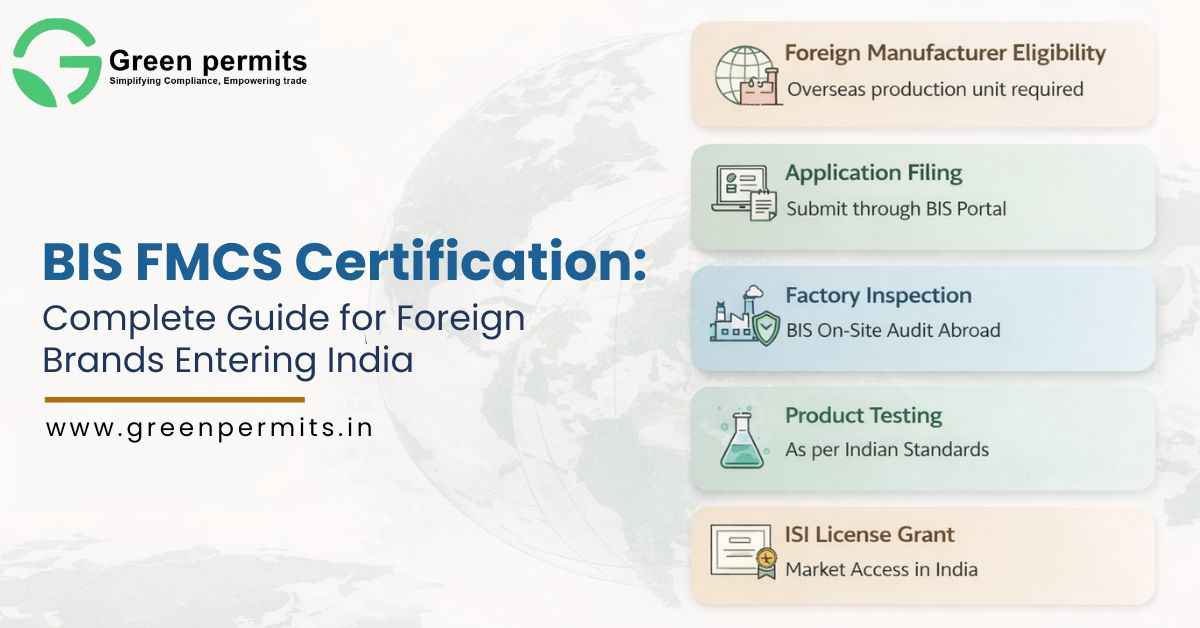
The BIS FMCS certification process involves several important stages, and each step must be handled carefully to avoid delays.
The process begins with identifying the correct Indian Standard (IS code) applicable to the product. This is followed by preparing detailed documentation, including manufacturing details, product specifications, and quality control processes.
Once the documentation is ready, the application is submitted to BIS along with the required fees. After submission, BIS officials schedule a factory inspection. Unlike domestic certification, this inspection takes place at the foreign manufacturing unit, making it a critical step in the process.
During the inspection, BIS अधिकारियों verify production processes, testing facilities, and compliance systems. Product samples are also collected and tested in BIS-approved laboratories to ensure they meet Indian standards.
If the product passes testing and the inspection is successful, BIS grants the FMCS license, allowing the manufacturer to use the ISI mark on exported products.
The overall timeline typically ranges from 3 to 6 months, depending on readiness, documentation, and inspection scheduling.
👉 For complete assistance, visit:
https://www.greenpermits.in/bis-fmcs-certification/
Documents Required for BIS FMCS Certification
Documentation is one of the most important aspects of FMCS certification. Foreign manufacturers must ensure that all documents are accurate and aligned with Indian standards.
The key documents include company registration certificates, manufacturing unit details, product specifications, quality control procedures, and test reports. In addition, documents related to the Authorized Indian Representative (AIR) are mandatory, as they act as the official point of contact in India.
Get Expert Help for BIS FMCS Certification
At Green Permits, we provide complete support for BIS FMCS certification, helping foreign manufacturers navigate the entire process smoothly.
✔ Assistance with IS standard identification
✔ Documentation and application support
✔ Coordination for factory inspection
✔ Faster approval with expert guidance
🌐 Website: https://www.greenpermits.in/
📞 +91 78350 06182
📧 wecare@greenpermits.in
👉 Book a Consultation with Green Permits
GPApril 27, 2026
If you are a foreign manufacturer planning to sell products in India, BIS FMCS Certification is a critical requirement you cannot ignore. Under the Foreign Manufacturer Certification Scheme (FMCS), overseas manufacturers must obtain BIS approval before exporting certain products to the Indian market.
This certification ensures that imported products meet Indian safety and quality standards, helping protect consumers and maintain product reliability.
To understand the detailed process, you can read this guide:
👉 https://www.greenpermits.in/02/bis-fmcs-certification-guide-for-foreign-manufacturers/
What is BIS FMCS Certification and Who Needs It
BIS FMCS Certification is specifically designed for foreign manufacturers who want to export products to India. It allows them to use the ISI mark on their products, confirming compliance with Indian Standards.
This certification is mandatory for multiple product categories such as electrical equipment, construction materials, chemicals, and consumer goods. If your product falls under mandatory BIS certification, you cannot sell it in India without FMCS approval.
Under this scheme, the responsibility lies with the foreign manufacturer, but they must appoint an Authorized Indian Representative (AIR) to coordinate with BIS authorities. This makes the process more structured but also slightly complex compared to domestic certification.
Step-by-Step BIS FMCS Certification Process
The BIS FMCS certification process involves several important stages, and each step must be handled carefully to avoid delays.
The process begins with identifying the correct Indian Standard (IS code) applicable to the product. This is followed by preparing detailed documentation, including manufacturing details, product specifications, and quality control processes.
Once the documentation is ready, the application is submitted to BIS along with the required fees. After submission, BIS officials schedule a factory inspection. Unlike domestic certification, this inspection takes place at the foreign manufacturing unit, making it a critical step in the process.
During the inspection, BIS अधिकारियों verify production processes, testing facilities, and compliance systems. Product samples are also collected and tested in BIS-approved laboratories to ensure they meet Indian standards.
If the product passes testing and the inspection is successful, BIS grants the FMCS license, allowing the manufacturer to use the ISI mark on exported products.
The overall timeline typically ranges from 3 to 6 months, depending on readiness, documentation, and inspection scheduling.
👉 For complete assistance, visit:
https://www.greenpermits.in/bis-fmcs-certification/
Documents Required for BIS FMCS Certification
Documentation is one of the most important aspects of FMCS certification. Foreign manufacturers must ensure that all documents are accurate and aligned with Indian standards.
The key documents include company registration certificates, manufacturing unit details, product specifications, quality control procedures, and test reports. In addition, documents related to the Authorized Indian Representative (AIR) are mandatory, as they act as the official point of contact in India.
Get Expert Help for BIS FMCS Certification
At Green Permits, we provide complete support for BIS FMCS certification, helping foreign manufacturers navigate the entire process smoothly.
✔ Assistance with IS standard identification
✔ Documentation and application support
✔ Coordination for factory inspection
✔ Faster approval with expert guidance
🌐 Website: https://www.greenpermits.in/
📞 +91 78350 06182
📧 wecare@greenpermits.in
👉 Book a Consultation with Green Permits
BIS FMCS Certification in India: Process, Documents & Guide for Foreign Manufacturers
GPApril 27, 2026
If you are a foreign manufacturer planning to sell products in India, BIS FMCS Certification is a critical requirement you cannot ignore. Under the Foreign Manufacturer Certification Scheme (FMCS), overseas manufacturers must obtain BIS approval before exporting certain products to the Indian market.
This certification ensures that imported products meet Indian safety and quality standards, helping protect consumers and maintain product reliability.
To understand the detailed process, you can read this guide:
👉 https://www.greenpermits.in/02/bis-fmcs-certification-guide-for-foreign-manufacturers/
What is BIS FMCS Certification and Who Needs It
BIS FMCS Certification is specifically designed for foreign manufacturers who want to export products to India. It allows them to use the ISI mark on their products, confirming compliance with Indian Standards.
This certification is mandatory for multiple product categories such as electrical equipment, construction materials, chemicals, and consumer goods. If your product falls under mandatory BIS certification, you cannot sell it in India without FMCS approval.
Under this scheme, the responsibility lies with the foreign manufacturer, but they must appoint an Authorized Indian Representative (AIR) to coordinate with BIS authorities. This makes the process more structured but also slightly complex compared to domestic certification.
Step-by-Step BIS FMCS Certification Process
The BIS FMCS certification process involves several important stages, and each step must be handled carefully to avoid delays.
The process begins with identifying the correct Indian Standard (IS code) applicable to the product. This is followed by preparing detailed documentation, including manufacturing details, product specifications, and quality control processes.
Once the documentation is ready, the application is submitted to BIS along with the required fees. After submission, BIS officials schedule a factory inspection. Unlike domestic certification, this inspection takes place at the foreign manufacturing unit, making it a critical step in the process.
During the inspection, BIS अधिकारियों verify production processes, testing facilities, and compliance systems. Product samples are also collected and tested in BIS-approved laboratories to ensure they meet Indian standards.
If the product passes testing and the inspection is successful, BIS grants the FMCS license, allowing the manufacturer to use the ISI mark on exported products.
The overall timeline typically ranges from 3 to 6 months, depending on readiness, documentation, and inspection scheduling.
👉 For complete assistance, visit:
https://www.greenpermits.in/bis-fmcs-certification/
Documents Required for BIS FMCS Certification
Documentation is one of the most important aspects of FMCS certification. Foreign manufacturers must ensure that all documents are accurate and aligned with Indian standards.
The key documents include company registration certificates, manufacturing unit details, product specifications, quality control procedures, and test reports. In addition, documents related to the Authorized Indian Representative (AIR) are mandatory, as they act as the official point of contact in India.
Get Expert Help for BIS FMCS Certification
At Green Permits, we provide complete support for BIS FMCS certification, helping foreign manufacturers navigate the entire process smoothly.
✔ Assistance with IS standard identification
✔ Documentation and application support
✔ Coordination for factory inspection
✔ Faster approval with expert guidance
🌐 Website: https://www.greenpermits.in/
📞 +91 78350 06182
📧 wecare@greenpermits.in
👉 Book a Consultation with Green Permits
0 Kommentare
0 Geteilt
3KB Ansichten
0 Bewertungen






 English
 Arabic
 French
 Spanish
 Portuguese
 Turkish
 Dutch
Dutch
 Italiano
 Russian
 Romaian
 Portuguese (Brazil)
 Greek
Greek
