ISI Mark Certification in India: Process, Documents & Approval Guide
If you are manufacturing or selling products in India, ISI Mark Certification is one of the most important compliance requirements you cannot ignore. It is issued by the Bureau of Indian Standards (BIS) and ensures that your product meets the required safety and quality standards before entering the market.
Many businesses think of it as just a regulatory step, but in reality, ISI certification directly impacts your brand credibility, product acceptance, and market expansion.
To understand the detailed breakdown, you can read this guide:
👉
https://www.greenpermits.in/04/isi-mark-certification-india-bis-process-approval-guide/
What is ISI Mark Certification and Why It is Mandatory
The ISI mark is a certification that confirms a product complies with Indian Standards (IS codes) set by BIS. It applies to a wide range of products such as electrical appliances, steel products, cement, packaged water, and more.
In India, more than 300+ product categories require mandatory BIS certification, and selling these products without ISI approval can result in penalties, product seizure, or even legal action.
Beyond compliance, ISI certification offers significant business advantages. It builds trust among customers, improves product quality perception, and makes it easier to enter government tenders and large distribution networks. In today’s competitive market, certified products are often preferred over non-certified alternatives, giving businesses a clear advantage.
Step-by-Step ISI Mark Certification Process
The ISI certification process involves multiple stages, and each step must be handled carefully to ensure smooth approval.
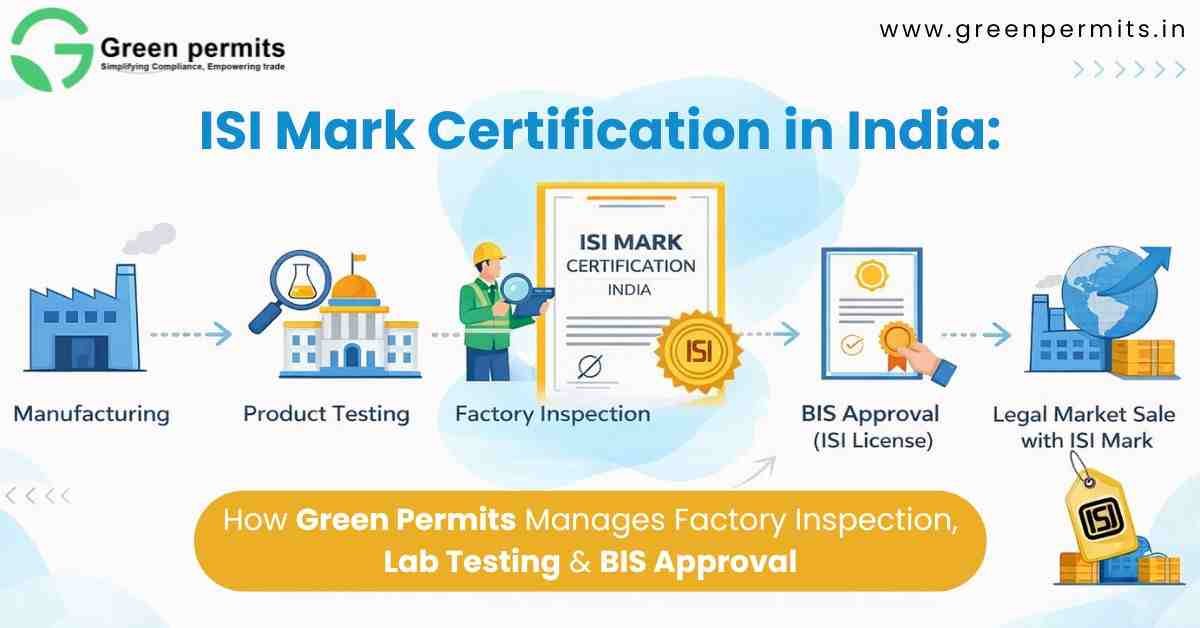
The process starts with identifying the correct Indian Standard (IS code) applicable to your product. This is a critical step because applying under the wrong standard can lead to delays or rejection. Once the standard is finalized, businesses need to prepare detailed documentation, including company details, manufacturing process information, and product specifications.
After documentation, the application is submitted through the BIS portal. Once the application is reviewed, BIS officials schedule a factory inspection. During this inspection, they verify manufacturing processes, quality control systems, and testing facilities available at your unit.
Following the inspection, product samples are collected and tested in BIS-approved laboratories. If the product meets all required standards, BIS grants the license, allowing the business to use the ISI mark on its products.
Typically, the entire process can take 30 to 60 days, depending on documentation accuracy and inspection readiness.
👉 For complete assistance, visit:
https://www.greenpermits.in/isi-mark-certification-process-in-india/
Documents Required for ISI Certification
Proper documentation is one of the most important aspects of ISI certification. Businesses must ensure that all submitted documents are accurate and consistent.
The key documents include company registration certificates, GST and PAN details, manufacturing process flow, product specifications, and quality control details. In addition, test reports and technical details of the product must be aligned with BIS standards.
Get Expert Help for ISI Certification
At Green Permits, we provide complete support for BIS and ISI certification - from documentation to final approval.
✔ End-to-end compliance handling
✔ Faster approval with expert guidance
✔ Support for manufacturers and importers
🌐 Website:
https://www.greenpermits.in/
📞 +91 78350 06182
📧 wecare@greenpermits.in
👉 Book a Consultation with Green Permits
ISI Mark Certification in India: Process, Documents & Approval Guide
If you are manufacturing or selling products in India, ISI Mark Certification is one of the most important compliance requirements you cannot ignore. It is issued by the Bureau of Indian Standards (BIS) and ensures that your product meets the required safety and quality standards before entering the market.
Many businesses think of it as just a regulatory step, but in reality, ISI certification directly impacts your brand credibility, product acceptance, and market expansion.
To understand the detailed breakdown, you can read this guide:
👉 https://www.greenpermits.in/04/isi-mark-certification-india-bis-process-approval-guide/
What is ISI Mark Certification and Why It is Mandatory
The ISI mark is a certification that confirms a product complies with Indian Standards (IS codes) set by BIS. It applies to a wide range of products such as electrical appliances, steel products, cement, packaged water, and more.
In India, more than 300+ product categories require mandatory BIS certification, and selling these products without ISI approval can result in penalties, product seizure, or even legal action.
Beyond compliance, ISI certification offers significant business advantages. It builds trust among customers, improves product quality perception, and makes it easier to enter government tenders and large distribution networks. In today’s competitive market, certified products are often preferred over non-certified alternatives, giving businesses a clear advantage.
Step-by-Step ISI Mark Certification Process
The ISI certification process involves multiple stages, and each step must be handled carefully to ensure smooth approval.
The process starts with identifying the correct Indian Standard (IS code) applicable to your product. This is a critical step because applying under the wrong standard can lead to delays or rejection. Once the standard is finalized, businesses need to prepare detailed documentation, including company details, manufacturing process information, and product specifications.
After documentation, the application is submitted through the BIS portal. Once the application is reviewed, BIS officials schedule a factory inspection. During this inspection, they verify manufacturing processes, quality control systems, and testing facilities available at your unit.
Following the inspection, product samples are collected and tested in BIS-approved laboratories. If the product meets all required standards, BIS grants the license, allowing the business to use the ISI mark on its products.
Typically, the entire process can take 30 to 60 days, depending on documentation accuracy and inspection readiness.
👉 For complete assistance, visit:
https://www.greenpermits.in/isi-mark-certification-process-in-india/
Documents Required for ISI Certification
Proper documentation is one of the most important aspects of ISI certification. Businesses must ensure that all submitted documents are accurate and consistent.
The key documents include company registration certificates, GST and PAN details, manufacturing process flow, product specifications, and quality control details. In addition, test reports and technical details of the product must be aligned with BIS standards.
Get Expert Help for ISI Certification
At Green Permits, we provide complete support for BIS and ISI certification - from documentation to final approval.
✔ End-to-end compliance handling
✔ Faster approval with expert guidance
✔ Support for manufacturers and importers
🌐 Website: https://www.greenpermits.in/
📞 +91 78350 06182
📧 wecare@greenpermits.in
👉 Book a Consultation with Green Permits




 Ban & Monetization Policy
 MyLiveRoom Rewards Program Rules & Eligibility









 English
 French
 Spanish
 Portuguese
 Deutsch
 Turkish
 Dutch
Dutch
 Italiano
 Russian
 Romaian
 Portuguese (Brazil)
 Greek
Greek
