


 Ban & Monetization Policy
 MyLiveRoom Rewards Program Rules & Eligibility
Medical Billing for Mental Health Services in the USA: Strategies for Stronger Revenue and Better Patient Care
Introduction
Mental healthcare has become one of the fastest-growing segments of the healthcare industry in the USA. As awareness around anxiety, depression, trauma, substance use disorders, and behavioral health continues to increase, more providers are expanding their services to meet rising patient demand.
However, delivering quality care is only part of the equation. Many mental health practices face ongoing challenges with insurance claims, reimbursement delays, coding complexities, and compliance requirements. These administrative hurdles can significantly impact financial performance if not managed properly.
This is where effective medical billing for mental health services becomes essential. Accurate billing processes help providers maintain steady cash flow, reduce claim denials, and focus more on patient outcomes rather than paperwork.
In this article, we'll explore the importance of mental health billing, common challenges providers face, and best practices for maximizing reimbursement while maintaining compliance.
Understanding Medical Billing for Mental Health Services
Mental health billing differs from many other healthcare specialties due to its unique coding requirements, session-based treatment structures, and payer-specific regulations.
Medical billing for mental health services involves submitting claims for counseling, psychotherapy, psychiatric evaluations, medication management, telehealth visits, and other behavioral health treatments.
Unlike many medical specialties that rely heavily on procedures and diagnostic testing, mental health services often require detailed documentation regarding:
- Session duration
- Treatment plans
- Medical necessity
- Progress notes
- Patient diagnoses
- Telehealth compliance
Even small documentation errors can lead to denied or delayed reimbursements.
Why Mental Health Billing Requires Specialized Expertise
Behavioral health providers operate within a highly regulated reimbursement environment. Insurance carriers frequently update policies, authorization requirements, and coding guidelines.
Common services that require precise billing include:
Psychotherapy Sessions
Different CPT codes are used based on session length and treatment type.
Psychiatric Diagnostic Evaluations
Initial assessments often require separate coding and documentation standards.
Medication Management
Psychiatrists and psychiatric nurse practitioners must accurately bill medication-related services.
Telepsychiatry Services
Virtual care has expanded significantly, creating additional compliance and billing requirements.
Because of these complexities, many providers rely on professional mental health billing services to improve claim accuracy and reduce administrative burdens.
Common Challenges in Mental Health Medical Billing
Many behavioral health practices struggle with reimbursement issues that directly impact revenue.
1. Frequent Claim Denials
Claims may be denied due to:
- Missing documentation
- Incorrect modifiers
- Coding errors
- Authorization issues
- Eligibility problems
Repeated denials can create substantial financial strain for practices.
2. Insurance Verification Issues
Mental health coverage varies significantly between insurance plans.
Failure to verify benefits before treatment can result in unpaid claims and patient billing disputes.
3. Prior Authorization Requirements
Many insurers require authorization for specific behavioral health services.
Missing approval requirements often leads to reimbursement delays or denials.
4. Changing Payer Policies
Insurance companies frequently update reimbursement guidelines for mental health treatment.
Practices must stay informed to avoid compliance issues.
5. Telehealth Billing Complexity
Since virtual behavioral healthcare became more common, billing regulations continue to evolve.
Incorrect telehealth coding remains a common cause of claim rejection.
The Growing Demand for Mental Health Billing Services
As behavioral health practices grow, administrative responsibilities increase as well.
Many providers find it difficult to balance patient care with revenue management responsibilities.
This has increased demand for specialized billing services for mental health providers that understand the nuances of behavioral healthcare reimbursement.
Professional billing teams can help:
- Reduce denied claims
- Accelerate reimbursements
- Improve collections
- Maintain compliance
- Track payer trends
- Enhance financial reporting
When billing processes are streamlined, providers can devote more time to clinical care and less time to administrative tasks.
Key Components of Effective Mental Health Billing
Successful mental health medical billing depends on several critical elements.
Accurate Coding
Correct CPT, HCPCS, and ICD-10 coding is essential for claim acceptance.
Billing teams must understand psychotherapy codes, psychiatric evaluation codes, crisis intervention services, and telehealth billing requirements.
Detailed Documentation
Insurance carriers require evidence of medical necessity.
Documentation should clearly support:
- Diagnosis
- Treatment goals
- Session details
- Progress measurements
- Clinical decision-making
Eligibility Verification
Verifying coverage before appointments helps prevent payment surprises and claim denials.
Timely Claim Submission
Submitting claims promptly reduces delays and improves cash flow.
Denial Management
A structured appeals process helps recover revenue that might otherwise be lost.
Benefits of Partnering with a Mental Health Billing Company
Many behavioral health practices choose to outsource revenue management functions to a specialized mental health billing company.
The benefits often include:
Improved Reimbursement Rates
Experienced billing professionals understand payer requirements and submit cleaner claims.
Reduced Administrative Burden
Providers spend less time handling billing-related tasks.
Better Cash Flow
Faster claim processing leads to more predictable revenue cycles.
Enhanced Compliance
Specialized billing experts stay updated on industry regulations and payer policies.
Scalability
Growing practices can expand without needing large in-house billing departments.
For multi-provider clinics and larger organizations, working with established mental health billing companies often becomes a strategic investment.
Mental Health Billing Solutions for Modern Practices
Today's healthcare environment demands advanced technology and streamlined workflows.
Effective mental health billing solutions typically include:
- Electronic claim submission
- Automated eligibility verification
- Denial tracking systems
- Real-time reporting dashboards
- Payment posting automation
- Revenue analytics
- Telehealth billing support
These tools help practices identify revenue leaks and optimize reimbursement performance.
Technology alone, however, is not enough. Human expertise remains critical for handling complex behavioral health claims.
Revenue Cycle Management in Mental Health Practices
Financial success depends on more than submitting claims.
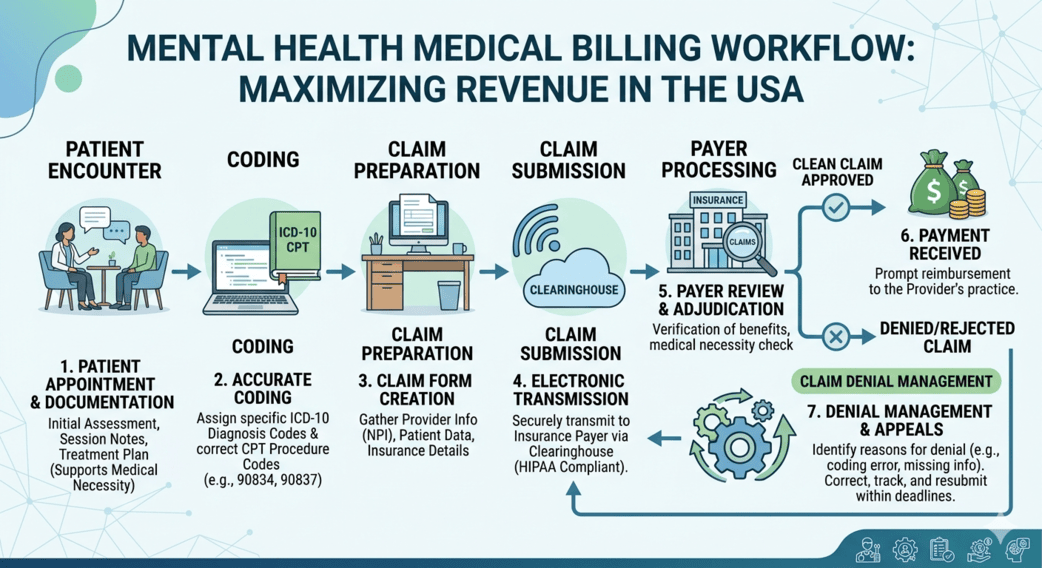
Comprehensive revenue cycle management services oversee every stage of the reimbursement process, including:
Patient Registration
Accurate demographic information reduces claim errors.
Insurance Verification
Coverage confirmation helps avoid eligibility-related denials.
Charge Entry
Services must be entered correctly for proper reimbursement.
Claims Submission
Clean claims improve first-pass acceptance rates.
Payment Posting
Accurate payment reconciliation ensures financial transparency.
Accounts Receivable Follow-Up
Outstanding claims require consistent monitoring and follow-up.
Denial Resolution
Appeals and corrections recover lost revenue.
Strong revenue cycle management creates a healthier financial foundation for mental health providers.
The Importance of Medical Coding Services
Coding accuracy plays a major role in reimbursement success.
Professional medical coding services help ensure that every service is represented correctly according to payer requirements and industry standards.
Benefits include:
- Reduced claim denials
- Improved compliance
- Accurate reimbursement
- Lower audit risk
- Better financial reporting
Mental health coding requires specialized expertise due to evolving regulations and payer-specific guidelines.
How Medical Billing and Coding Services Work Together
Many practices view billing and coding as separate functions, but they are closely connected.
Comprehensive medical billing and coding services create a seamless process from patient encounter to final reimbursement.
When coding is accurate:
- Claims are processed faster
- Denials decrease
- Compliance improves
- Revenue increases
This integrated approach helps behavioral health practices maintain operational efficiency while supporting long-term growth.
Why Credentialing Services Matter for Mental Health Providers
Before providers can receive insurance reimbursements, they must be properly enrolled with payer networks.
Professional credentialing services help ensure providers meet payer requirements and remain active within insurance networks.
Credentialing support often includes:
- Initial enrollment
- Revalidation
- Provider updates
- Payer communications
- Compliance monitoring
Delays in credentialing can significantly impact revenue, making this process a critical component of practice management.
Real-World Example: Improving Revenue Through Better Billing
Consider a growing behavioral health clinic with multiple therapists and psychiatric providers.
The clinic experienced:
- High denial rates
- Slow reimbursements
- Administrative overload
- Billing backlogs
After implementing specialized billing services for mental health providers, the organization improved documentation accuracy, streamlined coding workflows, and strengthened denial management processes.
Within several months, claim acceptance rates increased significantly, accounts receivable decreased, and providers were able to dedicate more time to patient care.
This example demonstrates how effective billing systems directly influence both financial performance and operational efficiency.
Supporting Long-Term Success in Behavioral Healthcare
Mental health practices face unique reimbursement challenges that require specialized attention.
As insurance regulations evolve and patient demand continues to grow, providers must establish efficient systems for:
- Coding accuracy
- Documentation compliance
- Eligibility verification
- Claims management
- Revenue tracking
- Credentialing support
Organizations that prioritize these areas are better positioned to achieve financial stability while maintaining high-quality patient care.
Conclusion
Effective medical billing for mental health services is essential for maintaining a healthy revenue cycle and supporting sustainable practice growth. From accurate coding and documentation to payer compliance and denial management, every step plays a critical role in reimbursement success.
Many behavioral health providers rely on specialized support to navigate these complexities and improve operational efficiency. Companies such as 247 Medical Billing Services help healthcare organizations strengthen financial performance through expertise in medical billing services, medical coding services, medical billing and coding services, revenue cycle management services, and credentialing services. When these functions work together effectively, providers can focus more on delivering exceptional mental healthcare and less on administrative challenges.
Frequently Asked Questions (FAQs)
1. What is medical billing for mental health services?
Medical billing for mental health services involves submitting insurance claims and managing reimbursements for behavioral health treatments such as psychotherapy, psychiatric evaluations, counseling, and medication management.
2. Why is mental health billing different from other medical specialties?
Mental health billing often requires detailed documentation, time-based coding, prior authorizations, and adherence to unique payer requirements, making it more specialized than many other healthcare fields.
3. What are the benefits of outsourcing mental health billing services?
Outsourcing can help reduce claim denials, improve reimbursement rates, strengthen compliance, lower administrative workload, and enhance overall revenue cycle performance.
4. How do mental health billing companies improve revenue?
Mental health billing companies use specialized expertise to submit cleaner claims, monitor payer requirements, manage denials, and optimize reimbursement processes.
5. What role do medical coding services play in behavioral health billing?
Medical coding services ensure that diagnoses and treatments are accurately translated into standardized codes required for insurance reimbursement and compliance.
6. Why are credentialing services important for mental health providers?
Credentialing services help providers enroll with insurance networks, maintain active participation status, and avoid reimbursement delays caused by enrollment issues.
 Greek
Greek
 English
 Arabic
 French
 Spanish
 Portuguese
 Deutsch
 Turkish
 Dutch
Dutch
 Italiano
 Russian
 Romaian
 Portuguese (Brazil)
