


 Ban & Monetization Policy
 MyLiveRoom Rewards Program Rules & Eligibility
What is BIS? BIS Full Form & BIS Certification Mark Guide
Introduction
Businesses manufacturing or importing products in India must comply with various quality and safety regulations. One of the most important regulatory bodies responsible for maintaining product quality is the Bureau of Indian Standards. If you are planning to manufacture, import, or sell regulated products, understanding What is BIS, the BIS Full Form, the importance of the BIS Certification Mark, and how to obtain a BIS Certificate Online is essential. This guide explains everything in simple language without unnecessary technical terms.
What is BIS?
What is BIS? BIS stands for the Bureau of Indian Standards, the national standards body of India. It works under the Ministry of Consumer Affairs, Food and Public Distribution and is responsible for developing product standards, certification schemes, testing requirements, and quality control measures. The primary objective of BIS is to ensure that products available in the Indian market are safe, reliable, and meet prescribed quality standards. The organization plays a significant role in protecting consumers while promoting fair trade practices.
Today, thousands of products require BIS approval before they can be legally sold in India.
BIS Full Form
The BIS Full Form is Bureau of Indian Standards. The organization was established under the Bureau of Indian Standards Act and replaced the earlier Indian Standards Institution (ISI). Over the years, BIS has expanded its certification schemes to include electronics, household appliances, construction materials, chemicals, automotive products, and many other categories. Whenever someone asks the BIS Full Form, it simply refers to the Bureau of Indian Standards—the authority responsible for maintaining product quality across India.
Why is BIS Important?
BIS certification benefits manufacturers, importers, retailers, and consumers alike.
Some major advantages include:
-
Ensures product safety
-
Improves customer confidence
-
Demonstrates compliance with Indian regulations
-
Enhances product credibility
-
Reduces the risk of substandard products entering the market
-
Supports easier business expansion
For many products, BIS certification is mandatory before they can be sold legally in India.
Understanding the BIS Certification Mark
The BIS Certification Mark is a symbol that indicates a product has successfully complied with applicable Indian Standards. When consumers see the BIS Certification Mark, they know that the product has undergone required testing and quality verification. The mark helps buyers identify certified products and builds trust in the manufacturer's commitment to quality. Different certification schemes may have different marking requirements depending on the product category, but the purpose remains the same—to confirm compliance with BIS standards.
Products That Commonly Require BIS Certification
Numerous products fall under mandatory BIS certification schemes, including:
-
Electronic appliances
-
Mobile accessories
-
LED lighting products
-
Batteries
-
Steel products
-
Cement
-
Pressure cookers
-
Kitchen appliances
-
Electrical equipment
-
Toys
-
Household products
Before importing or manufacturing any regulated product, businesses should verify whether BIS certification is mandatory.
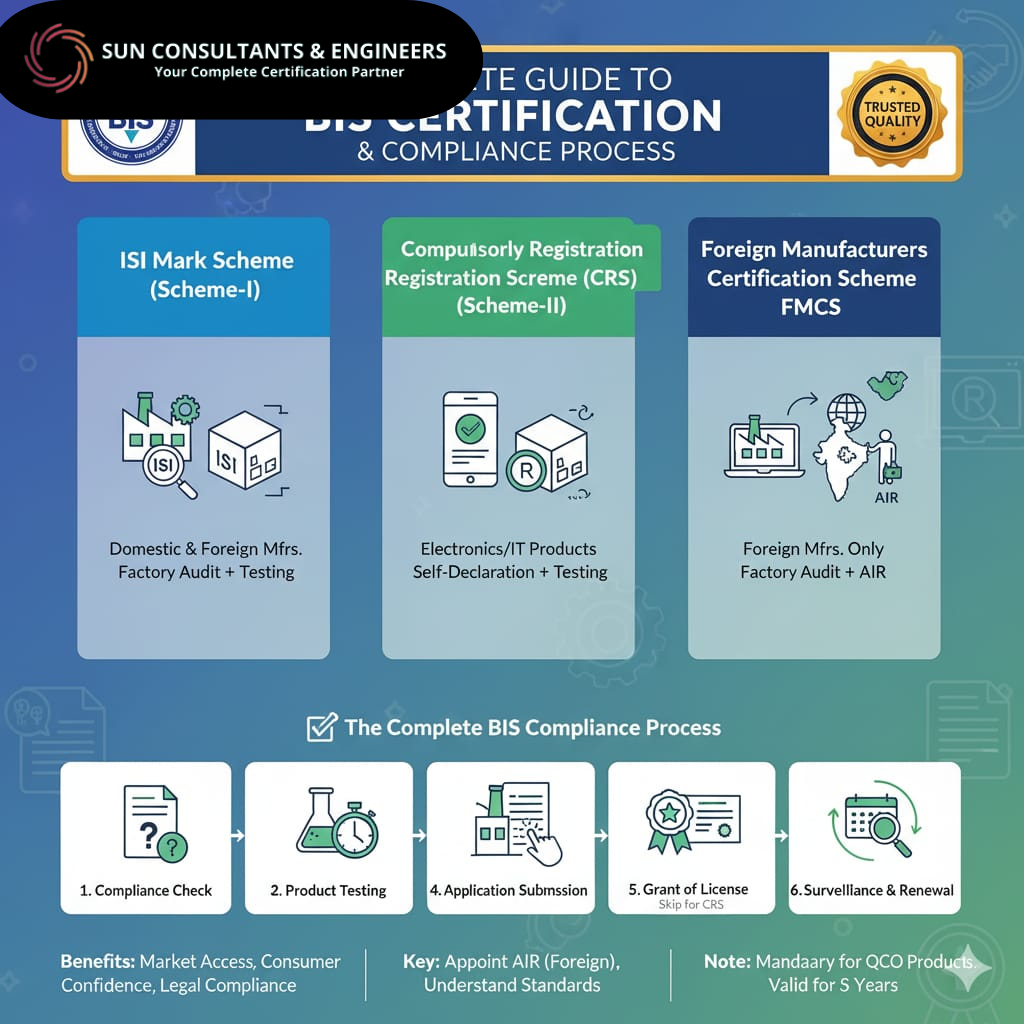
How to Apply for a BIS Certificate Online
Today, applicants can begin the process of obtaining a BIS Certificate Online through the official BIS digital system.
The general process includes:
Step 1: Product Identification
Identify the applicable Indian Standard for your product.
Step 2: Documentation
Prepare required documents, such as:
-
Company registration details
-
Manufacturing information
-
Product specifications
-
Test reports
-
Authorized representative details (if applicable)
Step 3: Product Testing
The product is tested in a BIS-recognized laboratory to ensure compliance with applicable standards.
Step 4: Online Application
Submit the application for a BIS Certificate Online along with supporting documents.
Step 5: Verification
BIS reviews the submitted information. Depending on the certification scheme, factory inspections or additional evaluations may also be required.
Step 6: Grant of Certification
Once all requirements are fulfilled, BIS issues the certification, allowing the manufacturer to use the applicable BIS Certification Mark.
Documents Commonly Required
Although documentation may vary depending on the product category, applicants generally need:
-
Company incorporation documents
-
Manufacturing license
-
Factory address proof
-
Product specifications
-
Quality management details
-
Test reports
-
Identity and authorization documents
-
Trademark details (if applicable)
Submitting complete and accurate documentation helps reduce delays.
Who Needs BIS Certification?
BIS certification may be required for:
-
Indian manufacturers
-
Foreign manufacturers exporting products to India
-
Importers
-
Brand owners
-
Authorized Indian Representatives (AIR)
Businesses should determine the applicable certification scheme before initiating the application.
Common Mistakes to Avoid
Many applicants face delays due to avoidable errors, including:
-
Selecting the wrong product standard
-
Submitting incomplete documentation
-
Using outdated test reports
-
Providing incorrect product specifications
-
Applying under the wrong certification scheme
Proper planning can significantly improve approval timelines.
Benefits of Getting BIS Certified
Obtaining BIS certification offers several business advantages:
-
Regulatory compliance
-
Better market acceptance
-
Improved customer confidence
-
Increased product credibility
-
Easier access to Indian markets
-
Reduced legal risks
-
Stronger competitive positioning
The BIS Certification Mark also serves as a visible indicator of quality and conformity.
Conclusion
Understanding What is BIS, knowing the BIS Full Form, recognizing the importance of the BIS Certification Mark, and learning how to apply for a BIS Certificate Online are essential for manufacturers and importers planning to sell products in India. BIS certification not only helps businesses comply with Indian regulations but also strengthens consumer trust and enhances product credibility. Choosing the correct certification process and ensuring accurate documentation can make the approval process smoother and more efficient.
 Italiano
 English
 Arabic
 French
 Spanish
 Portuguese
 Deutsch
 Turkish
 Dutch
Dutch
 Russian
 Romaian
 Portuguese (Brazil)
 Greek
Greek
