


 Ban & Monetization Policy
 MyLiveRoom Rewards Program Rules & Eligibility
Car Braking Systems: Every Type You Should Know
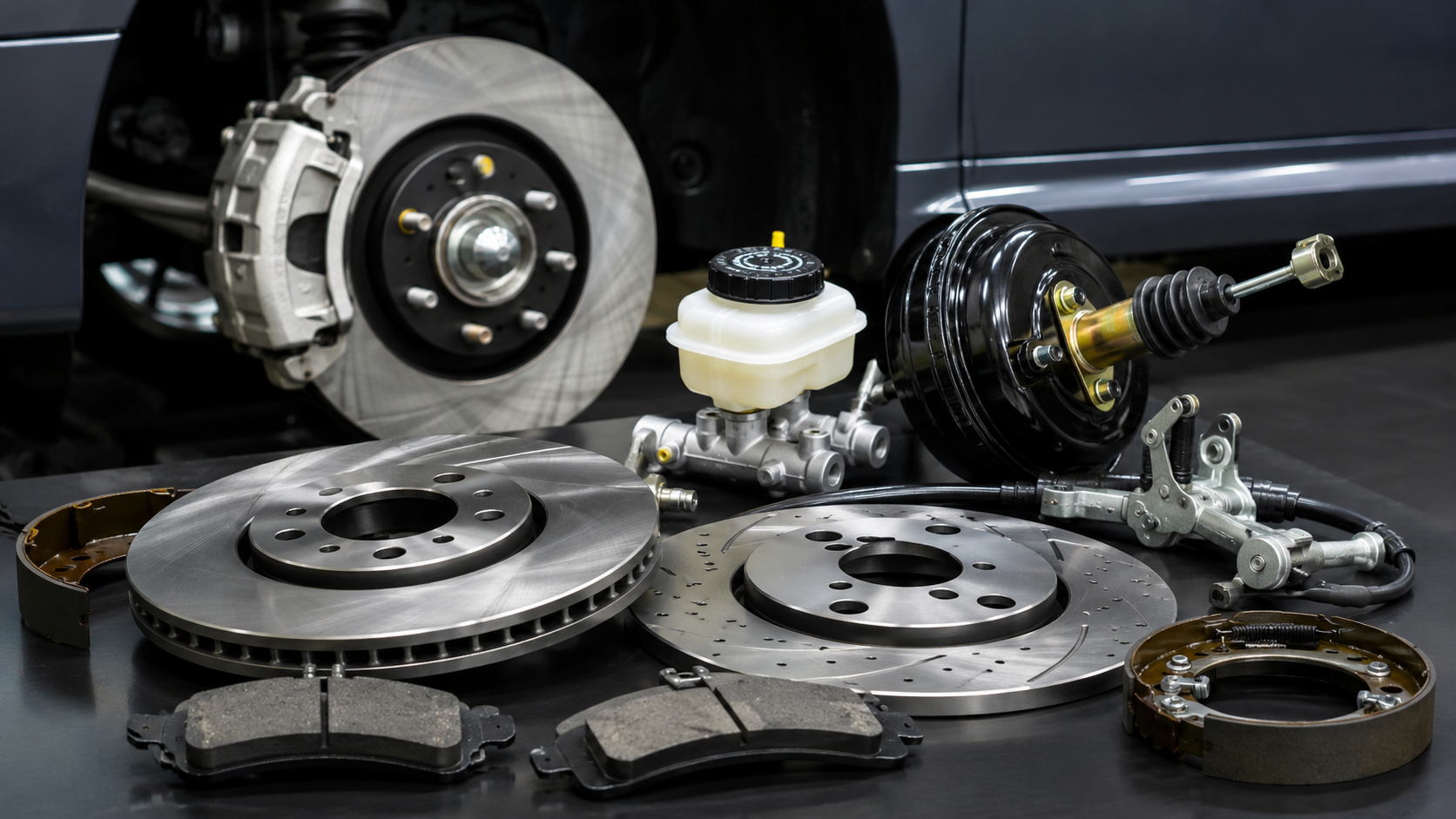
Your car's braking system is the single most important safety feature on the vehicle. Not the airbags. Not the crumple zones. The brakes. Everything else handles what happens after things go wrong. The brakes are what stop things from going wrong in the first place.
Most drivers press the pedal and move on. But what actually happens between that pedal input and a full stop involves multiple systems working in sequence, sometimes in less than a second. Understanding those systems isn't just trivia. It helps you know what to listen for, what to maintain, and why some cars stop better than others.
Here is every type of braking system found in cars, broken down clearly.
How Braking Works at a Basic Level
All braking is about energy conversion. A moving car has kinetic energy. To stop it, that energy has to go somewhere. In conventional systems, it gets converted into heat through friction. The harder the stop, the more heat generated. That is why brake fade exists, and why engineers have spent decades designing systems that manage heat better, distribute force more intelligently, and recover energy rather than simply losing it.
Mechanical Braking System
Mechanical brakes are the oldest type. They use a system of cables, rods, levers, and linkages to physically transmit force from the driver's input to the brake shoes or pads at the wheel. No fluid, no electronics.
This is exactly how early automobiles worked. By the mid-1930s, mechanical brakes were largely replaced by hydraulic systems for the primary service brake because they simply couldn't generate enough force for heavier, faster vehicles. Today, the mechanical braking principle lives on in one very specific application: the parking brake. When you pull that handbrake lever or press the parking brake pedal, a cable physically locks the rear brakes in place. Simple, reliable, and independent from the hydraulic system.
Hydraulic Braking System
Hydraulic brakes are the foundation of nearly every modern car's primary braking system. When you press the brake pedal, a piston inside the master cylinder pressurizes brake fluid. That pressurized fluid travels through sealed brake lines to wheel cylinders or calipers at each wheel, activating the friction components that slow the car down.
The physics at work here is Pascal's Law: pressure applied to a confined fluid transmits equally in all directions. This means a relatively small input force at the pedal translates into significant clamping or pushing force at each wheel. It is consistent, powerful, and far more reliable than mechanical linkages under load. The two main types of brakes that operate within a hydraulic system are disc brakes and drum brakes.
Disc Brakes
Disc brakes are the standard on the front wheels of virtually every passenger car sold today, and on all four wheels of most modern and performance-oriented vehicles.
The system consists of a metal rotor that spins with the wheel, a caliper mounted around it, and two brake pads that sit on either side of the rotor. When hydraulic pressure arrives at the caliper, pistons push the pads inward, clamping them against both faces of the spinning rotor. Friction slows the rotor, and therefore the wheel.
What makes disc brakes effective is heat management. Because the rotor is exposed to airflow, heat generated during braking dissipates into the air rather than building up inside a closed housing. This dramatically reduces brake fade during repeated or hard stops. Wet performance is also better, since the rotor sheds water with each rotation. Front wheels handle between 60 and 80 percent of total braking force, which is why front disc brakes became universal first, even on budget vehicles.
Drum Brakes
Drum brakes predate disc brakes, first appearing in 1900. They work from the inside out. A cylindrical drum is bolted to the wheel hub and rotates with it. Inside the drum, a pair of curved brake shoes are mounted on a fixed backing plate. When hydraulic pressure reaches the wheel cylinder inside the drum, it pushes pistons outward, forcing the shoes against the inner surface of the drum. Friction slows the wheel.
The main advantage of drum brakes is cost. They are cheaper to manufacture and integrate naturally with cable-operated parking brakes. Their enclosed design also protects internal components from debris on the road.
The drawbacks are meaningful. Heat builds up inside the drum with nowhere to go, which leads to faster brake fade. Wet weather can allow water to collect inside, reducing effectiveness and promoting corrosion. Because the rear wheels handle significantly less braking force than the front, drum brakes at the rear are a practical cost-saving measure for economy cars and light trucks without meaningfully compromising safety.
Anti-Lock Braking System (ABS)
ABS is not a separate brake type. It is an electronic safety layer built on top of the hydraulic system, and it has been mandatory on all new passenger vehicles sold in the European Union since 2004 and standard across most global markets since.
Speed sensors mounted at each wheel continuously monitor rotational rates while you brake. If a wheel is about to lock up, which is what causes skidding, the ABS control module rapidly modulates brake pressure to that wheel, releasing and reapplying it multiple times per second. The wheel keeps rotating instead of locking, and you retain steering control.
What ABS gives you is the ability to steer around an obstacle while braking hard. Without it, locking the wheels turns the car into a straight-line projectile with no ability to change direction.
Electronic Brake Force Distribution (EBD)
EBD works alongside ABS and electronic stability control (ESC) to intelligently manage how much braking force goes to each individual wheel in real time. The system accounts for road conditions, vehicle speed, passenger and cargo weight, and lateral forces during cornering.
A practical example: when braking through a corner, the outer tires carry more load than the inner ones. Applying equal brake force to all four wheels in this situation would lock up the lightly loaded inner tires. EBD prevents that by automatically adjusting brake pressure per wheel based on what the sensors are reading, improving both stopping distance and stability. It is active on virtually every car equipped with ABS.
Servo and Vacuum-Assisted Braking
Pushing a brake pedal hard enough to generate serious stopping force in a modern car without assistance would require considerable physical effort. Servo braking solves this. A vacuum booster, connected to the engine's intake manifold, creates a pressure differential across a diaphragm that multiplies your pedal input. The result is that a moderate push on the pedal produces far more hydraulic pressure at the calipers than your leg alone could generate. Most modern passenger cars use this as standard. Electric and hybrid vehicles use an electric vacuum pump or electro-hydraulic system instead, since they may not always have a running engine to produce intake vacuum.
Regenerative Braking
This is where electric and hybrid vehicles take a fundamentally different approach. In a conventionally braked car, all kinetic energy becomes waste heat. In a regenerative system, lifting off the throttle or pressing the brake pedal engages the electric motor in reverse, using it as a generator. The energy extracted from slowing the vehicle charges the high-voltage battery rather than being lost as heat.
The result is meaningfully extended range. In stop-and-go city driving, a significant portion of energy that would otherwise vanish at the brake pads is recovered and reused. Regenerative braking works in tandem with the conventional hydraulic system, blending the two to deliver the stopping force the driver requests. More than 55 percent of electric vehicles now use advanced braking distribution systems that coordinate both regenerative and friction braking simultaneously.
Electromagnetic Braking
Electromagnetic brakes use magnetic flux to oppose wheel rotation without any mechanical contact. When an electrical current passes through a coil near a rotating disc, it generates eddy currents in the disc that resist its rotation, slowing it down. No pads, no shoes, no friction surfaces wearing out.
This technology is more common in trains, trams, and heavy industrial equipment than in passenger cars. Its main appeal is zero wear on friction components and quick response, making it well-suited to systems that stop frequently and at high speeds. In passenger cars, electromagnetic principles show up more often as part of hybrid and EV motor braking configurations rather than as a standalone wheel-level system.
Why It Matters to Know This
Most drivers go years without thinking about what happens when they press the brake pedal. That is honestly a testament to how well-engineered modern braking systems are. But knowing what you have under your car helps you understand why brake fluid should be flushed on schedule, why front pads wear faster than rear ones, why your ABS might pulse during a panic stop, and why your EV seems to slow itself down without you touching the pedal.
The best braking system is one you never have to think about. Understanding it is what keeps it that way.
For more such informative blogs, keep following AutoVoB.
 Turkish
 English
 Arabic
 French
 Spanish
 Portuguese
 Deutsch
 Dutch
Dutch
 Italiano
 Russian
 Romaian
 Portuguese (Brazil)
 Greek
Greek
