


 Ban & Monetization Policy
 MyLiveRoom Rewards Program Rules & Eligibility
ICO vs IDO: A Complete Guide to Choosing the Best Token Fundraising Model
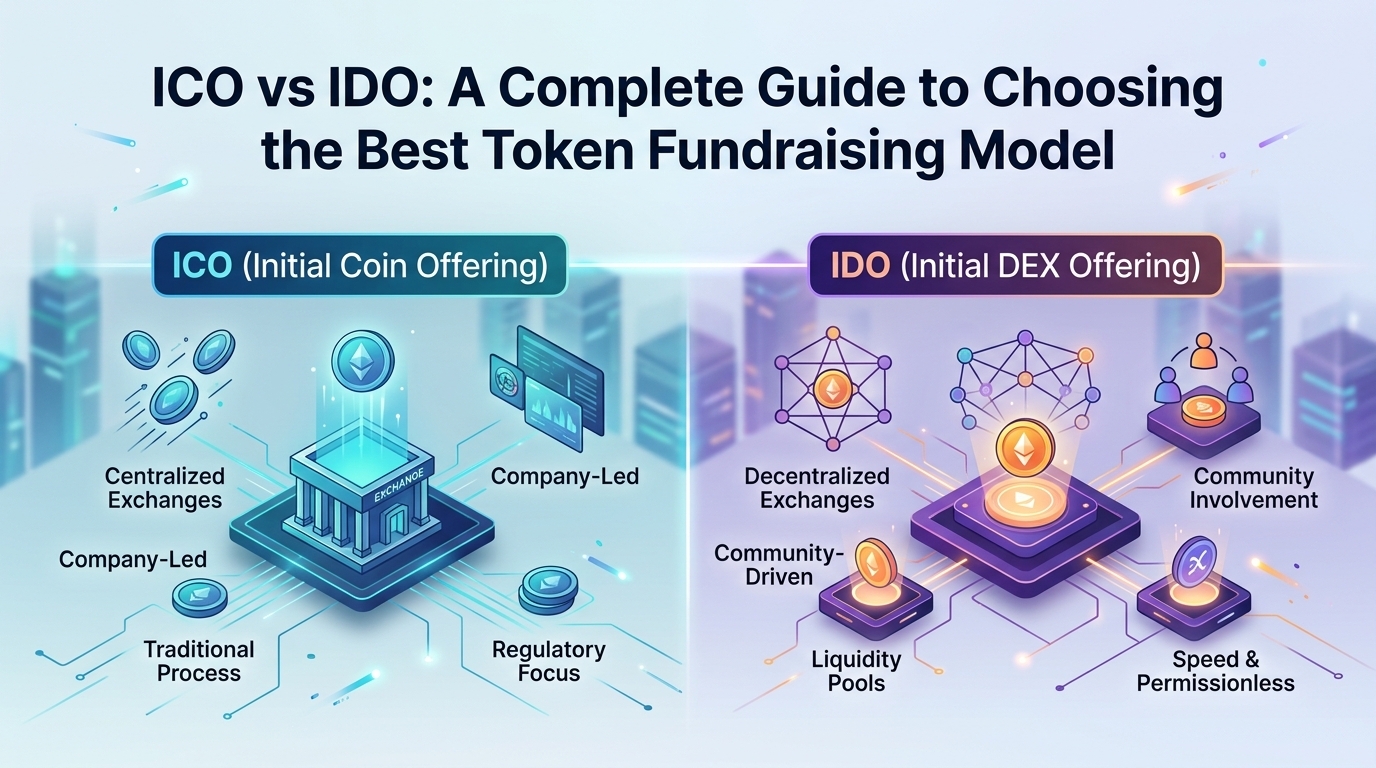
Blockchain fundraising has transformed significantly since the early days of cryptocurrency. In 2017, Initial Coin Offerings (ICOs) revolutionized startup financing by allowing blockchain projects to raise millions of dollars directly from global investors without relying on traditional venture capital. While the ICO boom demonstrated the immense potential of decentralized fundraising, it also exposed major weaknesses, including fraudulent projects, lack of transparency, regulatory uncertainty, and poor investor protection.
As decentralized finance (DeFi) matured, Initial DEX Offerings (IDOs) emerged as a more transparent and decentralized alternative. Rather than relying on centralized websites and manual token distribution, IDOs leverage decentralized exchanges (DEXs) and automated smart contracts to facilitate token sales while providing immediate liquidity.
Today, founders launching blockchain projects face an important decision: Should they conduct an ICO or choose an IDO?
The answer depends on several factors, including fundraising objectives, community size, regulatory strategy, liquidity requirements, tokenomics, and long-term ecosystem development. Understanding the strengths and limitations of each fundraising model enables blockchain startups to select the approach that best aligns with their business goals.
This guide explores ICOs and IDOs in detail, comparing their advantages, risks, operational differences, costs, and ideal use cases to help founders make informed fundraising decisions.
Understanding Initial Coin Offerings (ICOs)
An Initial Coin Offering (ICO) is a fundraising method in which blockchain projects sell newly created tokens directly to investors before the product or ecosystem becomes fully operational.
During an ICO, investors typically purchase tokens using cryptocurrencies such as Bitcoin, Ethereum, or stablecoins. Funds raised are used to finance product development, infrastructure, security, marketing, legal compliance, and ecosystem expansion.
Unlike traditional venture capital financing, ICOs allow projects to reach global participants without geographical restrictions. This democratization of fundraising helped accelerate blockchain innovation by enabling startups to access capital from retail investors worldwide.
A typical ICO process includes:
-
Whitepaper publication
-
Tokenomics design
-
Smart contract deployment
-
Website launch
-
Marketing campaign
-
Community building
-
Private sale
-
Public token sale
-
Token distribution
-
Exchange listings
Some of the most successful blockchain networks began through ICOs. Ethereum raised approximately $18 million in 2014, while projects such as EOS and Filecoin later secured hundreds of millions of dollars through token sales. These fundraising events demonstrated the ability of blockchain technology to attract substantial global investment.
However, the rapid growth of ICOs also resulted in numerous fraudulent schemes, unrealistic promises, and abandoned projects. Regulatory agencies across multiple jurisdictions responded by increasing scrutiny over token offerings, making compliance an increasingly important aspect of modern ICOs.
Understanding Initial DEX Offerings (IDOs)
An Initial DEX Offering (IDO) is a token launch conducted through a decentralized exchange rather than a project's own fundraising platform.
Instead of collecting investor funds manually and distributing tokens later, IDOs utilize automated smart contracts that execute token sales transparently on blockchain networks.
Once an IDO concludes, liquidity pools are generally established immediately on the decentralized exchange, allowing investors to trade tokens without waiting for centralized exchange approvals.
Most IDOs are launched on established launchpads that review projects before listing them. These launchpads often require projects to undergo smart contract audits, community verification, and technical evaluations before fundraising begins.
Popular blockchain ecosystems supporting IDOs include Ethereum, BNB Chain, Solana, Polygon, Avalanche, Arbitrum, and Base.
The typical IDO workflow includes:
-
Smart contract audit
-
Launchpad approval
-
Community whitelisting
-
Token sale
-
Automatic token allocation
-
Liquidity pool creation
-
Immediate secondary market trading
The decentralized nature of IDOs reduces reliance on intermediaries while providing transparent on-chain records that investors can independently verify.
ICO vs IDO: Key Differences
Although both fundraising models involve selling blockchain tokens, their operational structures differ considerably.
| Feature | ICO | IDO |
|---|---|---|
| Token sale platform | Project website | Decentralized exchange |
| Liquidity | Usually delayed | Immediate after launch |
| Token distribution | Manual or scheduled | Automated through smart contracts |
| Trading availability | Exchange listing required | Instant DEX trading |
| Intermediaries | Project-managed | Launchpad and DEX ecosystem |
| Transparency | Depends on project | Fully visible on-chain |
| Community participation | Often open globally | Frequently whitelist-based |
| Regulatory oversight | Higher compliance burden | Varies by jurisdiction |
These structural differences significantly influence investor confidence, fundraising speed, and long-term token performance.
Advantages of ICOs
ICOs remain attractive for projects requiring greater flexibility over fundraising operations.
One major advantage is complete control over the fundraising process. Project teams determine pricing structures, allocation schedules, vesting mechanisms, bonus programs, and investor eligibility without depending on third-party launchpads.
ICOs also enable customized fundraising strategies. Teams can organize multiple funding rounds—including seed, private, strategic, and public sales—to accommodate different investor groups.
Another benefit is the ability to raise substantial capital before listing on exchanges. Large infrastructure projects often require extensive funding for protocol development, security audits, compliance, and ecosystem incentives.
Additional ICO advantages include:
-
Flexible fundraising structure
-
Custom token distribution
-
Multiple investment rounds
-
Strong branding opportunities
-
Direct investor communication
-
Greater pricing control
-
Scalable fundraising campaigns
For well-established blockchain companies with experienced legal and compliance teams, ICOs remain an effective fundraising mechanism.
Advantages of IDOs
IDOs address many of the limitations associated with traditional ICOs.
Immediate liquidity is perhaps the biggest advantage. Once fundraising concludes, investors can trade tokens instantly through decentralized liquidity pools rather than waiting weeks or months for centralized exchange listings.
Transparency is another major strength. Every transaction—including fundraising, allocations, liquidity creation, and token transfers—is recorded on the blockchain, significantly reducing information asymmetry.
Lower operational costs also make IDOs attractive for startups. Launchpads often provide integrated infrastructure for whitelisting, token distribution, smart contract management, and liquidity deployment.
Additional IDO benefits include:
-
Instant liquidity
-
Automated token distribution
-
Decentralized participation
-
Lower infrastructure costs
-
Increased investor trust
-
Transparent fundraising
-
Reduced reliance on centralized exchanges
The combination of transparency and efficiency has made IDOs particularly popular among DeFi projects and community-driven ecosystems.
Choosing Between an ICO and an IDO
Selecting the appropriate fundraising model requires evaluating the project's maturity, financial objectives, technical capabilities, and community readiness.
An ICO may be preferable if:
-
The project requires substantial capital before launch.
-
Multiple private investment rounds are planned.
-
Strong legal and compliance resources are available.
-
Institutional investors are a primary target.
-
Long-term fundraising flexibility is essential.
An IDO may be the better choice if:
-
The project has an active Web3 community.
-
Immediate token liquidity is important.
-
Decentralized governance is a priority.
-
Lower fundraising costs are desired.
-
The product is closely integrated with DeFi ecosystems.
Many successful blockchain startups now combine fundraising approaches by conducting private seed rounds before launching public IDOs. This hybrid strategy balances early capital formation with decentralized community participation.
The Importance of Tokenomics Regardless of Fundraising Model
Whether a project chooses an ICO or an IDO, sustainable tokenomics ultimately determines long-term success.
Poor token design can undermine even the most successful fundraising campaign. Excessive circulating supply, weak utility, unfair allocations, or inadequate vesting schedules often lead to rapid sell-offs and declining investor confidence.
Effective tokenomics should define:
-
Token utility within the ecosystem
-
Supply mechanisms
-
Inflation or deflation strategy
-
Vesting schedules
-
Governance participation
-
Staking incentives
-
Treasury allocation
-
Ecosystem rewards
Projects that align token incentives with network growth generally build stronger communities and achieve greater long-term sustainability than those relying solely on speculative demand.
Emerging Trends in Token Fundraising
Blockchain fundraising continues to evolve as technology and regulations mature.
Many projects now incorporate decentralized autonomous organizations (DAOs) into fundraising governance, allowing token holders to participate in ecosystem decisions.
Cross-chain fundraising is becoming increasingly common, enabling projects to raise capital across multiple blockchain networks while expanding their user base.
Artificial intelligence is also improving investor analytics, fraud detection, and community engagement throughout fundraising campaigns.
Meanwhile, regulators worldwide are gradually introducing clearer digital asset frameworks, encouraging projects to integrate compliance into fundraising from the earliest development stages.
Future token launches are expected to combine decentralized infrastructure, stronger regulatory alignment, enhanced transparency, and community governance to create more sustainable fundraising ecosystems.
Conclusion
Choosing between an ICO and an IDO is not simply a technical decision it is a strategic choice that influences fundraising success, investor confidence, liquidity, and long-term ecosystem growth. ICOs provide flexibility, customized fundraising structures, and the potential to attract significant capital, making them well suited for mature projects with strong compliance capabilities. IDOs, on the other hand, emphasize decentralization, transparency, immediate liquidity, and community participation, making them ideal for DeFi protocols and Web3 startups seeking rapid market adoption. Regardless of the fundraising model selected, success ultimately depends on sustainable tokenomics, regulatory preparedness, robust smart contract security, and effective community engagement. Organizations such as Blockchain App Factory help blockchain startups navigate every stage of token fundraising by delivering end-to-end ICO and IDO development services, including token creation, launchpad integration, smart contract development, compliance support, and strategic consulting to maximize fundraising success.
 Deutsch
 English
 Arabic
 French
 Spanish
 Portuguese
 Turkish
 Dutch
Dutch
 Italiano
 Russian
 Romaian
 Portuguese (Brazil)
 Greek
Greek
