


 Ban & Monetization Policy
 MyLiveRoom Rewards Program Rules & Eligibility
The Rise of Decision Intelligence in Modern Supply Chains
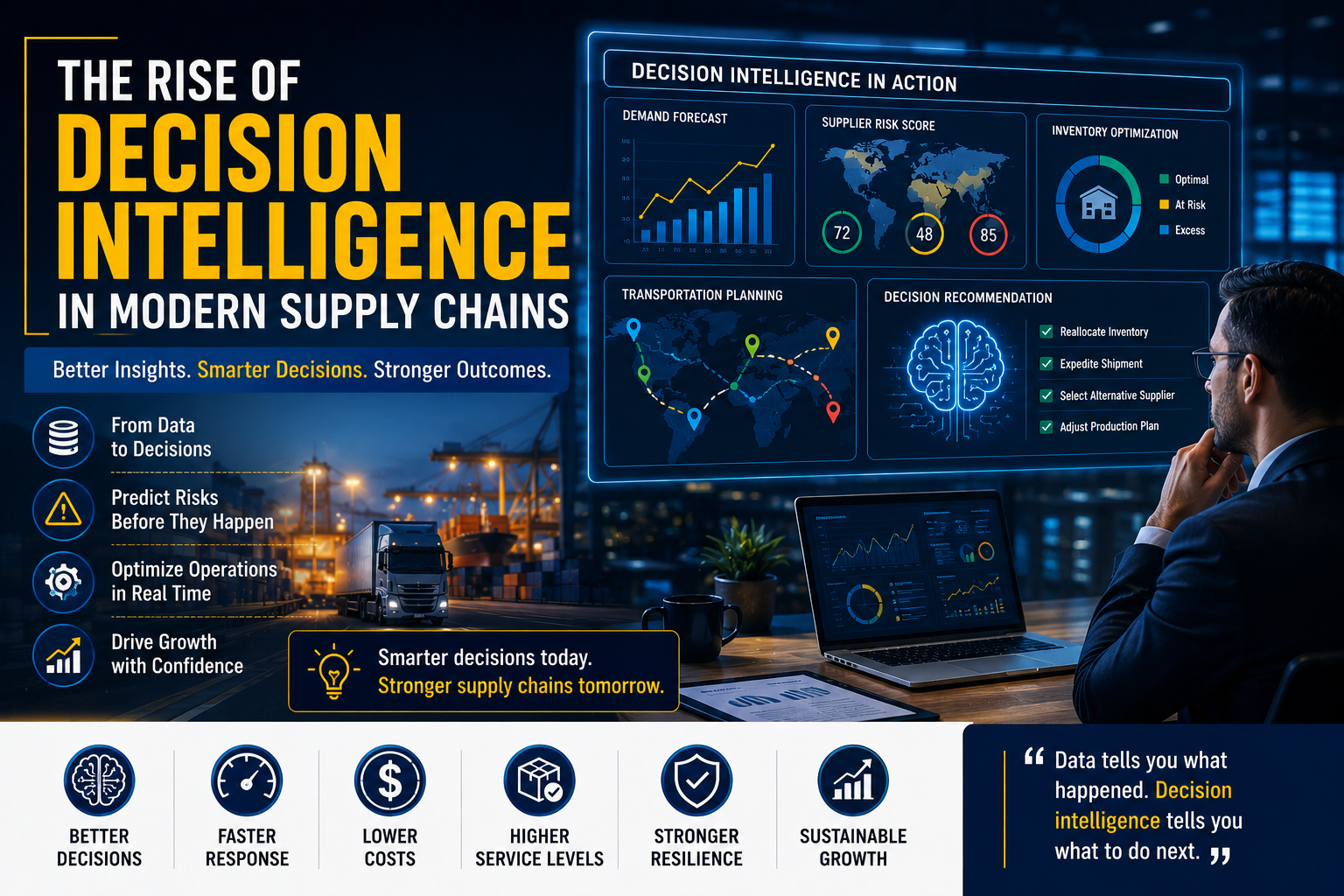
Businesses invested heavily in dashboards, tracking platforms, reporting tools, and real time alerts. The assumption was straightforward. If leaders could see everything happening across suppliers, warehouses, ports, and transportation networks, better decisions would naturally follow.
Unfortunately, visibility solved only half of the problem.
Knowing that a shipment will arrive late does not tell a business how to respond. Seeing inventory levels fall below target does not automatically identify the best replenishment strategy. Recognizing supplier risk does not determine which alternative vendor should receive future orders.
The competitive advantage is no longer information.
The competitive advantage is decision quality.
The Shift From Data Collection to Decision Quality
Modern supply chains generate extraordinary amounts of information every minute.
Inventory systems update continuously. Transportation providers provide shipment visibility in real time. Procurement teams monitor supplier performance scores while demand forecasting engines process thousands of customer transactions simultaneously.
Executives are drowning in information while often struggling to make faster decisions.
Decision intelligence changes the conversation by focusing less on what happened and more on what should happen next.
Instead of generating another dashboard, intelligent systems evaluate scenarios, compare outcomes, and recommend actions based on business priorities.
That shift may become one of the most important operational changes of this decade.
What Decision Intelligence Actually Looks Like
Imagine a supplier disruption occurs in Asia.
A traditional supply chain identifies the delay after it happens.
A decision intelligence platform reacts differently.
The system evaluates alternative suppliers, analyzes inventory positions across facilities, reviews customer demand forecasts, estimates revenue exposure, calculates freight costs, and recommends the most profitable response before executives even schedule a meeting.
The same principle applies to:
- Inventory allocation decisions.
- Carrier selection strategies.
- Procurement timing.
- Production planning.
- Warehouse capacity management.
- Distribution network optimization.
This is where businesses increasingly seek guidance from experienced 3PL logistics consulting services providers, third party logistics advisory specialists, and outsourced logistics strategy experts capable of aligning technology investments with operational goals.
Why Traditional Processes Are Becoming a Bottleneck
Many organizations still rely on decision making processes designed for a slower business environment.
Weekly meetings.
Monthly reports.
Spreadsheet driven planning.
Manual approvals.
Those methods worked when supply chains moved slower and disruptions were less frequent.
Today's markets operate differently.
Port congestion, geopolitical uncertainty, supplier failures, extreme weather events, and changing customer demand patterns can affect operations within hours rather than weeks.
Businesses that react faster often outperform businesses with lower operating costs.
Artificial Intelligence Is Becoming an Operational Partner
Artificial intelligence is no longer limited to forecasting demand or predicting delays.
Leading organizations now use AI to support:
- Dynamic inventory positioning.
- Supplier risk scoring.
- Transportation optimization.
- Procurement recommendations.
- Production scheduling.
- Revenue protection decisions.
This does not mean humans disappear from the process.
It means supply chain professionals spend less time gathering information and more time evaluating strategic tradeoffs.
Organizations investing in 3PL consulting expertise, freight optimization advisors, and supply network transformation specialists are often better positioned to integrate these capabilities successfully because technology alone rarely fixes broken processes.
The Financial Case for Better Decisions
Businesses often focus heavily on reducing freight costs or lowering inventory levels.
Decision quality can be equally valuable.
Faster and more accurate decisions can improve:
- Customer service performance.
- Working capital utilization.
- Forecast accuracy.
- Inventory efficiency.
- Supplier reliability.
- Revenue protection during disruptions.
A single avoided stockout or production interruption can often justify years of technology investment.
Human Expertise Still Matters
The rise of decision intelligence does not reduce the importance of experienced professionals.
It changes where they create value.
Future supply chain leaders will spend less time collecting information and more time focusing on strategy, supplier relationships, business growth initiatives, and scenario planning.
Technology improves speed.
People provide judgment.
The strongest organizations combine both.
Businesses interested in how operational expertise contributes to stronger supply chains can explore additional perspectives in Why Logistics Consultants Drive Business Growth.
Leaders preparing for increasingly volatile markets may also find useful insights in Predictable Supply Chains Are Over. Now What?.
The Next Competitive Divide
Over the next several years, the market is likely to separate organizations into two groups.
The first group will continue relying on historical reporting and manual decision making.
The second group will use predictive intelligence, scenario modeling, and automated recommendations to make decisions faster and with greater confidence.
The gap between these two groups may become one of the defining competitive differences of the next decade.
Final Thoughts
Supply chains have already won the battle for visibility.
The next challenge is intelligence.
Businesses that can transform operational data into faster, smarter, and more profitable decisions will create advantages that competitors struggle to replicate.
As this transition accelerates, demand will continue growing for experienced 3PL logistics consulting services, logistics strategy consultants, supply chain advisory specialists, and distribution optimization experts capable of converting technology investments into measurable business outcomes.
 English
 Arabic
 French
 Spanish
 Portuguese
 Deutsch
 Turkish
 Dutch
Dutch
 Italiano
 Russian
 Romaian
 Portuguese (Brazil)
 Greek
Greek
