


 Ban & Monetization Policy
 MyLiveRoom Rewards Program Rules & Eligibility
On-Device AI in Mobile Apps: Benefits, Use Cases, and Development Challenges
Key Takeaways
-
Understand on-device AI: See how processing data directly on smartphones improves speed, privacy, and offline functionality.
-
Explore real-world applications: Learn how businesses use AI in mobile apps for personalization, security, voice assistance, and image recognition.
-
Know the development challenges: Review key technical considerations for building AI-powered mobile apps, such as performance, security, and model optimization.
-
Build future-ready applications: Discover how expert mobile app development services support successful AI integration in modern apps.
Artificial intelligence is a major driver of mobile innovation. Features like personalized recommendations, chatbots, voice assistants, and image recognition are transforming user interactions. While AI processing was once limited to the cloud and required internet connectivity, advances in mobile hardware now allow many AI models to run directly on smartphones and tablets.
This shift to on-device AI is changing mobile app development. By processing information locally instead of relying solely on cloud servers, apps deliver faster responses, enhanced privacy, and improved offline functionality. As organizations invest in digital transformation, mobile app development services are increasingly incorporating AI to create smarter, more responsive applications.
This guide covers the fundamentals of on-device AI, its role in mobile app development, implementation strategies, key advantages, practical use cases, and development challenges.
What Is AI in Mobile App Development?
AI in mobile app development involves integrating AI technologies into mobile applications to automate tasks, analyze data, make predictions, and deliver personalized user experiences.
Rather than simply responding to user inputs, AI-powered applications can recognize speech, identify images, understand user behavior, recommend content, detect fraud, and continuously improve their performance based on usage patterns.
Modern mobile app development services combine AI technologies with user-centric design to build applications that are more intelligent, efficient, and adaptive than traditional mobile apps.
How to Use AI in Mobile Apps
Many businesses seek ways to use AI in mobile app development to enhance customer engagement.
AI can be integrated into mobile applications in several ways:
-
Personalized product and content recommendations.
-
Voice assistants and speech recognition.
-
AI-powered search.
-
Smart chatbots and virtual assistants.
-
Image and facial recognition.
-
Predictive analytics.
-
Fraud detection.
-
Language translation.
-
Smart notifications.
-
Automated workflow assistance.
Select AI capabilities based on the application's purpose, target audience, and business objectives.
What Is On-Device AI?
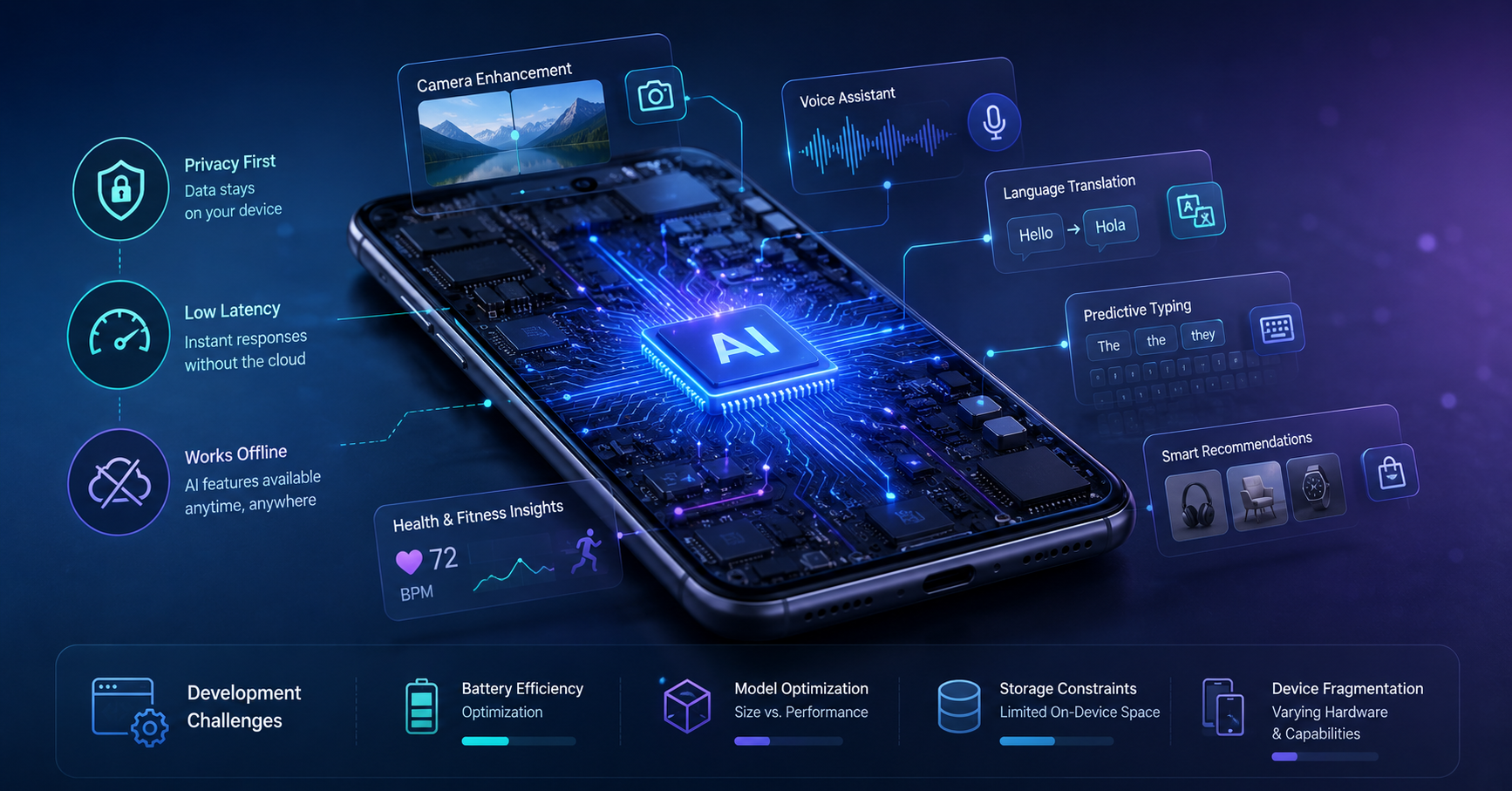
On-device AI runs artificial intelligence models directly on a mobile device rather than sending data to cloud servers for processing.
Modern smartphones feature dedicated AI hardware, such as Neural Processing Units (NPUs), enabling complex machine learning models to operate locally.
By performing AI tasks directly on the device, applications avoid transmitting sensitive user information over the internet, resulting in:
-
Faster response times.
-
Lower latency.
-
Better privacy.
-
Reduced internet dependency.
-
Improved offline functionality.
This approach is increasingly important as users expect instant and secure mobile experiences.
Benefits of On-Device AI
Faster Performance
With on-device AI, users receive results almost instantly without waiting for cloud communication.
Applications become more responsive, improving overall user satisfaction. One benefit of on-device AI is enhanced data privacy.
Sensitive data such as images, voice recordings, and personal preferences remain on the user's device instead of being sent to external servers.
This approach reduces privacy concerns and supports regulatory compliance.
Offline Functionality
Cloud-based AI depends on internet connectivity.
On-device AI allows applications to perform intelligent tasks without internet access, making it valuable for travel, healthcare, field services, and remote work environments.
Lower Cloud Costs
Processing AProcessing AI locally reduces requests to cloud infrastructure. can lower server workloads while improving application performance.
Better User Experience
Applications are faster, more reliable, and more personalized when AI operates locally.
This significantly increases customer engagement and retention.
Popular Use Cases of AI in Mobile Apps
Businesses across industries use AI in mobile apps to enhance customer experiences and operational efficiency.
Retail and streaming platforms use AI to recommend products, movies, music, and other content based on user preferences.
Voice Assistants
AI enables hands-free interaction using natural language processing and speech recognition.
Image Recognition
Healthcare, retail, and manufacturing apps use AI to identify products, scan documents, recognize objects, and analyze images.
Fraud Detection
Financial apps monitor user behavior to detect suspicious transactions and prevent fraud in real time.
Predictive Text and Smart Replies
Messaging apps use AI to suggest responses and improve typing speed.
Health Monitoring
Fitness and healthcare apps analyze activity, heart rate, sleep, and wellness data to deliver personalized recommendations.
Generative AI in Mobile App Development
The rapid growth of generative AI in mobile app development is creating entirely new user experiences.
Generative AI enables applications to:
-
Generate text.
-
Create images.
-
Summarize documents.
-
Answer customer questions.
-
Produce personalized recommendations.
-
Assist users with content creation.
Businesses are integrating generative AI into customer support, education, ecommerce, productivity tools, and enterprise apps to improve user engagement and automate repetitive tasks.
As AI models evolve, generative AI in mobile app development will play a growing role in creating intelligent digital experiences.
Development Challenges of On-Device AI
Although on-device AI offers significant advantages, developers must address several technical challenges. On-device AI models have less computing power than cloud servers.
AI models must be optimized to run efficiently without affecting app performance.
Battery Consumption: Continuous AI processing can increase battery usage if models are not optimized.d.
Storage Requirements: Some AI models require significant storage space, so model compression and optimization are important.t.
Device Compatibility
Smartphones vary in their AI hardware capabilities.
Developers must ensure consistent performance across devices. Like cloud AI, updating on-device models requires careful version management to ensure users always receive the latest improvements.
Best Practices for Building AI-Powered Mobile Apps
Organizations planning AI-powered mobile app development should follow several best practices.
-
Clearly define business objectives before selecting AI features.
-
Use lightweight AI models for mobile performance.
-
Prioritize user privacy and security.
-
Optimize applications for battery efficiency.
-
Test AI functionality across multiple devices.
-
Combine cloud AI with on-device AI when appropriate.
-
Continuously monitor and improve AI model performance.
These practices help businesses deliver reliable, scalable AI-powered applications.
How Evince Development Helps Businesses Build AI-Powered Mobile Applications
Integrating AI successfully requires expertise in mobile development, machine learning, cloud technologies, and user experience design. At Evince Development, we help businesses build secure, scalable, and intelligent mobile applications using the latest AI technologies. Our team delivers tailored solutions for personalized recommendations, intelligent automation, computer vision, and generative AI, ensuring alignment with business goals and exceptional user experiences.
Conclusion
Artificial intelligence is redefining the capabilities of mobile applications. By processing AI directly on devices, businesses deliver faster performance, stronger privacy, lower latency, and improved offline functionality. As mobile hardware evolves, on-device AI will become standard across industries, enabling smarter and more responsive digital experiences.
Organizations that invest in AI-powered mobile app development today will be better positioned to meet changing customer expectations and drive future innovation. With the right strategy and technology partner, businesses can build secure, scalable, and intelligent mobile applications ready for the next generation of digital transformation.
FAQs
What is AI in mobile app development?
AI in mobile app development is the use of technologies such as machine learning, natural language processing, and computer vision to enhance mobile app functionality and user experience.
How to use AI in mobile app development?
Businesses can integrate AI through chatbots, recommendation engines, voice recognition, predictive analytics, image recognition, fraud detection, and personalized user experiences.
What are the benefits of on-device AI?
On-device AI offers faster performance, improved privacy, offline functionality, reduced cloud dependency, and better overall user experiences.
What is generative AI in mobile app development?
Generative AI in mobile app development enables applications to generate text, images, summaries, recommendations, and conversational responses using advanced AI models.
Why choose professional mobile app development services for AI integration?
Experienced mobile app development services ensure that AI features are securely implemented, optimized for performance, and aligned with business objectives, resulting in scalable, future-ready mobile applications.
 English
 Arabic
 French
 Spanish
 Portuguese
 Deutsch
 Turkish
 Dutch
Dutch
 Italiano
 Russian
 Romaian
 Portuguese (Brazil)
 Greek
Greek
