


 Ban & Monetization Policy
 MyLiveRoom Rewards Program Rules & Eligibility
AI Agent Product Development: How to Build Agentic AI Products for Business
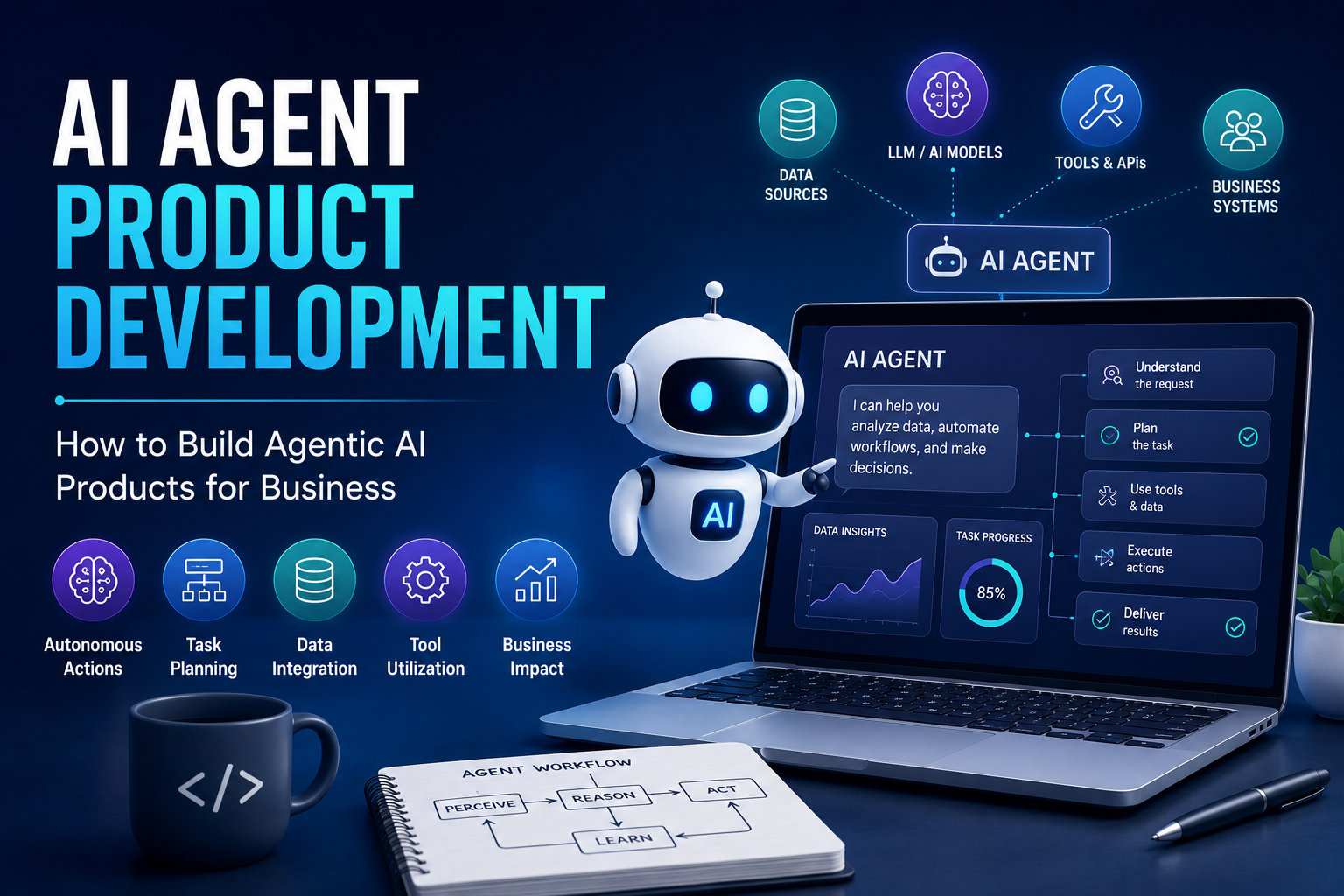
Businesses are moving beyond simple chatbots toward AI systems that can plan tasks, use tools, access business data, and complete multi-step workflows. AI agent product development focuses on building these systems into reliable products that support real business operations. Successful agentic AI product development requires clear use cases, controlled autonomy, secure integrations, and measurable outcomes for enterprise AI agents deployed into live workflows.
What Is AI Agent Product Development?
This differs from standard automation or conversational AI because an agent doesn't just respond; it plans steps, invokes tools, retrieves data, and executes a workflow with some degree of autonomy. Custom AI agent development typically covers a mix of these capabilities:
-
Task planning across multiple steps
-
Tool usage to take real actions
-
Data retrieval from business systems
-
Decision support based on live information
-
Workflow execution rather than a single response
-
Human approval built in for sensitive actions
Why Businesses Are Building Agentic AI Products
Agentic AI product development is gaining traction because it solves problems a simple chatbot can't touch. Enterprise AI agents are increasingly used for:
-
Automating multi-step internal processes
-
Speeding up customer support resolution
-
Assisting with research and information gathering
-
Monitoring operations and flagging anomalies
-
Increasing employee productivity on repetitive tasks
-
Supporting faster, data-driven decisions
Define the Right Business Use Case
Custom AI agent development works best when it starts with one focused workflow rather than trying to automate an entire department at once.
-
How much business value does this specific workflow create?
-
Is the required data actually available and accessible?
-
How complex is the task, realistically?
-
What's the risk level if the agent gets something wrong?
-
What integrations does the workflow require?
-
How much human oversight does this task need?
Many teams bring in AI agent development services at this stage specifically to help scope the first use case correctly, since a poorly chosen starting point can sink confidence in the whole initiative.
Understand the AI Agent Development Process
The AI agent development process generally follows a consistent sequence:
-
Define the business objective
-
Map the workflow in detail
-
Identify required data and tools
-
Select suitable AI models
-
Design agent behavior and boundaries
-
Build integrations
-
Add guardrails
-
Test and deploy
-
Monitor performance
Following these steps in order, rather than skipping to development first, is what separates AI agent product development that ships successfully from projects that stall in testing.
Design a Reliable AI Agent Architecture
A dependable AI agent architecture usually includes a language model, a prompt and instruction layer, memory, knowledge retrieval, tool integrations, workflow orchestration, permissions, monitoring, and human approval controls. A good setup matches the complexity of the task at hand; a simple internal tool doesn't need the same orchestration layer as a customer-facing agent handling sensitive data.
Add Security, Governance, and Human Oversight
Security and governance can't be an afterthought once an agent has real access to business systems. Role-based access, data privacy controls, and tool permissions need to be defined before launch, alongside audit logs and output validation. Approval workflows and hallucination controls matter most for high-risk actions: agents should recommend or prepare an action rather than execute it without human review, and usage monitoring should run continuously after launch.
Test the Agent Before Deployment
Testing an agentic product properly means going well beyond a simple demo. Real testing should cover task completion accuracy, tool selection quality, response quality, and failure handling, as well as security boundaries, cost per task, response time, and escalation behavior. AI agent development services that skip realistic scenarios in favor of simple demonstrations often miss the failure modes that real users uncover.
Measure Business Performance
Once live, these systems need clear metrics tied to business outcomes, not just technical performance:
-
Time saved per task or workflow
-
Number of tasks completed successfully
-
Accuracy and error rate
-
Escalation rate to a human
-
User adoption over time
-
Cost per workflow
-
Customer satisfaction where relevant
Choose the Right AI Development Partner
Evaluate a provider offering AI product development services on real agentic AI experience, not just general AI familiarity. Look for AI agent development services with genuine model and platform flexibility, strong integration capabilities, documented security practices, a clear testing process, an established monitoring approach, and post-launch support that extends beyond the initial deployment.
Conclusion
AI agent product development succeeds when a business starts with one well-scoped workflow, builds in the right guardrails, and treats agentic AI product development as an ongoing product rather than a one-time deployment. Whether you build this in-house or bring in AI product development services, the fundamentals stay the same: clear use cases, reliable architecture, and human oversight where it genuinely matters.
 Italiano
 English
 Arabic
 French
 Spanish
 Portuguese
 Deutsch
 Turkish
 Dutch
Dutch
 Russian
 Romaian
 Portuguese (Brazil)
 Greek
Greek
