


 Ban & Monetization Policy
 MyLiveRoom Rewards Program Rules & Eligibility
Shore Power Market Size, Growth, Trends, Forecast (2024-2032)
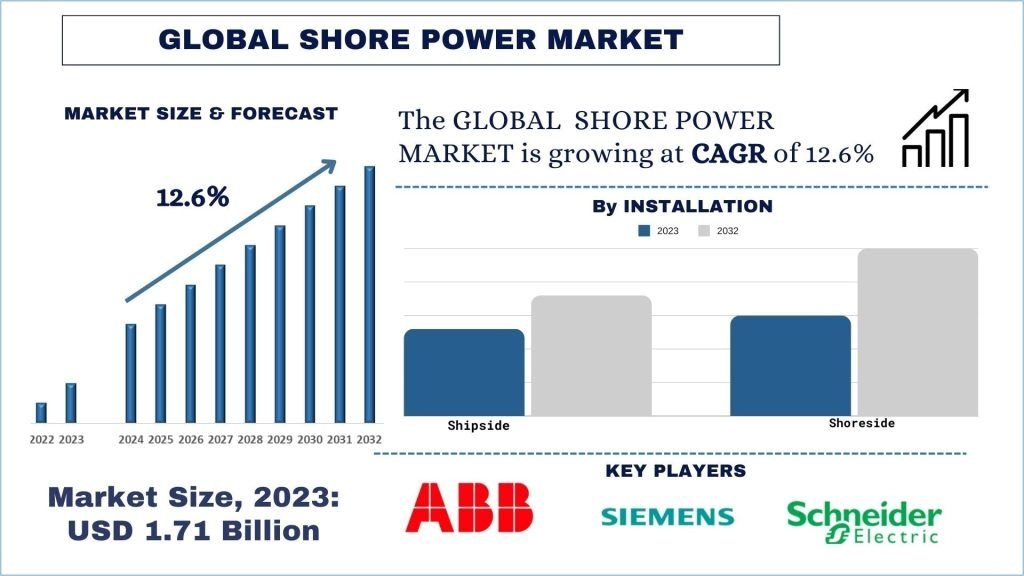
According to the UnivDatos, “Shore Power Market” report, the global market is at a CAGR of 12.6% during the forecast period from 2024 - 2032 to reach USD 4.91 billion by 2032.
The implementation of shore power initiatives has gained momentum across the globe to reduce emissions and improve sustainability in the maritime industry. Key players in this movement have been at the forefront of driving change through technological advancements, government policies, and strategic mergers.
How had initiatives taken by the key players are shaping the future of shore power?
Companies like ABB and Siemens have been leading the way in developing innovative solutions to make shore power more accessible and efficient for ports and vessels. ABB, for example, has developed advanced shore connection systems that allow ships to connect to the local power grid while in port, reducing their reliance on onboard generators and cutting emissions significantly. Similarly, Siemens has been actively developing smart grid technologies that optimize energy usage and reduce costs for ports and ships using shore power.
Further, in 2024, ABB announced to install of shore power to connect to suitably equipped vessels calling at Vlissingen’s DEME base by the end of 2024 as part of the “Temporary Shore Power Grant Scheme for Marine Vessels 2022 – 2023”, a government-supported initiative that stimulates the construction and use of shore power facilities in Dutch seaports.
In 2023, Siemen built two shore power facilities at the Ostuferhafen: a 50/60 Hz shore power facility for cruise ships and ferries and a 50 Hz shore power facility for ferries.
Furthermore, government policies have also played a crucial role in incentivizing the adoption of shore power. Countries like Norway and Sweden have been early adopters of shore power technology, offering subsidies and tax incentives to ports and shipping companies that invest in shore power infrastructure. In the United States, the California Air Resources Board (CARB) has mandated that certain ports provide shore power capabilities for vessels to reduce emissions in port areas. These policies have created a favorable environment for shore power initiatives' growth and encouraged other countries to follow suit.
In addition to technological advancements and government policies, strategic mergers and partnerships have fueled the expansion of shore power initiatives worldwide. Companies like Cavotec and Wärtsilä have joined forces to develop integrated shore power solutions that offer seamless connectivity and high efficiency for ports and vessels. These collaborations have allowed for the creation of end-to-end shore power systems that are tailored to meet the specific needs of different ports and shipping companies, further driving the adoption of shore power technology.
Access sample report (including graphs, charts, and figures) - https://univdatos.com/reports/shore-power-market?popup=report-enquiry
Furthermore, recent initiatives taken by organizations like the International Maritime Organization (IMO) and the Global Maritime Forum have set ambitious targets to reduce greenhouse gas emissions in the maritime industry, further propelling the growth of shore power initiatives. These initiatives, coupled with the increasing awareness of sustainability issues among consumers and stakeholders, have created a strong momentum for the expansion of shore power technology globally.
Conclusion
In conclusion, the advancements in shore power technology, government policies, strategic mergers, and global initiatives have positioned shore power as a key solution for reducing emissions and promoting sustainability in the maritime industry. With key players driving innovation and collaboration, the future of shore power looks bright, paving the way for a cleaner and more sustainable maritime industry.
Contact Us:
Email - contact@univdatos.com
Website - www.univdatos.com
 Dutch
Dutch
 English
 Arabic
 French
 Spanish
 Portuguese
 Deutsch
 Turkish
 Italiano
 Russian
 Romaian
 Portuguese (Brazil)
 Greek
Greek
