


 Ban & Monetization Policy
 MyLiveRoom Rewards Program Rules & Eligibility
Revenue Cycle Management Market Size Projected to Reach USD 818.3 Billion by 2032
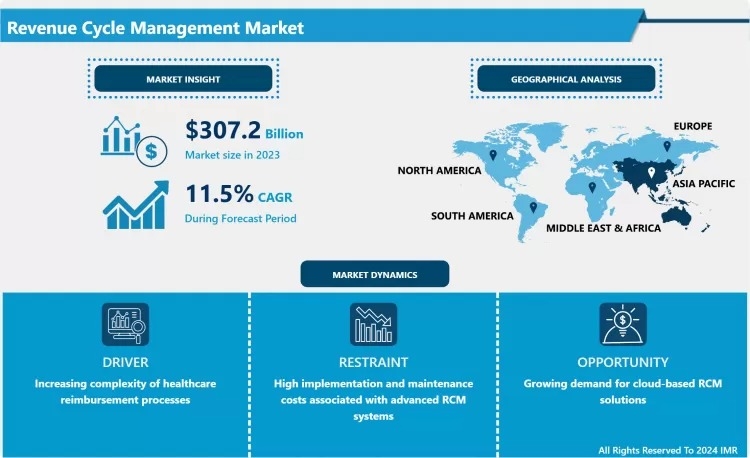
According to a new report published by Introspective Market Research, Revenue Cycle Management Market by Product, Component, Deployment, End-User, and Region, The Global Revenue Cycle Management Market Size Was Valued at USD 307.2 Billion in 2023 and is Projected to Reach USD 818.3 Billion by 2032, Growing at a CAGR of 11.5%.
Overview:
The global Revenue Cycle Management (RCM) market is a critical healthcare IT segment dedicated to managing the financial process of medical care, from patient registration and insurance verification to final payment collection. RCM solutions integrate administrative and clinical data to streamline the entire financial lifecycle of a patient encounter. Their primary advantage over fragmented, manual billing processes lies in their ability to automate complex workflows, reduce claim denials, accelerate reimbursements, and improve overall financial visibility and cash flow for healthcare providers. By replacing error-prone paper-based systems with integrated digital platforms, RCM enhances accuracy, ensures regulatory compliance, and directly impacts a provider's financial viability.
RCM systems are essential across the entire healthcare ecosystem. They are predominantly used by hospitals and health systems to manage high-volume, complex billing across multiple service lines and payers. Physician groups and outpatient clinics rely on RCM to handle claims efficiently and maintain practice profitability. Other key users include diagnostic laboratories, ambulatory surgical centers, and long-term care facilities. In an environment of shrinking margins and rising administrative costs, effective RCM is not merely a back-office function but a strategic imperative for healthcare organizations to ensure financial sustainability while focusing on patient care.
Growth Driver:
The foremost growth driver for the Revenue Cycle Management market is the relentless shift from traditional fee-for-service models to complex, value-based care (VBC) reimbursement structures. VBC models, which tie payments to patient outcomes and cost efficiency, introduce intricate billing requirements, risk-sharing arrangements, and stringent quality reporting mandates. Traditional billing systems are ill-equipped to handle this complexity. Modern RCM platforms are essential for capturing granular clinical and financial data, managing risk-adjusted payments, tracking quality metrics, and ensuring accurate reimbursement under bundled payments or capitated contracts. This fundamental transformation in healthcare economics is compelling providers to invest heavily in advanced RCM solutions as a survival tool to navigate the financial intricacies of value-based care.
Market Opportunity:
A significant market opportunity lies in the integration of advanced artificial intelligence (AI) and predictive analytics into RCM platforms to create intelligent, self-optimizing revenue cycles. AI can revolutionize key RCM functions by automating prior authorization, predicting claim denials before submission with corrective suggestions, optimizing coding accuracy, and personalizing patient payment plans based on financial risk scores. Furthermore, the expansion of RCM solutions to cater to the rapidly growing telehealth and remote patient monitoring sectors presents a substantial growth frontier. As these virtual care models become permanent, they create new billing and compliance challenges that require specialized RCM functionality, opening a new market segment for innovative vendors.
Revenue Cycle Management Market, Segmentation
The Revenue Cycle Management Market is segmented on the basis of Product, Component, Deployment, and End-User.
End-User
The End-User segment is further classified into Hospitals, Physician Practices, Diagnostic Laboratories, and Others. Among these, the Hospitals sub-segment accounted for the highest market share in 2023. Hospitals dominate RCM demand due to their immense scale, high patient volume, extreme complexity of services (inpatient, outpatient, emergency), and the vast array of payers and contracts they manage. The financial impact of inefficient RCM is magnified in a hospital setting, making investments in sophisticated, integrated RCM systems critical for maintaining operational solvency and funding essential care services.
Deployment
The Deployment segment is further classified into On-Premise and Cloud-based. Among these, the Cloud-based sub-segment accounted for the highest market share and is the fastest-growing. The shift to cloud-based RCM solutions dominates due to their lower upfront costs, scalability, automatic updates for ever-changing regulations (like ICD-11), and remote accessibility—a feature crucial for supporting decentralized workforces and multi-facility health systems. The cloud model offers the agility and cost structure needed to manage the dynamic healthcare financial landscape effectively.
Some of The Leading/Active Market Players Are-
• R1 RCM Inc. (US)
• Optum, Inc. (A UnitedHealth Group Company) (US)
• Cerner Corporation (An Oracle Company) (US)
• McKesson Corporation (US)
• Change Healthcare (An Optum/UnitedHealth Group Company) (US)
• athenahealth, Inc. (US)
• GE Healthcare (US)
• Conifer Health Solutions, LLC (US)
• Experian Information Solutions, Inc. (US)
• Allscripts Healthcare Solutions, Inc. (US)
• Epic Systems Corporation (US)
• 3M Company (US)
• CareCloud, Inc. (US)
• eClinicalWorks (US)
• “and other active players.”
Key Industry Developments
News 1:
In March 2024, Optum announced the launch of its new AI-powered "Intelligent Denials Management" module within its Optum360 RCM suite.
The module uses machine learning to analyze historical claims data, predict denial probability with over 90% accuracy, and provide automated, corrective workflows to prevent denials before claim submission.
News 2:
In February 2024, R1 RCM completed a strategic acquisition of a leading provider of patient engagement and payment platform technology.
The acquisition aims to create a more seamless end-to-end financial experience for patients, integrating upfront cost estimation, digital payment options, and flexible financing directly into the RCM workflow to improve patient collections and satisfaction.
Key Findings of the Study
• Hospitals are the dominant end-user, and Cloud-based deployment is the leading and fastest-growing model.
• North America holds the largest market share, driven by a complex healthcare reimbursement system, high healthcare expenditure, and early adoption of healthcare IT.
• The transition from volume-based to value-based care reimbursement models is the primary market growth driver.
• Key trends include the integration of AI/ML for predictive analytics, a focus on patient financial engagement, and the consolidation of vendors offering end-to-end RCM suites.

 English
 French
 Spanish
 Portuguese
 Deutsch
 Turkish
 Dutch
Dutch
 Italiano
 Russian
 Romaian
 Portuguese (Brazil)
 Greek
Greek
