


 Ban & Monetization Policy
 MyLiveRoom Rewards Program Rules & Eligibility
DC Fast EV Chargers: The Cornerstone of Modern Electric Mobility Infrastructure
Introduction
As electric vehicles (EVs) gain increasing traction across the globe, the demand for faster, more efficient charging solutions has become more pressing than ever. Among the diverse charging technologies currently available, DC fast EV chargers—commonly known as Level 3 chargers—have established themselves as the backbone of modern EV infrastructure. These high-power charging systems play a pivotal role in addressing a key concern for both current and prospective EV owners: the time required to recharge.
While Level 1 and Level 2 chargers remain ideal for home, workplace, and overnight charging, the need for rapid energy replenishment during long-distance travel or busy schedules has rendered DC fast charging an indispensable component of the EV ecosystem. As governments, businesses, and automakers ramp up investments in clean transportation, the widespread deployment of DC fast chargers is transforming the accessibility, convenience, and practicality of electric driving.
This article delves into the definition of DC fast EV chargers, their operational principles, charging capabilities, the significance of the 80% charging threshold, and the wide-ranging benefits they offer to everyday drivers and the broader energy sector.
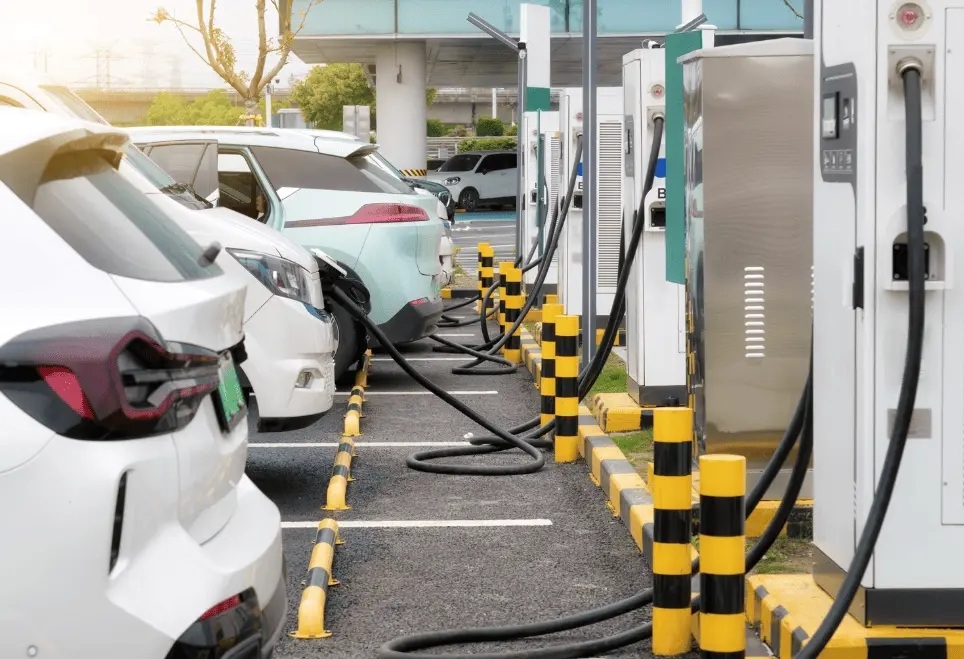
DC EV Charging Stations
What Is a DC Fast EV Charger?
DC fast EV chargers represent the fastest category of EV charging equipment currently on the market, capable of delivering extremely high power levels to recharge an EV’s battery in a fraction of the time required by conventional chargers. Depending on the vehicle and charger specifications, these advanced stations can charge an EV battery from a low state of charge (SOC) to approximately 80% in as little as 20 to 30 minutes.
Direct Current vs. Alternating Current
The primary distinction between DC fast chargers and lower-level chargers lies in the type of power they deliver:
-
Level 1 and Level 2 chargers supply alternating current (AC). Before this energy can be stored in the EV’s battery, the vehicle must convert the AC to direct current (DC) using its onboard charger.
-
In contrast, DC fast chargers handle this conversion internally. They deliver direct current directly to the battery, bypassing the vehicle’s onboard AC-to-DC converter.
This bypass is game-changing. Since the conversion hardware in a vehicle is significantly smaller than that in a fast charger, DC chargers can deliver vastly higher power levels—typically 50 kW, 150 kW, 300 kW, and even 500 kW in some next-generation systems.
Real-World Charging Examples
Charging speed ultimately depends on two key factors: the maximum power the vehicle can accept and the charger’s power rating. Here are some real-world examples:
-
The 2025 Lucid Air, which supports ultra-fast charging, can add 200 miles of range in just 17 minutes when connected to a 300 kW charger.
-
The 2025 Chevrolet Equinox EV, with a maximum acceptance rate of 150 kW, can gain 77 miles of range in approximately 10 minutes.
These benchmarks highlight the immense advantage of DC fast charging for EV mobility, especially during long road trips or time-sensitive journeys.
Why DC Fast EV Chargers Often Charge Only to 80%
New EV drivers often wonder why charging slows down dramatically once the battery reaches 80% SOC. This phenomenon is a fundamental trait of lithium-ion battery chemistry.
How Charging Behavior Changes After 80%
-
Below 80% SOC, the battery can safely accept energy at a high rate.
-
Once the battery exceeds 80%, the battery management system (BMS) gradually reduces the charging speed to protect the battery’s long-term health.
This phase, known as constant voltage charging, ensures cell stability and reduces stress on the battery. As a result, the charging curve flattens, meaning the final 20% of charge may take as long as—or even longer than—the first 80%.
Why Most Drivers Stop at 80%
Many EV experts and manufacturers recommend charging only as much as needed to reach your next destination or charging station. Stopping at 80% offers several benefits:
-
Saves significant time at DC fast charging stations.
-
Reduces queue congestion at busy charging hubs.
-
Minimizes heat buildup and extends the battery’s overall lifespan.
For long road trips, the optimal strategy is simple: charge to 80%, drive to the next station, recharge briefly, and repeat. This approach ensures both charging efficiency and battery longevity.
Factors Affecting DC Fast EV Charging Speeds
The speed at which a DC fast charger can replenish an EV battery is influenced by several interconnected factors:
1. Vehicle Charging Capability
Each EV has a unique maximum charging rate, determined by its battery design, cooling system, and onboard technology. Vehicles capable of handling 200–350 kW will charge much faster when connected to high-power DC stations.
2. Charger Power Output
DC charging stations are available in various power levels, including:
-
50 kW – Early-generation chargers that are still widely used today.
-
100–150 kW – Mid-range chargers common in many public charging networks.
-
250–350 kW – Ultra-fast chargers designed for newer EV models.
-
500 kW and above – Emerging megawatt-level technologies for heavy-duty EVs.
The actual power delivered to the vehicle is always the lower value between the charger’s maximum output and the vehicle’s acceptance rate.
3. Cable and Connector Limitations
Charging cables and connectors must be able to handle high current loads. At power levels above 300 kW, thick, liquid-cooled cables are often used to manage heat buildup effectively.
4. Shared Power at Charging Stations
Some charging networks use power-sharing technology, where multiple charging stalls draw energy from a single shared power cabinet. If several EVs are charging simultaneously, the available power may be distributed across the stalls, temporarily reducing charging speeds.
Benefits of Using DC Fast EV Chargers
DC fast chargers offer numerous compelling advantages that solidify their role as the cornerstone of modern EV infrastructure.
1. Ultra-Fast Charging Speeds
Speed is the most significant benefit of DC fast charging. A 20 to 30-minute charging session can provide enough range for hundreds of kilometers of driving. For many families and businesses, this rapid turnaround is essential—it reduces downtime and allows EVs to seamlessly integrate into daily routines.
This speed also makes long-distance EV travel more feasible, addressing range anxiety and bringing EVs closer in convenience to traditional gasoline-powered vehicles.
2. Exceptional Convenience for On-the-Go Charging
The accessibility of DC fast chargers is expanding rapidly. They are now commonly found in:
-
Highway rest stops
-
Shopping malls
-
Hotels and resorts
-
Gas stations
-
Business centers
-
Municipal parking lots
This growing network allows EV drivers to charge their vehicles during everyday activities, such as dining, shopping, or attending meetings.
3. Versatility Across EV Models
DC fast chargers support a wide range of electric vehicles, from compact city cars to large SUVs and commercial EVs. Most modern EVs are compatible with fast charging, although connector types vary by region:
-
CCS (Combined Charging System) – Widely used in North America and Europe.
-
CHAdeMO – An older standard primarily used in Japanese EVs.
-
NACS (North American Charging Standard) – Rapidly gaining adoption across the United States.
This broad compatibility ensures that drivers can access fast charging regardless of their vehicle’s brand or model.
4. Supports Long-Distance Travel
The rapid expansion of national DC fast charging corridors has made interstate EV travel more accessible than ever. Networks such as Electrify America, EVgo, Tesla Supercharger, and IONITY have deployed thousands of stations along major highways, allowing drivers to plan cross-country trips with confidence.
For many EV owners, DC fast chargers transform electric travel from a local convenience to a viable national mobility solution.
5. Encourages EV Adoption
Fast, reliable charging is critical to accelerating EV adoption. Many potential buyers are hesitant to switch to electric due to concerns about charging time and accessibility. DC fast chargers address these pain points by offering:
-
Charging speeds comparable to refueling a gasoline vehicle.
-
Widespread installation in public locations.
-
Reduced waiting times and downtime.
-
Greater confidence in long-distance travel.
As charging infrastructure expands, EVs become a more attractive option for households, businesses, and commercial fleets.
China manufacturer offers high-quality industrial products with competitive pricing and advanced production capabilities.
6. Ideal for Commercial and Fleet Applications
Businesses operating delivery vans, taxis, ride-share vehicles, or logistics fleets rely on rapid charging to keep their vehicles on the road. DC fast chargers offer:
-
High vehicle uptime.
-
Quick turnaround between driving shifts.
-
Reduced operational downtime.
-
Predictable scheduling and route planning.
Fleet depots increasingly use a combination of Level 2 chargers for overnight charging and DC fast chargers for mid-day top-ups, balancing efficiency and cost-effectiveness.
7. Enhances Energy Efficiency and Smart Grid Integration
Modern DC fast chargers are increasingly integrated with smart energy management systems. These technologies enable:
-
Load balancing to reduce strain on the power grid.
-
Dynamic pricing based on grid demand.
-
Integration with solar panels and battery storage systems.
-
Remote monitoring and diagnostics.
These innovations ensure that fast charging infrastructure can scale sustainably as EV adoption continues to rise.
The Growing Global Importance of DC Fast EV Charging Infrastructure
Investments and Expansion Worldwide
Governments and private operators are making unprecedented investments in DC fast charging infrastructure. Many countries have set ambitious deployment targets, offering incentives, grants, and subsidies to expand public fast charging networks.
Urban and Rural Deployment
While urban centers remain a top priority for charging infrastructure, rural areas and major transportation corridors are also seeing rapid expansion of fast-charging coverage, ensuring equitable access to electric mobility.
Technological Advancements in the Next Decade
Several innovations are shaping the next generation of DC fast chargers, including:
-
Higher power output (500 kW–1 MW).
-
Advanced liquid cooling technologies.
-
Battery-buffered charging stations.
-
Vehicle-to-grid (V2G) capabilities.
These advancements promise even faster charging times and more efficient energy distribution across widespread EV networks.
Conclusion
DC fast EV chargers are revolutionizing the electric mobility landscape by providing unparalleled speed, convenience, and accessibility for drivers. As the fastest category of EV charging technology available, they dramatically reduce charging times, enabling EV owners to travel longer distances with fewer interruptions and greater confidence.
With global demand for electric vehicles continuing to surge, the expansion of fast-charging infrastructure is essential to supporting widespread adoption. From everyday commuters and travelers to commercial fleet operators, DC fast chargers deliver the performance and reliability needed to keep electric transportation moving forward.
As technology evolves and new charging solutions emerge, DC fast charging will remain at the forefront of modern EV infrastructure—paving the way for a cleaner, faster, and more sustainable future for mobility.
© 2026 Myliveroom — Live Events & Online Communities
 English
English
 Arabic
 French
 Spanish
 Portuguese
 Deutsch
 Turkish
 Dutch
Dutch
 Italiano
 Russian
 Romaian
 Portuguese (Brazil)
 Greek
Greek
