


 Ban & Monetization Policy
 MyLiveRoom Rewards Program Rules & Eligibility
How IoT Is Transforming India's Oil & Gas Industry in 2026
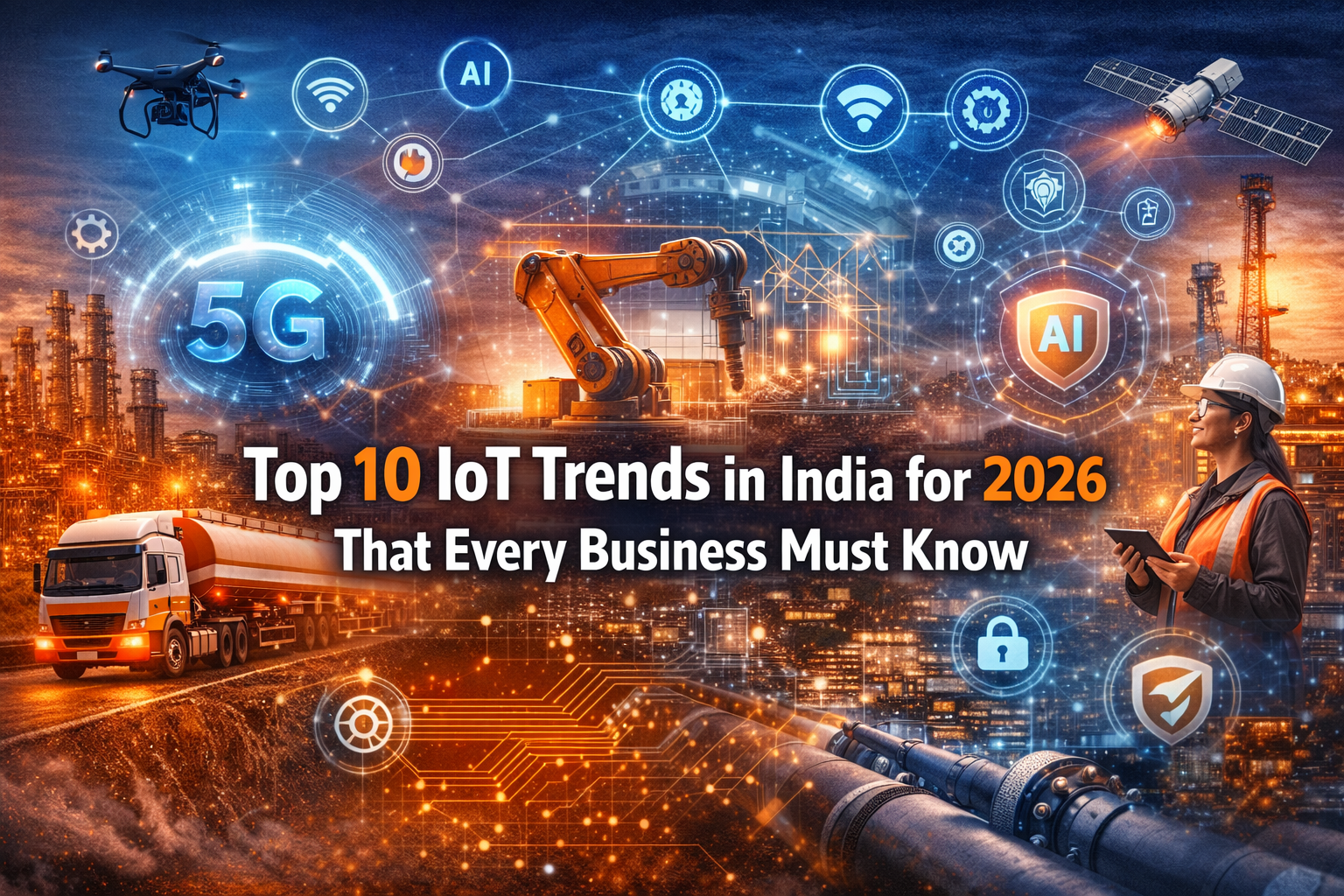
Introduction: The Oil Fields Are Getting Smarter
Go to any large-scale fuel terminal in India at present, and you will find some changes taking place. You would see fewer clipboards, less manual inspection, and many more computerized screens. It is through the sensors that most of the tasks that previously required a workforce are being done. It is how the IoT works in the oil and gas sector in India by 2026; it is no longer a future prediction.
India is the third-largest consumer of oil in the world. The stakes are enormous. Even a one percent reduction in fuel pilferage across the country's distribution network can save hundreds of crores every year. That is exactly why energy giants like IOCL, BPCL, and Shell are not just experimenting with connected technology — they are deploying it at scale.
This blog takes you inside that transformation, what is driving it, how it works on the ground, and what it means for every business operating in India's energy ecosystem.
The Problem That Started It All: Fuel Loss Nobody Could Prove
For decades, India's oil and gas sector operated on a trust-based system. Trucks loaded fuel at terminals, drove to destinations, and unloaded. Simple enough — on paper.
But the reality was far messier. Fuel disappeared between Point A and Point B. Sometimes a little. Sometimes a lot. Drivers, loaders, and even supervisors had ways of making inventory numbers match while siphoning off product along the way. The industry quietly called it shrinkage. Everyone knew it existed. Almost nobody could prove exactly where it happened.
That is where smart oil and gas industry solutions changed the game permanently.
How IoT Is Solving the Fuel Pilferage Crisis
The most immediate and measurable impact of Industrial IoT India 2026 has been in cargo security. Companies like KritiLabs Technologies, based in Chennai, have deployed advanced locking systems on bulk transport trucks that completely remove the human element from the equation.
Here is how it works in practice. A fuel tanker is loaded at a terminal. The moment loading is complete, an electronic lock engages automatically. No physical key exists. The only way that the lock opens is through a One Time Password generated by the platform and valid only within a specific geo-fenced location — the exact delivery point registered in the system.
In the event that the truck moves out of its designated route, the system is aware of this at once. In case anyone tries to interfere with the locking system during transit, the alarm rings right away, sending notifications to the fleet supervisor as well as the terminal manager. Every little activity – whether it be time of departure, route, locking of the system, or delivery – is recorded into a computerized logbook which cannot be tampered with in any way.
Such technology has been used by IOCL and BPCL in thousands of tankers, logging more than 1.3 million kilometres daily.
Predictive Maintenance: Fixing Problems Before They Happen
In addition to security, another major operational cost in the oil and gas sector comes from unexpected downtime. The pump at the faraway pipeline facility stops working; the compressor in the processing plant breaks down. Before a technician gets there, hours or even days worth of production are wasted.
IoT technology can really shine when it comes to predictive maintenance in the oil and gas sector. Various parameters such as temperature, vibrations, pressure, and flow rates are constantly monitored using connected sensors. Artificial intelligence that is applied to all of this data then identifies what “normal” means and any deviations from that pattern.
In practical terms, this means a pipeline operator in Rajasthan receives an alert on their phone that a pressure sensor at a specific junction has been reading outside normal parameters for the past six hours. A maintenance crew is dispatched before any rupture occurs. The cost of prevention is a fraction of the cost of repair, not to mention the environmental and regulatory consequences of a spill.
It is what AI-powered monitoring in oil and gas actually looks like — not robots replacing workers, but intelligent systems giving workers information they could never have gathered manually.
Real-Time Monitoring Across the Entire Supply Chain
One of the most transformative aspects of IoT for pipeline safety and supply chain visibility is the ability to see everything, everywhere, at once.
In the old model, a terminal manager in Mumbai had no visibility into what was happening at a depot in Nagpur until a report arrived — hours or days later. Decisions were made on stale data. Inventory mismatches were discovered only at month-end.
In today’s world, where connected oil and gas systems are possible, the same supervisor is able to see real-time information about tank levels, vehicle movements, deliveries, and exceptions, all from one dashboard. If the truck has been delayed by two hours, this will generate an exception. When there are insufficient tank levels in a retail facility, it generates a refill order.
This level of real-time operational intelligence was simply not possible five years ago. In 2026, it will become the baseline expectation across India's energy sector.
Worker Safety: The Use Case Nobody Talks About Enough
There is one dimension of digital transformation in oil and gas India that does not get enough attention — worker safety.
Oil and gas environments are inherently hazardous. Gas leaks, pressure failures, and fire risks are constant concerns. Historically, detection relied on scheduled inspections and human observation. By the time a problem was noticed, it was often already dangerous.
IoT devices used in refineries and other processing facilities now detect any abnormal gas levels, temperatures, and mechanical stresses on-site instantly. If these levels exceed pre-set limits, emergency evacuation alarms will be automatically activated. There is no need for anyone to notify workers that there is an issue.
In a sector where a single incident can cost lives and billions in damages, this is not a luxury feature. It is becoming a regulatory expectation under India's occupational safety frameworks.
The Make in India Angle: Why This Matters Beyond the Industry
There is a bigger story here that goes beyond fuel trucks and pipeline sensors. India's oil and gas sector is one of the largest adopters of domestically built IoT technology in the country.
Companies operating under the Make in India IoT solutions framework building hardware, software, and entire solution stacks within India are proving that the country does not need to import intelligence from Silicon Valley or Europe. From PESO-certified devices designed for hazardous environments to AI platforms that process millions of data points from refineries, Indian engineering is leading this transformation.
It matters for two reasons. First, it creates a feedback loop of local expertise and innovation. Second, it gives Indian operators solutions that are designed for Indian conditions — the heat, the road quality, the regulatory environment, and the scale of operations that few other countries can match.
What Comes Next: Edge Computing and AI2OT
Looking ahead to the next phase of IoT adoption in India's energy sector, two technologies stand out.
Edge computing for oil and gas operations means that data processing happens at the device level — on the truck, at the pipeline junction, inside the refinery — rather than being sent to a distant cloud server first. It dramatically reduces response time for critical alerts and works even in areas with poor connectivity, which is still a reality across large parts of India's energy infrastructure.
The second is what KritiLabs calls AI2OT — the convergence of Artificial Intelligence and the Internet of Things into a single operational layer. Rather than treating AI and IoT as separate tools, AI2OT embeds intelligence directly into connected systems. The result is not just smarter monitoring — it is autonomous decision-making at the operational level.
Conclusion: The Smartest Oilfields in the World Are Being Built in India
India's oil and gas sector is not just catching up with global technology standards — in some areas, it is setting them. The scale of deployment, the complexity of the supply chain, and the ingenuity of the solutions being developed here are genuinely world-class.
For businesses operating in or serving this sector, the message is clear. IoT adoption in Indian industries is no longer a competitive advantage — it is a table stake. Those who build on connected infrastructure today will operate with a cost, safety, and efficiency edge that will be very difficult for others to close.
The oilfields are getting smarter. And they are getting smarter in India.
F&Q
Q1. How is IoT used in the oil and gas industry in India?
IoT helps track vehicles, monitor pipelines, prevent fuel theft, and improve safety using real-time data.
Q2. What are the main benefits of IoT in oil and gas operations?
It reduces theft, cuts downtime, improves safety, and gives better control over operations.
Q3. How does IoT prevent fuel theft in tanker trucks in India?
It uses GPS tracking, geo-fencing, and smart locks that open only with secure access codes.
Q4. What is predictive maintenance and how does it help oil and gas companies?
It uses sensors to detect issues early, helping avoid breakdowns and reduce repair costs.
Q5. Which Indian companies are using IoT in oil and gas?
Companies like Indian Oil, BPCL, and Shell India use IoT for tracking and operations.
Q6. Is IoT mandatory for oil and gas companies in India?
Not fully, but GPS tracking and monitoring systems are required in many cases for compliance.
Q7. How does real-time monitoring work in oil and gas pipelines?
Sensors track pressure and flow, sending alerts if any issue is detected.
Q8. What is the future of IoT in India's oil and gas sector?
It includes AI systems, faster data processing, drones, and fully connected operations.
 Portuguese (Brazil)
 English
 Arabic
 French
 Spanish
 Portuguese
 Deutsch
 Turkish
 Dutch
Dutch
 Italiano
 Russian
 Romaian
 Greek
Greek
