


 Ban & Monetization Policy
 MyLiveRoom Rewards Program Rules & Eligibility
Why HuaShun Lunch Box Mold Achieves Consistent Walls Across Sixteen Cavities
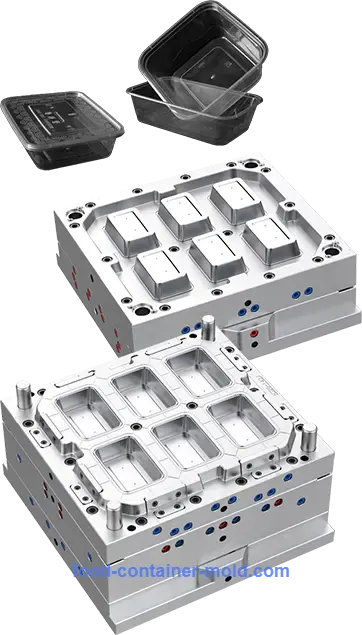
A production manager ordering a sixteen-cavity tool for disposable lunch boxes knows one truth: thin walls sell, but uneven walls return as scrap. A Lunch Box Mold must push molten plastic into every corner of every cavity at the same pressure, same temperature, and same speed. HuaShun Mould, operating from Zhejiang with fifteen years of thin-wall experience, treats wall uniformity as a non-negotiable specification. Does your current mold supplier measure flow balance before shipping the tool?
The first critical factor sits inside the runner system. A cold runner layout for a Lunch Box Mold must split the melt stream into equal-length paths to each cavity. Any length difference creates a pressure drop variation. The cavity receiving melt first will over-pack while the last cavity struggles to fill. HuaShun engineers design H-pattern or radial runners so that each branch travels the same distance from the sprue. This geometric symmetry costs nothing in steel but saves entire production batches from rejection.
Flow leaders and flow restrictors represent the second tool. Even with equal runner lengths, small differences in cavity shape or ejector pin placement alter flow resistance. A skilled mold maker adds a 0.05-millimeter restriction land at the gate of a cavity that naturally fills faster. Conversely, a flow leader—a shallow, wide channel—directs extra melt to a difficult corner. These micro-adjustments require precision machining. HuaShun's thirty-plus production machines hold tolerances within 0.01 millimeter, allowing such fine corrections.
The gate design itself ranks as the third factor. For a rectangular lunch box, gate position determines how the wall thickness behaves along the perimeter. A single edge gate on the long side creates a flow front that wraps around the corners unevenly, producing a thick spot near the gate and a thin spot at the far corner. A diaphragm gate or a multi-point tunnel gate system delivers melt simultaneously to both long sides. HuaShun's portfolio includes square three-grid boxes and round bowls, each requiring a gate strategy matched to the part geometry.
Cooling circuit layout forms the fourth pillar of wall uniformity. Uneven cooling causes differential shrinkage. A thick wall section stays hot longer, shrinking more than a thin section nearby. That mismatch creates warpage visible to any food packer. A uniform wall starts with a uniform cooling rate. Conformal cooling channels—machined to follow the part contour—pull heat away evenly. Traditional straight-drilled cooling lines leave hot spots behind. The food-container-mold website highlights HuaShun's investment in five-axis machining, which enables conformal cooling for thin-wall tools.
Venting represents the fifth, often overlooked, factor. Trapped gas creates a cushion that prevents melt contact with the cavity wall. That gas cushion produces a dull, thinner surface. A properly vented Lunch Box Mold allows air to escape through 0.02-millimeter deep vents along the parting line. For deep-drawn shapes like a one-liter rectangular box, additional venting pins in the core side prevent burning and incomplete filling. HuaShun designers place vents empirically, drawing on a database of hundreds of thin-wall projects.
Material viscosity consistency also demands attention. Polypropylene homopolymer and random copolymer flow differently. A mold optimized for homopolymer will show wall variation when running copolymer. HuaShun provides two sets of flow simulation data for each Lunch Box Mold contract: one for each resin grade. This proactive step prevents surprises during production trials.
Finally, injection speed profiling matters. A uniform wall requires a constant melt front velocity, not constant screw speed. As the melt enters each cavity, the flow front area changes. Modern molding machines offer multi-stage injection profiles. HuaShun supplies recommended speed profiles with every shipped tool, based on actual test shots from their in-house injection floor.
For detailed design guides and flow simulation samples for your next container project, visit https://www.food-container-mold.com/. A multi-cavity mold that delivers uniform walls reduces scrap, speeds cycle time, and satisfies food safety inspectors. The path to perfect wall consistency runs through runner balance, gate placement, cooling design, and venting precision.
 Romaian
 English
 Arabic
 French
 Spanish
 Portuguese
 Deutsch
 Turkish
 Dutch
Dutch
 Italiano
 Russian
 Portuguese (Brazil)
 Greek
Greek
