


 Ban & Monetization Policy
 MyLiveRoom Rewards Program Rules & Eligibility
Lab-Grown vs Natural Diamond Earrings: The Complete Guide (2026)
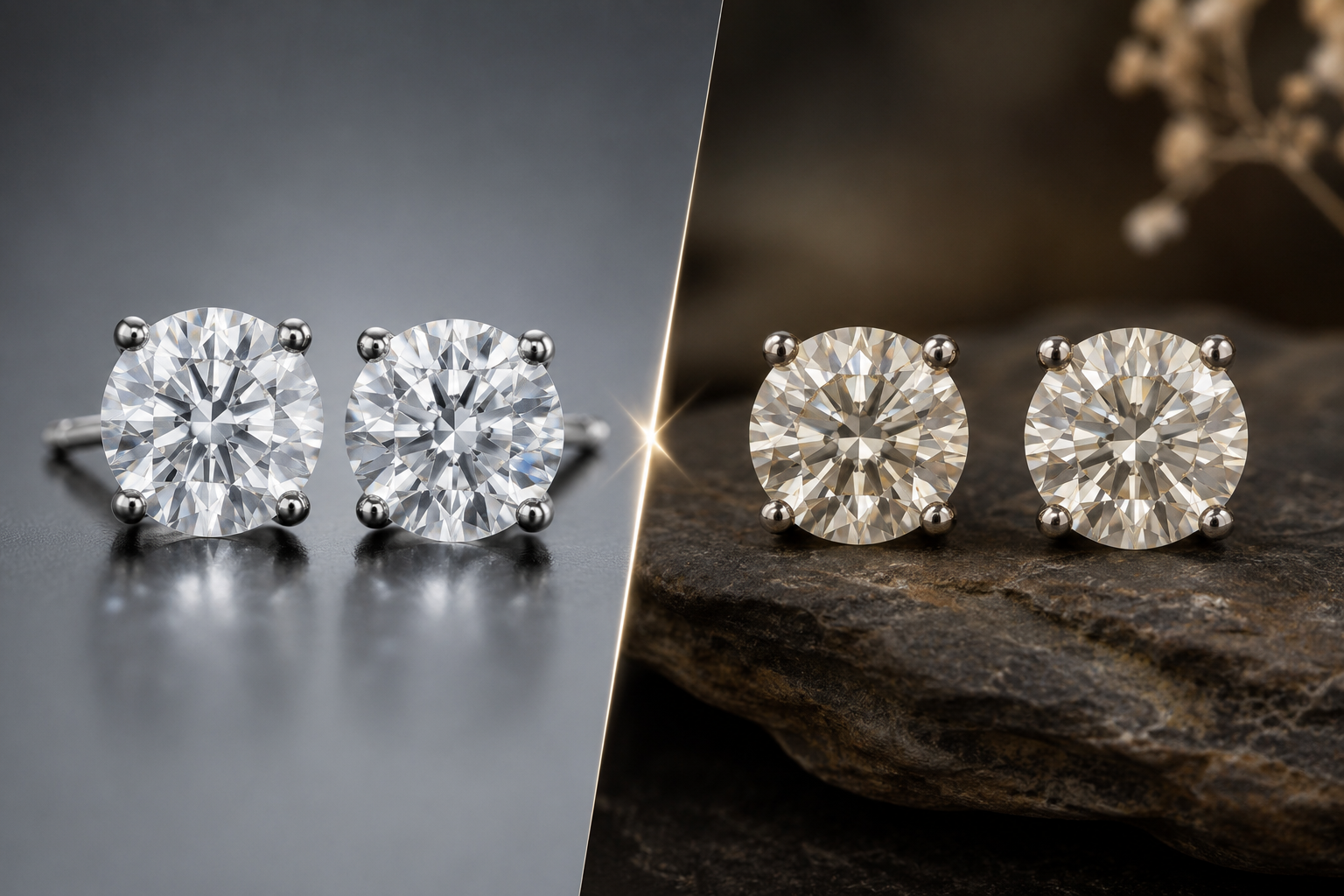
Diamond earrings are one of the most timeless jewelry pieces you can own. But in 2026, buyers in the USA face a new and exciting decision before they shop: natural diamonds or lab-grown diamonds?
The market has shifted dramatically. Lab-grown diamond earrings now make up a significant share of all diamond jewelry sales in the United States — and for good reason. They offer the same brilliance, the same hardness, the same sparkle, and a dramatically lower price tag.
But natural diamonds still hold their place. Rarity, heritage, and investment value continue to draw buyers who want something the earth itself created over billions of years.
This guide covers everything — from how each diamond is made, to GIA certification, to earring-specific buying tips no one else tells you about. By the end, you will know exactly which option is right for your budget, your lifestyle, and your values.
What Are Natural Diamond Earrings?
Natural diamonds are geological miracles. They form 100 to 200 miles beneath the earth's surface, under extreme heat (around 2,200°F) and pressure, over periods of one to three billion years. Volcanic activity then pushes them closer to the surface through structures called kimberlite pipes, where they are eventually mined.
Because every natural diamond forms under unique conditions, no two are exactly alike. This geological individuality is part of what makes natural diamonds so valued. Natural diamonds often contain tiny amounts of nitrogen, which can influence color and is one of the technical markers gemologists use to identify them.
Natural diamond earrings carry centuries of romantic tradition. They are a common choice for:
-
Anniversary gifts
-
Family heirlooms passed across generations
-
Milestone purchases where rarity and long-term value matter
-
Buyers who value the story of where their diamond came from
The trade-off is cost. Because mining is a large, resource-intensive process involving land, water, energy, and logistics, natural diamonds carry a significant price premium.
What Are Lab-Grown Diamond Earrings?
Lab-grown diamonds are real diamonds created in a controlled laboratory environment. Scientists replicate the exact conditions that produce natural diamonds — the same carbon structure, the same extreme heat and pressure — but compress the timeline from billions of years to just a few weeks.
The result is chemically, physically, and optically identical to a mined diamond. Both are pure carbon arranged in the same crystal lattice. Both score 10 on the Mohs hardness scale. Both reflect and refract light in the same way.
Lab-grown diamonds have no nitrogen — this is the key technical difference gemologists use to distinguish them from natural diamonds, and it requires specialized equipment to detect. To the naked eye, and to most professionals without tools, they look identical.
How Are Lab-Grown Diamonds Made?
There are two primary production methods:
1. High Pressure High Temperature (HPHT) This method replicates the natural conditions under which diamonds form in the earth. A small diamond seed is placed under extreme pressure (around 1.5 million pounds per square inch) and high temperature. Carbon atoms bond to the seed and grow into a diamond over several days or weeks.
2. Chemical Vapor Deposition (CVD) Diamond seeds are loaded into a plasma reactor chamber and exposed to carbon-rich gases. When heated with microwave energy, carbon atoms break down and deposit onto the seed in layers, slowly building a diamond crystal. CVD is widely used today and allows precise control over the diamond's properties.
Both methods produce genuine diamonds that are then cut, polished, graded, and set into jewelry — exactly like natural diamonds.
Are Lab-Grown Diamonds Really Real?
Yes. Completely and unambiguously real.
This is the most common misconception buyers have. Lab-grown diamonds are not:
-
Cubic zirconia (CZ) — a different chemical compound entirely
-
Moissanite — a silicon carbide gemstone that mimics diamond's look but differs in composition and hardness
-
Glass or resin simulants
Lab-grown diamonds are diamonds. The U.S. Federal Trade Commission recognized them as real diamonds in 2018. The Gemological Institute of America (GIA) has been grading lab-grown diamonds since 2007. They have the same hardness, fire, brilliance, and scintillation as mined diamonds.
The only difference is origin — not quality, not appearance, not durability.
Natural vs Lab-Grown Diamond Earrings: Side-by-Side Comparison
|
Feature |
Natural Diamond |
Lab-Grown Diamond |
|
Chemical Composition |
Pure carbon |
Pure carbon |
|
Hardness (Mohs) |
10 |
10 |
|
Brilliance & Sparkle |
Excellent |
Identical |
|
Origin |
Earth (mined) |
Laboratory |
|
Nitrogen Content |
Trace amounts |
None |
|
Price |
Higher |
30–50% lower |
|
Resale Value |
Higher |
Lower |
|
Environmental Impact |
Higher (mining) |
Lower (energy-based) |
|
GIA/IGI Certifiable |
Yes |
Yes |
|
Visible Difference |
None to naked eye |
None to naked eye |
|
Production Time |
Billions of years |
A few weeks |
|
Rarity |
Naturally rare |
Increasingly accessible |
Price: The Biggest Practical Difference
For most buyers, price is the deciding factor — and the gap is significant.
Lab-grown diamonds typically cost 30% to 50% less than natural diamonds of comparable quality. As production technology continues to improve and scale, prices for lab-grown diamonds have continued to fall, meaning your budget stretches even further.
What this means in practice:
-
If you have a $2,000 budget for diamond stud earrings, a natural diamond might get you 0.5 total carat weight in good quality. The same budget in lab-grown could get you 1.0 total carat weight or higher — the same quality, twice the size.
-
You can afford better clarity, better color, and better cut with lab-grown diamonds at any given price point.
This affordability is especially attractive for everyday earrings, gifts, and first-time diamond buyers.
GIA and IGI Certification: What to Look For
Never buy diamond earrings without certification. A certified diamond comes with an independent grading report that verifies its quality and authenticity.
GIA (Gemological Institute of America)
The GIA is the most respected diamond grading authority in the world. It has graded lab-grown diamonds since 2007. In 2019, GIA updated its lab-grown reports to remove the term "synthetic" — recognizing that these are genuine diamonds. GIA grades lab-grown diamonds on color, clarity, cut, and carat weight using the same standards as natural diamonds.
IGI (International Gemological Institute)
IGI is another widely recognized certification body that grades both natural and lab-grown diamonds. Many lab-grown diamond jewelry brands use IGI certification, and it is a fully reliable indicator of quality.
What the 4Cs Mean for Earrings
When reading a certificate, focus on the 4Cs:
-
Cut — The most important factor for sparkle. An excellent or very good cut maximizes light reflection.
-
Color — On a scale of D (colorless) to Z (yellow). For earrings, G–H is a sweet spot: near-colorless and excellent value.
-
Clarity — Refers to internal flaws (inclusions). VS2 or SI1 are ideal for earrings — inclusions at this grade are not visible to the naked eye.
-
Carat — The weight of the diamond. Earrings are typically worn in pairs, so carat is expressed as "total carat weight" (TCTW) for the pair.
Earring-Specific Buying Tips (What Most Guides Skip)
Most diamond buying guides focus on engagement rings. Earrings are different — and these nuances can save you significant money.
Clarity: Go Lower Than You Would for a Ring
Earrings sit beside your face and are rarely examined up close. At conversational distance, even a trained gemologist cannot see inclusions in an SI1 or SI2 diamond earring without magnification. You do not need VS1 or Flawless clarity in earrings. Choose SI1 or VS2 and use the savings to go up in carat size instead.
Color: G–H Is the Sweet Spot
Because earrings are not surrounded by other diamonds (unlike a halo ring setting), color shows slightly more than in multi-stone ring settings. That said, G or H color is nearly colorless and looks stunning in white gold or platinum earring settings.
Size Matters More Than Perfection
For earrings — especially studs and hoops — visible size is the first thing people notice. A slightly larger carat weight in an excellent cut will outshine a smaller flawless diamond every time. Prioritize cut and carat; save on color and clarity.
Stud Earring Setting Styles
-
Prong setting — Classic four or six prong. Maximum light enters the diamond.
-
Bezel setting — Metal surrounds the diamond. More secure for active wearers.
-
Martini setting — V-shaped, low-profile. Diamond sits closer to the ear, very modern.
-
Halo setting — Small diamonds surround the center stone, making it appear larger.
Popular Earring Styles in Lab-Grown and Natural Diamonds
Diamond Stud Earrings
The most classic choice. Studs are timeless, versatile, and suitable for every occasion from daily office wear to formal events. In lab-grown diamonds, buyers can afford significantly larger studs for the same price.
Diamond Hoop Earrings
Hoops set with diamonds along the front face are a major fashion trend. They add glamour without being overly formal. Lab-grown hoops allow buyers to get diamonds across a longer hoop span — more coverage, more sparkle — at an accessible price.
Drop and Dangle Earrings
These hang below the earlobe and catch light beautifully with movement. Popular for weddings and evening events. Because they are rarely examined closely, lab-grown diamonds at SI1 clarity in drop styles are an excellent value.
Halo Earrings
A center diamond encircled by a ring of smaller diamonds. Halo settings create the illusion of a much larger center stone. In lab-grown diamonds, this style becomes accessible to far more buyers.
Tennis Earrings (Linear Drop)
A string of diamonds set in a line down the ear. Dramatic and modern. Lab-grown diamonds make this style attainable without the five-figure price tags common for natural versions.
Sustainability: Which Is More Ethical?
This is an increasingly important question for American jewelry buyers — especially millennials and Gen Z shoppers.
Lab-Grown Diamonds: Lower Environmental Footprint
Lab-grown diamonds do not require large-scale land excavation, do not displace ecosystems, and eliminate concerns about conflict diamonds (also called blood diamonds — stones mined in war zones and sold to finance armed conflict). For buyers who prioritize ethical sourcing and environmental responsibility, lab-grown diamonds offer clear advantages.
However: producing lab-grown diamonds in reactors requires substantial electricity. The environmental benefit depends heavily on whether the manufacturer uses renewable energy. When shopping, look for brands that disclose their energy sourcing.
Natural Diamonds: Industry Reforms Underway
The natural diamond industry has made significant strides through initiatives like the Kimberley Process, which certifies that diamonds are conflict-free. Many mining operations now operate under strict environmental and labor standards. Some buyers value the economic benefits mining provides to communities in diamond-producing regions.
Bottom line: Lab-grown diamonds generally have a lower environmental impact, but responsible natural diamond mining is improving. Either choice can be made ethically with the right research.
Durability and Everyday Wear
Both natural and lab-grown diamonds score 10 out of 10 on the Mohs hardness scale — making them the hardest natural substance known. They are equally resistant to scratching and chipping and suitable for daily wear.
Lab-grown diamond earrings can be heirloom-quality pieces that last generations. Their durability is in no way inferior to natural diamonds.
Care tips for any diamond earrings:
-
Clean with warm water, mild dish soap, and a soft-bristled brush monthly
-
Store in a soft pouch or lined jewelry box to prevent scratching
-
Have the prongs and settings checked by a jeweler once a year
-
Avoid chlorine and harsh chemicals that can damage metal settings
Investment and Resale Value
This is where natural and lab-grown diamonds genuinely differ.
Natural diamonds have a longer track record as luxury assets. Their rarity — a finite resource — supports long-term value retention. Exceptional natural diamonds (particularly colored diamonds and large stones) can appreciate over time. For buyers treating jewelry as a long-term financial asset, natural diamonds hold the stronger position.
Lab-grown diamonds have lower and declining resale value. As production technology improves, lab-grown diamonds become easier and cheaper to produce — which puts downward pressure on their market price. The resale market for lab-grown diamonds is still developing, and buyers should not expect to recoup a significant portion of purchase price.
If you are buying for: daily beauty, style, and personal enjoyment → lab-grown is outstanding value.
If you are buying for: rarity, long-term asset value, or heirloom legacy → natural diamonds have the edge.
Lab-Grown vs Natural Diamond Earrings: Pros and Cons
Lab-Grown Diamond Earrings
Pros:
-
30–50% lower price for the same quality
-
100% real diamonds — identical in every measurable way
-
Environmentally friendlier (especially when produced with renewable energy)
-
Ethically sourced without conflict-diamond concerns
-
Allows larger carat sizes at the same budget
Cons:
-
Lower resale value
-
Less rarity — not a finite resource
-
Some buyers and traditionalists still prefer mined diamonds
-
Resale market is still developing
Natural Diamond Earrings
Pros:
-
Rare and finite — each stone is geologically unique
-
Better resale and long-term value retention
-
Traditional luxury with centuries of heritage
-
Preferred for heirloom pieces and symbolic significance
Cons:
-
Significantly more expensive
-
Environmental and ethical concerns depending on mining source
-
Smaller stone sizes at the same price point
-
Mining industry, while improving, still has an environmental footprint
Moissanite and Cubic Zirconia: What They Are (And Why They Are Different)
While researching lab-grown diamonds, you will likely encounter moissanite and cubic zirconia (CZ). These are not diamonds — lab-grown or otherwise. Here is a quick breakdown:
|
Lab-Grown Diamond |
Moissanite |
Cubic Zirconia |
|
|
Composition |
Carbon |
Silicon carbide |
Zirconium dioxide |
|
Hardness (Mohs) |
10 |
9.25 |
8.5 |
|
Brilliance |
Diamond-level |
Higher dispersion (rainbow effect) |
High but fades over time |
|
Price |
Moderate |
Lower |
Very low |
|
Durability |
Excellent |
Very good |
Moderate |
Moissanite is a popular diamond alternative with its own devoted following — it has more fire (color dispersion) than a diamond. CZ is a lower-cost simulant that scratches more easily and can cloud over time. Neither is a diamond, lab-grown or natural.
Who Should Buy Lab-Grown Diamond Earrings?
Lab-grown diamonds are an excellent choice if you:
-
Want beautiful diamond earrings at a lower price point
-
Value ethical sourcing and environmental responsibility
-
Are buying your first pair of diamond earrings
-
Want a larger or more impressive pair of earrings within a set budget
-
Plan to wear earrings daily without worrying about the financial risk of loss or damage
-
Are gifting diamond earrings for a birthday, graduation, Mother's Day, or anniversary
Who Should Buy Natural Diamond Earrings?
Natural diamonds may be the better fit if you:
-
Value the rarity and geological story behind your jewelry
-
Are purchasing a piece meant to be an heirloom across generations
-
View the purchase partly as a luxury asset with resale potential
-
Prefer the tradition and symbolism associated with mined diamonds
-
Are purchasing at a high price point where rarity genuinely matters
Final Verdict: Which Should You Choose?
There is no universal right answer — it depends on your priorities.
Choose lab-grown diamond earrings if you want outstanding beauty and sparkle at an honest price, care about ethical sourcing, or want to maximize the size and quality of your earrings within a real-world budget. For everyday luxury, gifting, and modern style, lab-grown diamonds are a brilliant choice in every sense of the word.
Choose natural diamond earrings if the story, rarity, and heritage of your diamond matter to you, if you are making a long-term investment purchase, or if you want a piece that can be passed down as a meaningful family heirloom.
Either way, you are getting a real diamond — one of nature's (or science's) most stunning creations. And whether it formed over a billion years underground or in a laboratory over a few weeks, it will catch the light the same beautiful way on your ears.
Always purchase from reputable jewelers who provide certified diamonds, transparent sourcing information, and clearly disclose whether a diamond is natural or lab-grown. Certification from GIA or IGI is your best guarantee of quality and authenticity.
Frequently Asked Questions
Q: Can you tell the difference between lab-grown and natural diamonds with the naked eye?
No. Both are visually identical. Even trained jewelers need specialized equipment — such as a DiamondView machine — to distinguish between them based on growth patterns and trace elements.
Q: Do lab-grown diamonds hold their value?
Not as well as natural diamonds. The resale market is lower, and falling production costs mean lab-grown diamonds are likely to become more affordable over time. Buy lab-grown for personal enjoyment, not investment.
Q: Are lab-grown diamond earrings good for everyday wear?
Absolutely. With a Mohs hardness of 10, lab-grown diamonds are just as durable as natural ones. They are an excellent choice for daily wear, especially for buyers who want to enjoy fine jewelry without the anxiety of losing an extremely expensive piece.
Q: What certification should I look for on lab-grown diamond earrings?
Look for GIA (Gemological Institute of America) or IGI (International Gemological Institute) certification. Both are widely respected. The certificate should include color, clarity, cut, and carat grades.
Q: Is a 1 carat lab-grown diamond the same as a 1 carat natural diamond?
Yes. Carat is a unit of weight (0.2 grams), and 1 carat is 1 carat regardless of origin. The diamond will be the same physical size.
Q: What clarity grade should I choose for diamond earrings?
SI1 to VS2 is the ideal range for earrings. Inclusions in this range are not visible to the naked eye, making higher clarity grades unnecessary and a poor use of budget in earring settings.
Q: Do lab-grown diamonds come in fancy colors?
Yes. Fancy colored lab-grown diamonds (pink, blue, yellow) are produced in laboratories and are far more affordable than their natural colored counterparts, which are extremely rare and expensive.
 Russian
 English
 Arabic
 French
 Spanish
 Portuguese
 Deutsch
 Turkish
 Dutch
Dutch
 Italiano
 Romaian
 Portuguese (Brazil)
 Greek
Greek
