


 Ban & Monetization Policy
 MyLiveRoom Rewards Program Rules & Eligibility
Robotics vs Artificial Intelligence: What's the Difference and Why Your Child Needs Both
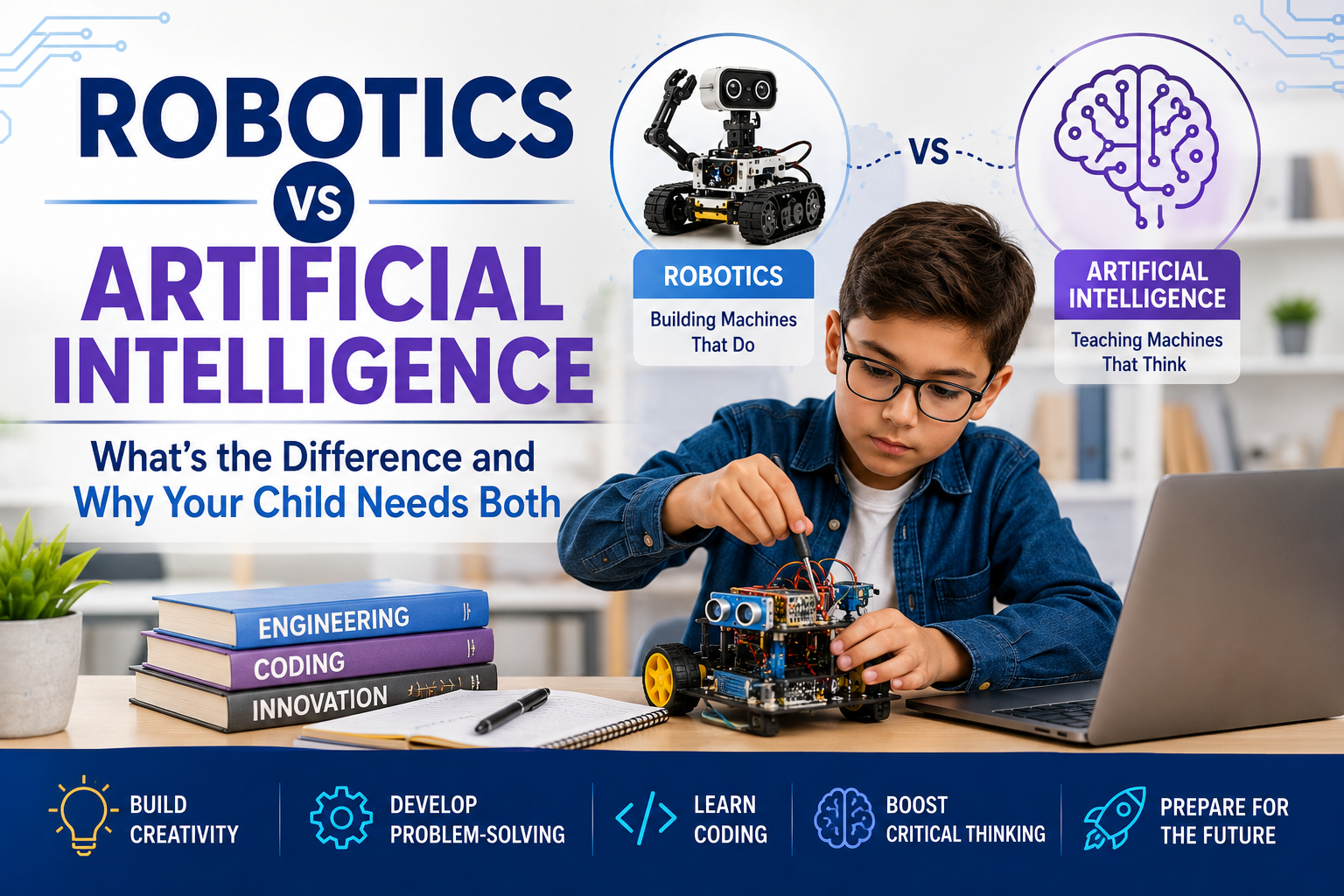
Every parent I talk to these days has some version of the same question. Should I enroll my child in a robotics class or an AI class? Which one is more important? Which one will actually help them in the future? And honestly, what even is the difference between the two?
If you have been sitting with these questions, you are not alone. The conversation around STEM education for kids has exploded over the last few years, and with it has come a lot of terminology that sounds impressive but is rarely explained in plain language. Robotics. Artificial intelligence. Machine learning. Coding. Automation. These words get thrown around in school brochures and technology news articles as if every parent already understands what they mean and how they relate to each other.
Most parents do not. And that is completely understandable — because nobody ever sat down and explained it simply.
That is exactly what this blog is going to do. By the end of it, you will understand what robotics and AI actually are, how they are different from each other, why your child genuinely benefits from learning both, and what that learning looks like in practice for kids growing up in the United States today.
Let us Start With the Question Everyone Is Thinking But Not Asking.
When most people think of a robot, they picture something physical. A machine with arms. Something that moves, builds things on an assembly line, or, depending on your movie preferences, eventually becomes self-aware and takes over the world.
When most people think of artificial intelligence, they picture something digital. An algorithm. A chatbot. Something invisible that runs behind the screen and makes decisions.
Here is the thing: both of those mental images are partly right. And the connection between them is more interesting than most people realise.
What Is Robotics, Really?
At its simplest, robotics is the science and engineering of building and programming machines that can perform tasks in the physical world.
A robot is a machine with three defining characteristics. It has a physical structure with mechanical parts that can move, grip, sense, or navigate. It has electrical components, motors, sensors, circuits — that allow it to interact with its environment. And it is programmable, meaning a human can write instructions that tell it what to do, when to do it, and how to respond to what it encounters.
When children learn robotics for kids programmes, they are learning all three layers simultaneously. They assemble physical components — understanding how gears, motors, and sensors work together. They wire up circuits — developing a basic understanding of electronics. And they write code — learning how to give logical instructions that translate into physical movement and behaviour.
This is why robotics education is so powerful as a learning tool. It makes abstract concepts tangible. When a child writes a piece of code and their robot actually moves because of it, that is not just exciting. It is the moment when logic, creativity, and engineering click into place all at once.
What Is Artificial Intelligence for Children?
This is where things get genuinely interesting — and where most explanations get unnecessarily complicated.
Artificial intelligence is the science of teaching computers to think, learn, and make decisions in ways that resemble how humans think.
Notice that there is nothing physical about that definition. AI lives in software. It is a set of mathematical models and algorithms — patterns of logic that allow a computer system to analyse data, recognise patterns, and make predictions or decisions without being explicitly programmed for every possible situation.
When you ask your phone a question, and it gives you a relevant answer, that is AI. When a music app learns your taste and suggests songs you actually like, that is AI. When a car navigates traffic using cameras and sensors, that is AI making thousands of small decisions per second.
For children learning AI and robotics different concepts at the school level, artificial intelligence education does not mean sitting a ten-year-old down with university-level mathematics. It means teaching them how computer systems learn from examples, how pattern recognition works, how to train a simple model using images or sounds, and how to think critically about the decisions that AI systems make.
These are genuinely learnable concepts for children as young as eight or nine, and the thinking skills they build through this learning apply far beyond technology into every area of life.
So What Is the Actual Difference Between Robotics and AI?
Here is the clearest way to think about it.
Robotics is primarily about the body. It is concerned with the physical — how a machine is built, how it moves, how it interacts with objects and environments in the real world. A robot without AI is simply a machine that follows the exact instructions it was given. Push this button, move left. Detect an obstacle, stop. Follow this path. It does what it is told, precisely and reliably, nothing more.
Artificial intelligence for children's education, in contrast, is about the mind. It is about giving systems the ability to learn, adapt, and make decisions based on data rather than explicit instructions. An AI system without any physical form can still analyse language, generate text, recommend content, or detect patterns in medical images.
Now here is where it gets exciting for the future. When you combine the two — when you give a robot a physical body and an AI brain — the possibilities become extraordinary. A robot that can learn from its environment. A machine that improves its own performance over time. An automated system that handles unexpected situations because it has been trained to recognise what unexpected looks like.
This is already happening in the real world. Autonomous vehicles. Surgical robots. Smart warehouse systems. Agricultural drones that identify diseased crops and apply treatment only where it is needed. These technologies exist because engineers who understood both robotics and AI built them together.
And this is precisely why the robotics vs artificial intelligence for kids conversation is not really an either/or question. It is a both/and conversation.
Why Your Child Needs Both — Not One or the Other
Here is the argument that I think matters most for parents making decisions about their children's education.
The jobs that will shape the economy when your child enters the workforce are not the jobs that exist today. Research consistently shows that a significant portion of the roles that primary school children will eventually hold do not yet exist because the technology that will create those roles has not been fully developed or deployed yet.
What this means practically is that specific technical skills your child learns today are less important than the thinking frameworks they develop. And the combination of robotics and AI education builds exactly the thinking frameworks that the future demands.
-
Problem-solving under constraints. Robotics teaches children to work within physical and logical constraints. If the sensor is here, and the motor responds in this way, how do you achieve that outcome? This is structured problem-solving with real, immediate feedback.
-
Pattern recognition and critical thinking. The benefits of robotics education for students extend into AI learning n. Naturally,hildren who understand how robots follow instructions begin to understand how AI systems learn to improve on those instructions. The conceptual bridge between the two is coding, which teaches children to think logically and communicate precisely.
-
Creativity within structure. Both disciplines require creative thinking within a structured framework. The code has to be syntactically correct, the robot has to be physically stable — but within those constraints, there are infinite ways to solve a problem. This balance of creativity and rigour is one of the most valuable cognitive skills a child can develop.
-
Collaboration and communication. Robotics projects almost always involve teamwork. Children learn to divide tasks, communicate progress, and integrate contributions from multiple people toward a shared goal. These are not technology skills — they are leadership and communication skills that every employer values.
What This Actually Looks Like in the Classroom
Theory is one thing. Let us talk about what coding and robotics for school students actually looks like in practice, because this is often where parents are most surprised.
Younger children, typically from ages six to ten s, start with physical block-based programming and simple robot kits. They learn to give clear, sequential instructions. They experiment with sensors that respond to light, sound, or touch. They build things, break things, rebuild them, and figure out why something did not work the way they expected it to.
Older children from around ten upward move into text-based coding, more complex robotics platforms, and introductory AI concepts. They train simple image classifiers. They build robots that can navigate environments autonomously. They work with IoT sensor devices that collect real-world data and feed it into software systems that process and respond to it.
By the time a teenager completes a well-structured robotics and AI programme, they have a foundation that looks like this: an understanding of how physical systems work, the ability to write code that makes machines behave intelligently, a conceptual framework for how AI learns from data, and the problem-solving confidence that comes from hundreds of hours of hands-on experimentation.
That is not a narrow technical skill. That is a way of thinking about the world.
The Role of STEM Labs in Making This Real
One of the most important developments in education over the last decade has been the growth of dedicated STEM labs for schools — physical spaces where students can experiment with real hardware, build real projects, and fail safely in an environment designed for learning through doing.
A good STEM lab is not a computer room with educational software on the screens. It is a space stocked with robotics kits, sensors, microcontrollers, 3D printers, and electronic components — the tools that allow children to build things that actually work and learn from things that do not work yet.
For schools across the United States, establishing this kind of dedicated learning environment has become a genuine priority as the connection between hands-on STEM learning and long-term academic and career outcomes becomes clearer in the research. Children who spend time in well-equipped STEM labs consistently demonstrate higher engagement, stronger problem-solving skills, and greater confidence in approaching unfamiliar challenges — not just in science and technology, but across all subjects.
Starting the Journey: What Parents Can Do Right Now
If you are reading this and thinking — yes, I want this for my child — the most important next step is simply finding a good starting point. Here is a practical guide.
Start with age-appropriate robotics. Most children can begin with simple robotics concepts between the ages of six and eight. Look for programmes that use physical kits — not just screen-based learning — because the hands-on element is where the most important learning happens.
Do not wait for school to provide it. Schools are improving, but they are also navigating budget constraints, curriculum requirements, and staff training challenges. Supplementary programmes, such as after-school classes, workshops and summer camps, often provide richer robotics and AI learning experiences than a busy classroom can deliver.
Look for programmes that teach both. The most effective learning experiences for children in this space are the ones that do not separate robotics from AI but teach them as connected disciplines — because that is how they actually exist in the real world.
Focus on thinking skills, not just tools. The specific platform your child uses to learn robotics matters less than whether the programme encourages genuine problem-solving, creative experimentation, and independent thinking. A child who learns to think like an engineer is better prepared than a child who knows how to operate one specific piece of software.
The Future Is Already Here - Your Child Just Needs the Right Map
We are living in a moment where the technology your child will be working with — and possibly building — in their professional life is already taking shape. Autonomous systems. Intelligent machines. Data-driven decision-making. The physical and digital worlds are converging faster than most educational systems have been able to keep up with.
The children who will navigate that future most confidently are the ones who understand both how machines move and how machines think. Who can build a physical system and programme it with intelligence? Those who see robotics and AI not as separate subjects but as two complementary lenses on the same fascinating world.
The question is not robotics or AI for your child. The question is how soon you want them to start building the skills that will define their generation.
If you are looking for a structured, hands-on programme that teaches both robotics and AI in a genuinely integrated way — with age-appropriate projects, experienced instructors, and a curriculum built around real-world outcomes, STEM-Xpert is worth exploring.
 Romaian
 English
 Arabic
 French
 Spanish
 Portuguese
 Deutsch
 Turkish
 Dutch
Dutch
 Italiano
 Russian
 Portuguese (Brazil)
 Greek
Greek
