


 Ban & Monetization Policy
 MyLiveRoom Rewards Program Rules & Eligibility
The PCI DSS Compliance Checklist You Actually Need in 2026

If your business accepts card payments, you already know the pressure that comes with it. One breach, one missed requirement, and you are looking at fines, lost partnerships, and a customer trust problem that takes years to fix. I have spent time helping businesses work through PCI requirements, and the single biggest issue I see is not a lack of effort. It is a lack of clarity.
So here is a practical PCI DSS compliance checklist that maps to how real businesses operate, including the changes brought in by PCI 4.0.
Why the Stakes Are Higher Than Ever
Before getting into the checklist itself, the numbers are worth understanding.
According to IBM’s 2025 Cost of a Data Breach Report, the global average cost of a data breach reached USD 4.88 million, a 10% increase from the prior year. For financial services companies, the average cost rose to USD 6.08 million per incident. These are not edge cases. They represent the median exposure for organizations that failed to maintain adequate controls.
Gartner projects that organizations prioritizing continuous threat exposure management, which maps closely to PCI’s monitoring and testing requirements, could see a two-thirds reduction in breach impact by 2026. The connection is direct: the controls in your PCI security compliance checklist are not box-ticking exercises. When implemented well, they measurably reduce risk.
Understanding where your payment data actually flows is step one. If you are not sure how card data moves through your systems, our guide on card scheme compliance provides useful context on what networks expect from the merchants and processors in their ecosystems.
Why PCI 4.0 Changed the Game
PCI DSS 4.0 became the only active standard as of March 31, 2024, when version 3.2.1 was officially retired. The current version is PCI DSS 4.0.1, published in June 2024, which clarified requirements without adding new ones.
Emma Sutcliffe, SVP Standards Officer at PCI SSC, put it clearly at the standard’s launch: “PCI DSS v4.0 is more responsive to the dynamic nature of payments and the threat environment. Version 4.0 continues to reinforce core security principles while providing more flexibility to better enable diverse technology implementations.” (PCI Security Standards Council)
Version 4.0 introduced a customized approach alongside the traditional defined approach. Under the defined approach, you follow prescribed controls exactly. Under the customized approach, you demonstrate that your controls meet the intent of each requirement, documented and validated through testing. Smaller merchants will mostly stay with the defined approach. Larger, more complex organizations now have genuine flexibility to build controls that match their architecture rather than bending their architecture to match the controls.
The Core PCI DSS Compliance Checklist
This covers the 12 PCI DSS requirements organized across the six goals of the standard. Use this as your working baseline.
1. Build and Maintain a Secure Network
- Install and maintain network security controls that govern traffic into and out of the cardholder data environment (CDE).
- Change all vendor-supplied default passwords and security settings before any system goes live. This remains one of the most common gaps found during audits. Default credentials on payment terminals and network devices are a basic entry point that attackers rely on.
2. Protect Cardholder Data
- Identify where cardholder data lives across your environment and document it in a data flow diagram.
- Do not store sensitive authentication data after authorization, including full track data, CVV, or PINs.
- Use strong encryption (AES-256 or equivalent) for stored cardholder data wherever storage is genuinely necessary.
- Encrypt cardholder data in transit across public networks using TLS 1.2 or higher. TLS 1.0 and 1.1 are no longer acceptable under PCI 4.0.
If you process transactions across multiple payment gateways, the way cardholder data flows between environments becomes more complex to scope. Our overview of multiple payment gateway setups covers how data routing decisions affect your compliance surface.
3. Maintain a Vulnerability Management Program
- Use and regularly update antivirus and anti-malware software on all systems commonly affected by malware.
- Apply security patches within defined timeframes. Under PCI 4.0.1, critical vulnerabilities must be patched within 30 days. Non-critical patches should follow your documented targeted risk analysis timeline.
4. Implement Strong Access Control Measures
- Restrict access to cardholder data by business need to know. Access should be the minimum required.
- Assign a unique ID to each person with computer access. Shared credentials are both a compliance problem and a forensic nightmare after an incident.
- Restrict physical access to cardholder data. Server rooms, point-of-sale terminals, and printed records all fall under this requirement.
5. Regularly Monitor and Test Networks
- Track and monitor all access to network resources and cardholder data. Log management is non-negotiable.
- Review logs daily, or use automated alerting tools that flag anomalies in real time. PCI 4.0 strengthens this expectation significantly, moving organizations away from manual daily reviews toward automated detection.
- Conduct internal and external penetration testing at least once per year and after any significant infrastructure change.
6. Maintain an Information Security Policy
- Maintain a documented policy covering information security responsibilities for all personnel.
- Conduct annual security awareness training. Under PCI 4.0, every requirement now explicitly asks organizations to document who is responsible for that control. This was optional guidance before. It is a requirement now.
PCI 4.0 Requirements That Deserve Special Attention
These are the areas where businesses most commonly fall short.
Targeted risk analysis. PCI 4.0 requires a documented targeted risk analysis for certain requirements before implementing controls. You are not just executing a checklist. You are justifying your approach with evidence.
Multi-factor authentication (MFA). MFA is now required for all access into the CDE, not just remote access. This is a significant expansion from version 3.2.1, which limited MFA requirements to remote access scenarios.
Password complexity updates. Minimum password length has increased to 12 characters. If your policies still say 8, that is a gap.
E-commerce script controls. Requirement 6.4.3 requires organizations to manage and authorize all scripts running on payment pages. Requirement 11.6.1 requires monitoring for unauthorized changes to payment pages. If you run an online checkout, this applies directly to how your payment infrastructure is built and monitored.
Understanding how authentication layers interact with your compliance obligations matters here. Our breakdown of 3D Secure authentication explains how 3DS fits into your overall fraud and compliance posture.
How to Use This PCI Requirements Checklist Practically
Start with scoping. The single most effective thing you can do is reduce what falls inside your CDE. If you can tokenize or outsource payment processing entirely, do it. The fewer systems that touch cardholder data, the smaller your audit surface and your risk.
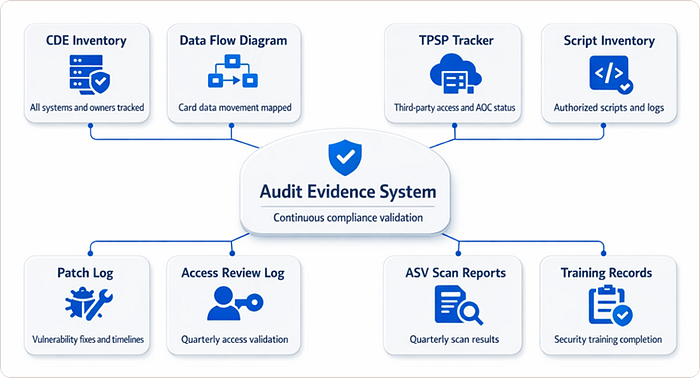
Once scope is defined, map each item in this PCI DSS checklist to a system owner, a documented control, and an evidence source. Evidence is what separates organizations that pass assessments from those that scramble before them.
Review quarterly, not just annually. PCI compliance is not a once-a-year project. Patch cycles, access reviews, log monitoring, and vulnerability scans all carry recurring requirements. Treating them as continuous operating practice rather than pre-audit preparation is what the standard is actually designed to encourage.
For high-risk merchant categories with additional compliance obligations around fraud and disputes, our guide to card scheme compliance and the Visa Acquirer Monitoring Program are worth reading alongside this checklist. Compliance with card brand programs and PCI DSS overlap in ways that matter operationally.
One Final Note
PCI DSS 4.0 compliance is not just about avoiding fines. The requirements, when properly implemented, form a genuinely strong security baseline. I have seen organizations treat compliance as a ceiling. The smarter ones treat it as a floor.
If you are working through a formal assessment, engage a Qualified Security Assessor (QSA) early. If you are self-assessing using a Self-Assessment Questionnaire (SAQ), match your SAQ type carefully to your merchant level and processing environment.
Get the scope right first. The rest of this PCI DSS checklist follows from there.
Need help mapping your payment environment to PCI requirements? If you are working through a compliance gap assessment or trying to understand how your current infrastructure maps to PCI 4.0, contact the Beast Insights team to work through it together.
 Portuguese (Brazil)
 English
 Arabic
 French
 Spanish
 Portuguese
 Deutsch
 Turkish
 Dutch
Dutch
 Italiano
 Russian
 Romaian
 Greek
Greek
